Introduction
Learning Japanese grammar can feel like deciphering a complex puzzle. From particles like は (wa) and が (ga) to verb conjugations and sentence structures, it’s easy to get overwhelmed. But what if technology could help you learn smarter, not harder?
Thanks to advancements in AI-powered language tools, mastering Japanese grammar is now more accessible than ever. Whether you’re a beginner struggling with basic sentence patterns or an intermediate learner fine-tuning nuances, AI can provide personalized, interactive, and efficient learning experiences.
In this blog post, we’ll explore:
- How AI tools enhance grammar learning
- The best AI-powered apps for Japanese grammar
- Practical ways to integrate AI into your study routine
- Unique insights on optimizing AI for fluency
Let’s dive in!
Why Japanese Grammar Is Challenging (And How AI Can Help)
Japanese grammar is fundamentally different from English. Key hurdles include:
- Particles (助詞 – joshi): Tiny words like は, が, を, and に dictate sentence structure.
- Verb Conjugations: Japanese verbs change based on politeness, tense, and formality.
- Sentence Order: The subject-object-verb (SOV) structure is the opposite of English.
- Contextual Nuances: Many phrases rely on implied meaning rather than direct translation.
How AI Bridges the Gap
AI-powered tools help by:
✅ Providing real-time corrections (like a virtual tutor)
✅ Generating personalized exercises based on mistakes
✅ Breaking down complex grammar into digestible explanations
✅ Offering speech recognition for pronunciation practice
Top AI Tools for Learning Japanese Grammar
Here are some of the best AI-driven apps and platforms to accelerate your grammar mastery:
1. LingoDeer (Visit Site)
- Why It’s Great: Uses AI to tailor lessons based on your progress.
- Grammar Focus: Breaks down particles, verb forms, and sentence structures with interactive exercises.
- Best For: Beginners to intermediate learners.
2. Bunpo (Check It Out)
- Why It’s Great: AI-powered SRS (Spaced Repetition System) for grammar retention.
- Grammar Focus: Covers JLPT levels N5-N1 with clear explanations.
- Best For: Structured learners preparing for JLPT.
3. Renshuu (Explore Here)
- Why It’s Great: AI customizes quizzes based on weak areas.
- Grammar Focus: Includes user-generated content for real-life usage.
- Best For: Learners who enjoy community-driven learning.
4. DeepL Translate (Try It)
- Why It’s Great: More accurate than Google Translate for nuanced grammar.
- Grammar Focus: Helps dissect sentence structures.
- Best For: Intermediate/advanced learners checking natural phrasing.
5. ChatGPT (Custom AI Tutors)
- Why It’s Great: You can ask, “Explain は vs. が with examples” and get instant explanations.
- Grammar Focus: Great for clarifying doubts in real-time.
- Best For: Self-learners who need on-demand explanations.
(Looking for more tools? Check out our Best Apps for Learning Japanese guide!)
Practical Ways to Use AI for Japanese Grammar Mastery
1. Instant Grammar Explanations
Instead of scouring textbooks, ask AI:
- “What’s the difference between てくれる and てもらう?”
- “Give me 5 example sentences using なければならない.”
Pro Tip: Use ChatGPT or Claude AI for personalized breakdowns in plain English.
2. AI-Generated Quizzes & Drills
Apps like Bunpo and Renshuu use AI to create adaptive quizzes. The more mistakes you make in a topic, the more it reinforces that area.
3. Real-Time Writing Corrections
Tools like LanguageTool (Visit Site) and Grammarly for Japanese (still evolving) can help spot unnatural phrasing.
4. Speech Recognition for Grammar Practice
Google Translate’s speak-to-text feature or Duolingo’s voice exercises help you practice sentence structures verbally.
5. AI-Powered Spaced Repetition
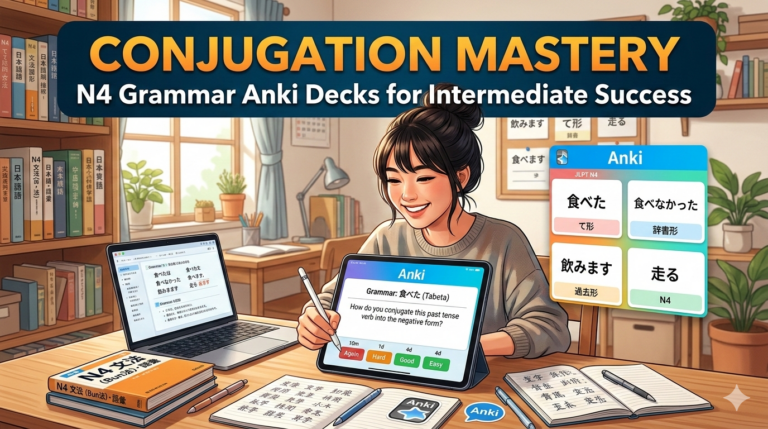
Anki is great, but AI-enhanced SRS (like Bunpo’s) adjusts review frequency based on your recall strength.
Unique Insights: How to Maximize AI for Grammar Learning
1. Combine AI with Traditional Study Methods
AI is a supplement, not a replacement. Pair it with:
- Textbooks like Genki or Tae Kim’s Guide
- Immersion (anime, podcasts, reading)
2. Ask AI for “Real-Life” Examples
Instead of rote memorization, prompt:
“Show me 10 natural sentences using かもしれない in daily conversations.”
3. Track Progress with AI Analytics
Some apps (like LingoDeer) track weak spots—review these regularly.
4. Use AI to Simulate Conversations
Chatbots (e.g., HelloTalk’s AI features) let you practice grammar in a dialogue format.
Potential Downsides & How to Avoid Them
While AI is powerful, beware of:
❌ Over-reliance on translations (AI isn’t perfect)
❌ Ignoring fundamentals (balance AI with structured learning)
❌ Generic explanations (cross-check with native sources)
Solution: Use AI as a helper, not a crutch. Verify with native speakers when possible.
Final Thoughts: Learning Japanese Grammar Smarter with AI
AI tools are game-changers for Japanese learners. They provide instant feedback, personalized exercises, and deeper explanations—making grammar less intimidating.
However, the key is balance. Combine AI with immersion, textbooks, and real-life practice for the best results.
What’s your favorite AI tool for Japanese grammar? Let us know in the comments!
(For more tips, read our Balancing Grammar and Vocabulary in Your Japanese Studies: A Practical Guide post!)
Master the JLPT N2 with a Free Practice Test (Download Now!)
Master JLPT N4 Grammar: Free Printable Flashcards + Download PDF