Why Japanese Grammar Doesn’t Have to Be Scary
Learning Japanese can feel overwhelming—especially when you’re staring down complex grammar rules, particles, and verb conjugations. But what if you had a quick-reference guide that breaks everything down into bite-sized, easy-to-understand chunks?
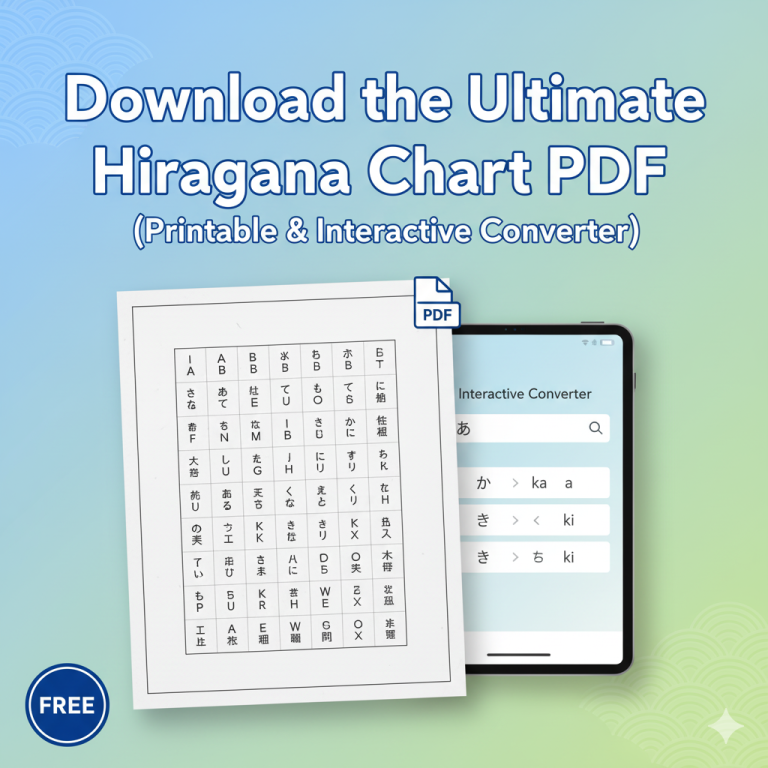
That’s exactly why we created this Japanese Grammar Cheat Sheet PDF—a handy resource for learners at all levels. Whether you’re just starting with は (wa) and が (ga) or polishing your keigo (敬語), this cheat sheet has you covered.
What’s Inside the Japanese Grammar Cheat Sheet?
Our free PDF is designed to be your go-to reference, whether you’re studying for the JLPT, traveling to Japan, or just learning for fun. Here’s a sneak peek:
1. Essential Japanese Particles (助詞 – Joshi)
Particles are tiny words that define a sentence’s structure—but they trip up even intermediate learners. Our cheat sheet clarifies:
- は (wa) vs. が (ga) – The eternal struggle!
- を (wo/o) – The direct object marker.
- に (ni) – Used for time, direction, and indirect objects.
- で (de) – Indicates the location of an action.
2. Verb Conjugations Made Simple
Japanese verbs change form based on tense, politeness, and meaning. Our cheat sheet includes:
- Present/Future (辞書形 – Dictionary form) – 食べる (taberu) = “to eat”
- Past Tense (た形 – Ta-form) – 食べた (tabeta) = “ate”
- Negative Form (ない形 – Nai-form) – 食べない (tabenai) = “don’t eat”
- Te-Form (て形) – 食べて (tabete) = “eat and…” (used for requests & connections)
🔗 Related Post: Mastering the Causative Form in Japanese Grammar: A Complete Guide

3. Sentence Structure Patterns
Unlike English, Japanese follows a Subject-Object-Verb (SOV) order. Example:
- English: “I eat sushi.”
- Japanese: 私は寿司を食べます。 (Watashi wa sushi o tabemasu.)
Our cheat sheet includes common sentence patterns for questions, requests, and more.
4. Polite vs. Casual Speech
Knowing when to use です/ます (desu/masu) vs. plain form is crucial:
- Polite: 行きます (ikimasu) = “I go” (formal)
- Casual: 行く (iku) = “I go” (informal)
📌 Insight: Japanese people switch between polite and casual speech depending on the situation. Use polite forms with strangers and superiors!
5. Must-Know Adjectives
Japanese adjectives come in two types:
- い-adjectives: 楽しい (tanoshii) = “fun”
- な-adjectives: 静かな (shizuka na) = “quiet”
Our cheat sheet shows how to conjugate and use them naturally.
How to Use This Cheat Sheet Effectively
✅ For Beginners:
- Print it out and stick it on your wall.
- Refer to it while doing exercises from Genki or Tae Kim’s Guide.
✅ For Intermediate Learners:
- Test yourself by covering sections and recalling rules.
- Compare similar grammar points (e.g., は vs. が).
✅ For Advanced Learners:
- Use it as a quick refresher before JLPT exams.
- Practice creating complex sentences using all grammar forms.
Why This Cheat Sheet Works (When Others Don’t)
Most Japanese grammar guides are either too basic or too complex. Ours is different because:
✔ Visual-friendly layout – Easy to scan, even in a hurry.
✔ Real-life examples – Learn grammar in context.
✔ Covers all levels – From N5 (beginner) to N1 (advanced).
🔗 Recommended Resource: Tofugu’s Japanese Grammar Guide (for deeper dives).
Download Your FREE Japanese Grammar Cheat Sheet PDF
Ready to speed up your Japanese learning? Click below to get instant access:
Final Thoughts
Grammar is the backbone of any language, and Japanese is no exception. Instead of memorizing endless rules, keep this cheat sheet handy—it’s like having a sensei in your pocket!
🔗 More Japanese Learning Resources:
- Best Apps to Learn Japanese in 2024
- Japanese Grammar Charts: Visualizing Verb Forms & Particles
- Downloadable Japanese Grammar Cheat Sheet for Fast Reference