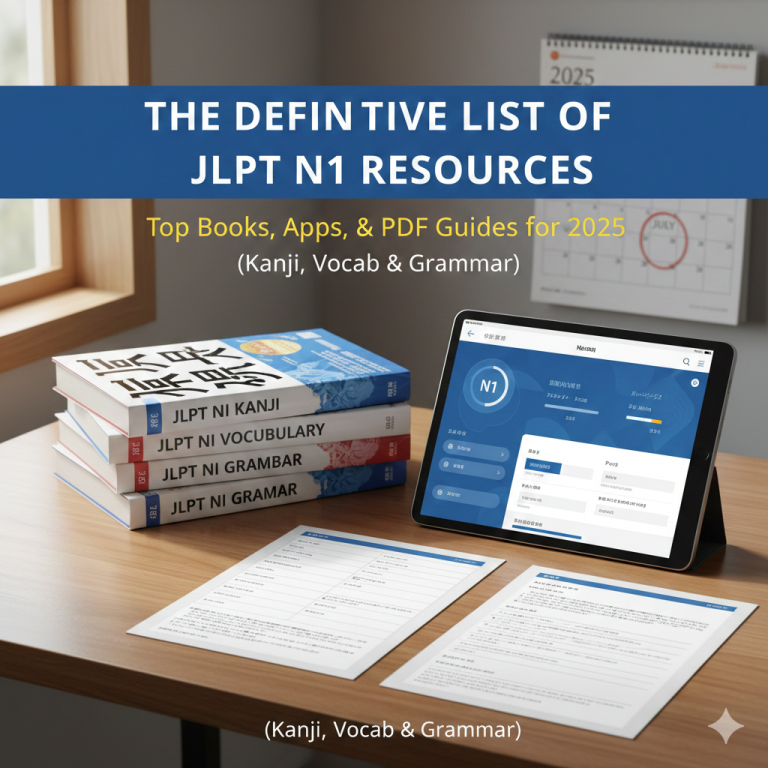
So, you’ve set your sights on the summit: the JLPT N1. You can hold a conversation, read a novel (with a dictionary close by), and maybe even understand the news. But then you open an N1 grammar book… and it feels like you’re reading a different language again.
Don’t worry. This feeling is a rite of passage. The jump from N2 to N1 is significant, especially in the grammar section. It’s not just about new patterns; it’s about depth, nuance, and a level of formality and literary flair you don’t often encounter in daily life.
The key isn’t just to memorize these patterns; it’s to understand their soul. And having the right resources, like a well-structured JLPT N1 Bunpou PDF, can make all the difference.
Why is N1 Grammar So… Different?
Before we hunt for resources, let’s understand our opponent. N1 grammar isn’t just a list of “~ばかりに” or “~が早いか”. It’s characterized by:
- Nuance Over Rule: Many N1 patterns have terrifyingly similar English translations. The real challenge is feeling the subtle difference in tone and context. For example, both ~や否や and ~が早いか mean “as soon as,” but the latter often implies an almost reckless immediacy of the second action.
- The Written Word: A huge chunk of N1 grammar is most commonly found in formal writing, newspapers, academic journals, and literature. You might not hear your friends using ~であれ~であれ at the izakaya, but you’ll definitely see it in an editorial.
- Compound Patterns: N1 loves to combine patterns, creating super-structures that can make a sentence look like a complex math equation. Untangling these is a core skill.
The Hunt for the Ultimate JLPT N1 Bunpou PDF
Let’s be real: we all want that one magical PDF that has everything. The truth is, the “perfect” PDF doesn’t exist because everyone learns differently. However, a great PDF is an invaluable portable study buddy.
Here’s what you should look for in a quality JLPT N1 grammar PDF:
- Clear, Concise Explanations: It should explain the nuance, not just the meaning.
- Realistic Example Sentences: Sentences that actually sound like something a native would write or say.
- Context Cues: Notes on formality (e.g., written vs. spoken, formal vs. informal).
- Comparison Notes: This is gold. A good resource will compare similar patterns and highlight the differences.
- Practice Exercises: You can’t learn grammar by just reading. You need to actively use it.
Where to Find Great N1 Grammar PDFs (The Ethical Way)
Instead of just Googling “JLPT N1 grammar pdf free download,” which can lead to sketchy sites and pirated material, here are some legitimate and high-quality sources:
- Official JLPT Resources: The official JLPT site offers sample questions and, occasionally, workbooks. These are pure gold for understanding the test format.
- Reputable Language Sites:
- Tofugu: A fantastic resource for all things Japanese. While they might not have a single massive PDF, their individual grammar point articles are deep, cultural, and hilarious. Searching their site for a specific grammar point is always a good idea.
- JTest4You: This site is a legend in the JLPT community. It offers compiled grammar lists for all levels with examples, and while it’s ad-supported, it’s a tremendous free resource. You can often find printable PDF lists here.
- University & Institutional Sites: Some university Japanese departments share their learning materials publicly. A search for “大学 日本語 文法 資料” ([university Japanese grammar materials]) can sometimes yield amazing, academically rigorous PDFs.
A Samurai’s Insight: Don’t just download a PDF and let it gather digital dust. The real power comes from how you use it. Create your own “Master PDF” by combining pages from different sources, adding your own notes and highlighted examples. The act of curating is an act of learning.
Beyond the PDF: Must-Have Study Materials for N1 Grammar
A PDF is a great start, but to truly master N1 grammar, you need a multi-pronged attack. Here are my top recommendations:
- The “Somato” of Grammar Books (総まとめ, Sōmatome): The N1 So-Matome Grammar book is excellent for a structured, bite-sized approach. It’s designed to be completed in 6 weeks, making it perfect for busy learners. It gives you a little bit every day.
- The Grammar Encyclopedia (新完全マスター, Shin Kanzen Master): If Sōmatome is your daily training, Shin Kanzen Master N1 Grammar is your detailed technique manual. It’s denser, more comprehensive, and has tougher practice questions. It’s brutal but incredibly effective. Using both is a powerful strategy.
- The Dictionary You’ll Actually Read (日本語文型辞典, A Dictionary of Japanese Grammar): This is the holy trinity. The series (Beginner, Intermediate, Advanced) by Seiichi Makino and Michio Tsutsui is not a book you read cover-to-cover, but it’s the best reference you will ever own. If you encounter a grammar point you don’t understand, this book will explain it in glorious, nuanced detail.
How to Study: From Rote Memory to Fluid Understanding
Memorizing a list is step zero. Here’s how to move beyond that:
- Create Nuance-Driven Flashcards: On your Anki or Quizlet card, don’t just put “~ぬきで // without.” Add a key nuance: “~ぬきで // without (omitting something that is usually standard or expected).” Example: 敬称ぬきで話しましょう (Let’s talk without honorifics).
- Read, Read, Read: This is non-negotiable. Read Japanese news on sites like NHK News Web Easy (then graduate to the main NHK News site), opinion pieces, and short stories. Your goal is to see these grammar patterns in the wild. When you find one, screenshot it or write it down. Context is everything.
- The “Why” Behind the “What”: For every new pattern, ask “Why did the author choose this pattern and not a similar one?” This critical thinking is what separates N1 passers from N1 masters.
- Active Output: Try to write sentences using the new grammar. Even better, try to use it in a conversation with a language partner (on platforms like iTalki or HelloTalk). Making mistakes and being corrected is the fastest way to learn.
A Peek into the N1 Mind: Practical Application of “Tricky” Grammar
Let’s make this real. Let’s look at two advanced patterns that often confuse learners.
Grammar Point 1: ~ばこそ (ba koso)
- Meaning: “Precisely because…” (used to emphasize that this specific reason is the sole cause for something positive)
- Nuance: It carries a strong, emotional emphasis. It’s not a neutral “because”; it’s a heartfelt “it was for this reason and this reason alone!”
- Example: あなたを信じていればこそ、こんなに辛い時も待っていたのです。
- “It was precisely because I believed in you that I was able to wait through such a painful time.”
Grammar Point 2: ~であれ~であれ (de are… de are)
- Meaning: “Whether… or…” / “No matter what…”
- Nuance: Very formal and written. It’s used to state that the following conclusion applies universally, regardless of the options presented.
- Example: 晴天であれ暴雨であれ、決行は変わらない。
- “Whether it’s clear skies or a rainstorm, the decision to proceed is unchanged.”
See the difference? One is for emotional emphasis, the other for universal, formal statements. This is the level of detail you need to absorb.
Your Samurai Study Plan for N1 Grammar Conquest
- Gather Your Armory (Weeks 1-2): Get your primary resources. Choose either Sōmatome or Shin Kanzen Master as your core textbook. Find a good PDF list from a reputable source as a quick reference. Have the Dictionary of Japanese Grammar on standby.
- The Grind (Weeks 3-12): Study 2-4 new patterns per day. Don’t just read them. Write example sentences. Draw diagrams if it helps. Spend at least 30 minutes reading native material to hunt for them.
- Practice Makes Permanent (Ongoing): Do all the exercises in your books. Find past papers or mock exams online. Time yourself. The N1 test is a marathon of focus, and you need to build that stamina.
- Review and Refine (The Final Month): In the last month, stop learning new patterns. Shift your focus entirely to review, mock tests, and strengthening your weak points. Re-read all those example sentences you collected.
The Final Sword Stroke
Passing the JLPT N1 grammar section is a monumental achievement. It’s not just about a certificate; it’s about unlocking a deeper layer of the Japanese language. You’ll start reading novels and feeling the author’s intent in the grammatical structures they choose. You’ll watch historical dramas and understand the weight of the formal dialogue.
The journey is long and requires consistent effort. There will be days you feel defeated by a list of confusing patterns. On those days, take a break, watch your favorite anime or variety show, and remember why you started this journey in the first place.
You are a language warrior. You have the strategy, the resources, and the spirit. Use your JLPT N1 Bunpou PDF wisely, but never forget to look beyond it into the living language itself.
Understanding JLPT N1 & CEFR B2 Level Equivalency: A Deep Dive into Language Proficiency
JLPT N1 Study Materials: Free Books & Practice Resources

頑張ってください、侍! (Ganbatte kudasai, samurai!) Go for it!