Konnichiwa, future N1 champions!
Let’s be real. The jump from N2 to N1 is… significant. It’s less like stepping up a stair and more like being asked to scale a cliff. You move from understanding clear, structured language to deciphering the abstract, opinionated, and nuanced prose found in newspapers, academic essays, and complex literature.
The right JLPT N1 books are your climbing gear. They won’t climb the cliff for you, but they will give you the pitons, ropes, and harness you need to make the ascent possible—and maybe even enjoyable.
The key mistake I see? Students buying every book in sight, creating a towering, guilt-inducing monument to their anxiety on their desk. Don’t do this. The goal is strategic selection, not hoarding.
Here’s my philosophy: you need a Core Trinity and a set of Specialized Tools. Let’s break it down.
The Core Trinity: Your Non-Negotiable Foundation
These three series are the undisputed champions of JLPT prep. You should build your entire plan around at least one of them.
1. The Gold Standard: Shin Kanzen Master (新完全マスター) Series
If JLPT prep books had a royal family, Shin Kanzen Master would be sitting on the throne. These books are rigorous, comprehensive, and incredibly thorough. They are written entirely in Japanese, which is a feature, not a bug—it immerses you in the language from page one.
- Shin Kanzen Master Bunpou (文法 – Grammar): This is arguably the most important book in your arsenal. It doesn’t just list grammar points; it groups them by function and meaning (e.g., 〜にいたっては for emphasizing an extreme example, 〜ばそれまでだ for saying “if that happens, it’s all over”). This functional grouping is vital for N1, where you need to understand the author’s intent and nuance, not just sentence structure.
- Best For: Learners who love structure, deep dives, and clear, logical explanations. It’s for those who want to master the grammar, not just memorize it.
- Practical Application: Don’t just read the examples. For each new grammar point, try to write two original sentences: one that mimics the example and one that applies it to your own life or opinions. This active creation cements understanding.
- Shin Kanzen Master Dokkai (読解 – Reading Comprehension): This book is a masterpiece. It teaches you how to read for the N1. It breaks down different text types (advertisements, essays, editorials, emails) and teaches specific strategies for each. It shows you how to find the author’s main argument, identify supporting points, and understand what pronouns are referring to—a classic N1 trick question.
- Best For: Everyone. Seriously. If you buy only one book from this series, make it this one. Reading is the biggest point section on the test.
- Insight: The book’s real value isn’t in the practice passages themselves, but in the methodology it teaches before them. Read the strategy pages multiple times.
- Shin Kanzen Master Choukai (聴解 – Listening Comprehension): N1 listening is brutal. It’s fast, uses advanced vocabulary, and often features conversations where the key information is implied, not stated. This book trains you to listen for specific details, summarize main points, and understand the speakers’ attitudes and relationships.
- Best For: Those who find listening their weakest skill. The practice questions are notoriously slightly harder than the actual exam, which is perfect training.
Link to the series: Find Shin Kanzen Master N1 on Amazon JP (Try using a service like White Rabbit Express if you need help ordering from Japan).

2. The Accessible All-Rounder: Sou Matome (総まとめ) Series
Where Shin Kanzen Master is intense and dense, Sou Matome is structured and gentle. It’s designed as an 8-week “round-up” program, with daily lessons that take about 30-45 minutes. Each book is divided into weekly and daily chunks.
- The Vibe: Less intimidating. It uses more furigana and has sections translated into English, Korean, and Chinese. It’s great for building a consistent study habit because the path is laid out for you.
- Best For: Busy people who need a clear schedule, visual learners, and those who find Shin Kanzen Master too daunting to start with. It’s a fantastic first step before diving into the deeper end with Shin Kanzen.
- The Catch: It’s not as deep. The explanations can feel a bit brief compared to Shin Kanzen. Many students use Sou Matome for a first pass through the material and then use Shin Kanzen Master for review and deepening their understanding. This is a powerful combo!
3. The Practice King: Try! (トライ) Series
The Try! N1 textbook is unique because it’s structured around the Japanese Language Proficiency Test itself. It’s published by the Asia Student Cultural Association and is very well-respected.
- The Vibe: It integrates grammar, reading, and listening practice around specific test-like contexts. You learn a chunk of grammar and then immediately see it applied in reading and listening exercises.
- Best For: Learners who want an all-in-one solution that mirrors the integrated nature of the exam. It’s fantastic for applying knowledge in a practical context right away.
- Practical Application: Use this as your “application” tool. After studying a grammar point in Shin Kanzen Master, see how it’s used in the longer passages and dialogues in the Try! book.
Specialized Tools: Sharpening Your Specific Skills
Once your core is set, these books address specific weaknesses.
For Vocabulary Conquest: The Power of “Nihongo So-Matome N1 Goi” & “N1 Token Appu Moji Goi”
Vocabulary is a beast. You need to know not just the meaning, but the nuance, collocation (which words go together), and slightly differing synonyms.
- Sou Matome N1 Goi: Great for daily, consistent exposure. It introduces words in thematic groups.
- N1 Token Appu Moji Goi (単問アップ 文字・語彙): This book is a secret weapon for the first section of the test. It drills you specifically on the types of questions asked in the 文字・語彙 (Characters/Vocabulary) section: choosing the correct reading, using the right word in context, and finding the appropriate paraphrase. It’s hyper-focused and incredibly effective for boosting your score on that specific part.
For Listening Domination: Beyond the Core
If listening is your nemesis, you need extra firepower.
- Speed Master Choukai: This book is fantastic because it starts with fundamental skills (like catching numbers and specific details) and gradually builds up to full, complex conversations and monologues. The “speed” in the title refers to the pace of the audio, which is very realistic.
- Practical Application: Don’t just listen once. For a single practice track, try this 3-step method: 1) Listen blind and answer the questions. 2) Listen again while reading the script, noting all the words or phrases you missed. 3) Listen a final time without the script. This is exhausting but utterly transformative.
The Final Boss: Mock Exams
You would not run a marathon without doing practice runs. Do not take the N1 without taking full, timed mock exams.
- Official JLPT Practice Workbooks: These are released by the Japan Foundation and are the most accurate representation of the test’s format and difficulty. These are essential. You can find them for free on the official JLPT website.
- Shin Kanzen Master Moshi to Taisaku (模試と対策 – Mock Tests & Strategies): A book of three full-length practice tests. The quality is excellent, and the answer explanations are very detailed.
Crafting Your 2025 Study Plan: A Samurai’s Strategy
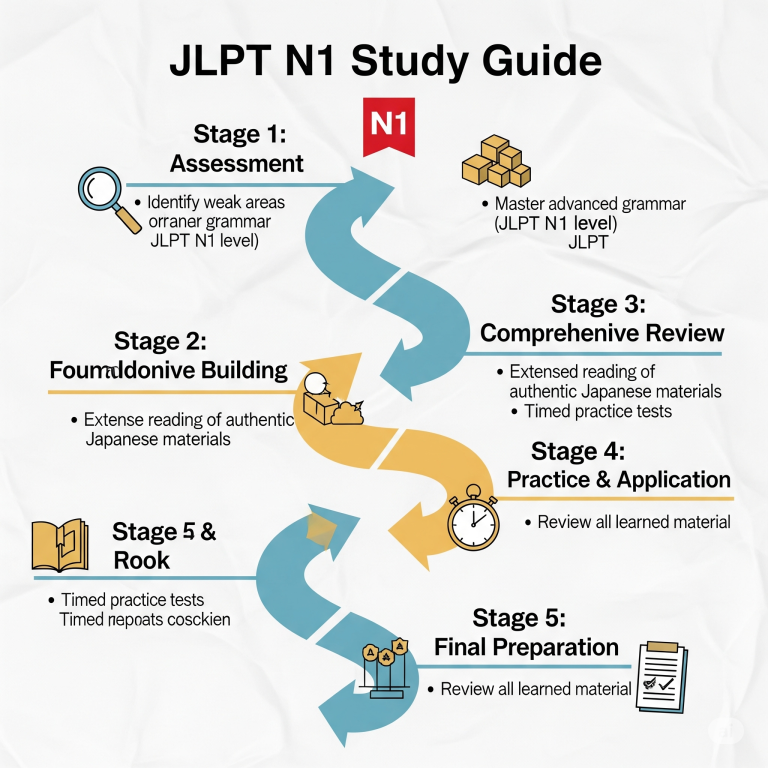
Okay, you have the books. Now what? Here’s a sample 6-month plan using a hybrid approach.
- Months 1-2 (Foundation): Use Sou Matome. Complete one week’s worth of lessons each week for grammar, vocabulary, and reading. This gives you a broad overview.
- Months 3-4 (Deep Dive): Switch to Shin Kanzen Master Bunpou and Dokkai. Go through them systematically, using your Sou Matome knowledge as a base to build upon. This is where you deepen your understanding.
- Month 5 (Skill Sharpening): Integrate N1 Token Appu for vocab drilling and Speed Master for intensive listening practice. Start doing a few practice questions from the “Try!” series.
- Month 6 (Exam Condition): This is mock exam month. Every weekend, take a full, timed practice test from the Official Workbook or the Shin Kanzen Master Mock Test book. Use the weekdays to review every single mistake you made—understand why you got it wrong. Was it a vocabulary gap? A misread nuance? A listening trap? Target your weaknesses.
The Human Element: A Final Word of Encouragement
The N1 journey is a marathon run in daily sprints. Some days, you’ll feel like you understand everything. Other days, you’ll read a newspaper editorial and feel utterly lost. This is normal.
Your books are tools, but you are the craftsman. Your consistency, your willingness to sit with confusion, and your ability to learn from mistakes are what will ultimately earn you that passing score.
Remember why you started. Think of the novels you’ll finally read, the news you’ll understand without subtitles, the deep conversations you’ll have. That’s the real prize.
Ready for more specific strategies? Check out my other posts on How to Master JLPT N1 Reading Comprehension and Building a JLPT N1 Vocabulary Mind Palace.
Now, pick up your book—your katana of knowledge—and begin your training. 頑張ってください! I’ll be cheering for you.