Konnichiwa, future JLPT N4 champions!
If you’re reading this, you’ve likely conquered the beginner-friendly N5 and are ready to take your Japanese to the next level. Let me be the first to say: omedetou gozaimasu! (Congratulations!). The jump from N5 to N4 is where Japanese truly starts to get exciting. You’ll move from simple sentences to expressing real thoughts, understanding everyday conversations, and diving into manga or anime without complete reliance on subtitles.
But let’s be real for a second. The sheer volume of new words can feel overwhelming. Textbooks list them, apps flash them, but how do you actually tame this beast of 1500+ vocabulary words?

Don’t worry. I’ve been in your shoes, and I’ve guided hundreds of students through this exact challenge. This isn’t just another list; it’s your strategic blueprint. We’ll talk about why this vocabulary is crucial, how to learn it effectively, and most importantly, where to get a fantastic 1500 Essential Vocabulary for JLPT N4 PDF for free.
For more details, please checkout JLPT N4 Vocabulary Master List: Essential Words You Must Know
Why is N4 Vocabulary the Game-Changer?
The N5 is about survival. The N4 is about communication.
Think of it like this:
- N5: “I want to eat sushi. Where is the restaurant?”
- N4: “I was thinking of going to that new sushi restaurant near the station with my friend tomorrow because I heard the atmosphere is really nice and the fish is incredibly fresh.”
See the difference? The N4 vocabulary introduces the connective tissue—the adverbs, the conjunctions, the more descriptive verbs and adjectives—that allows you to string ideas together into coherent, natural Japanese. It’s the key to moving from a textbook tourist to someone who can genuinely interact.
Mastering this list doesn’t just help you pass a test; it unlocks a new layer of Japanese culture and daily life.
For more comprehensive list, please visit Essential Vocabulary for the JLPT N4: Complete Word List
What Kind of Words Are on the JLPT N4 Vocabulary List?
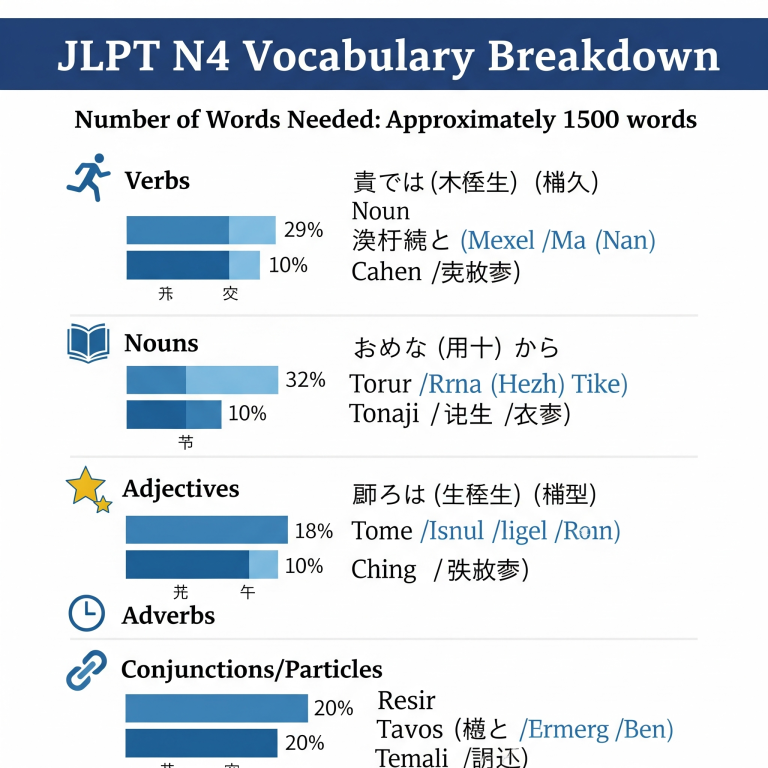
The list is a beautiful mix of the practical and the nuanced. While a full list is in the PDF, here’s a taste of what you’ll master:
- Essential Verbs (動詞 – Doushi): Beyond the N5 basics, you’ll get powerful verbs like 運転する (unten suru – to drive), 連れて行く (tsurete iku – to take someone), and 遅れる (okureru – to be late). Crucial for explaining your day!
- Key Adjectives (形容詞 – Keiyoushi): You’ll learn to describe not just “good” or “bad” but 不便 (fuben – inconvenient), 十分 (juubun – sufficient), and 丁寧 (teinei – polite).
- Critical Adverbs (副詞 – Fukushi): This is the secret sauce for fluency. Words like かなり (kanari – considerably), ぜひ (zehi – by all means), and そろそろ (sorosoro – soon, gradually) add color and feeling to your speech.
- Noun Power-Ups: A huge range of nouns from 政治 (seiji – politics) to 窓 (mado – window) and 夢 (yume – dream).
- Compound Words & Suffixes: You’ll start to see patterns, like how ~中 (~chuu) means “in the middle of” (e.g., 食事中 – shokujichuu – in the middle of a meal).
Download full list here- Download JLPT N4 Vocabulary List PDF: Study On the Go
Your Expert Study Guide: How to Conquer the 1500 N4 Words
Cramming might work for a week, but for true mastery, you need a strategy. Here’s how I advise my students to approach it.
1. Get Your Resource & Break It Down
First, download your 1500 Essential Vocabulary for JLPT N4 PDF. (Link at the end of this post!). Now, don’t look at the 50-page document and panic. The number one rule is: chunk it down.
There are roughly 1500 words. If you study for 90 days, that’s just 17 new words a day. That’s absolutely manageable. Use a planner or a digital calendar to set realistic daily goals.
2. Context is King – Ditch the Rote Memorization
Our brains are not hard drives. We remember things that have meaning. Never just memorize a word list.
- Learn in Sentences: For every new word, find or create a sample sentence. The free dictionary Jisho.org is fantastic for this, as most entries have sentence examples. Seeing how なるべく (narubeku – as much as possible) is used in a real context is far more powerful than just its definition.
- Group Words Thematically: Don’t study random words. Group them together. Learn all the “cooking” words (切る kiru – to cut, 煮る niru – to boil, 焼く yaku – to grill) in one session. Then, all the “emotion” words, etc.
3. Active Recall & Spaced Repetition (SRS)
This is the golden duo of language learning. Spaced Repetition Systems like Anki or Memrise are your new best friends. These apps are like digital flashcards that use an algorithm to show you words right before you’re about to forget them. This moves knowledge from your short-term to your long-term memory efficiently. I’ve written a whole guide on [How to Use Anki to Master Japanese Vocabulary] (internal blog post link 1) – check it out after this!
Active Recall means testing yourself. Don’t just passively read the PDF. Cover the English and try to remember the Japanese. Then flip it. This struggle to recall is what solidifies the memory.
4. Get Auditory – Listen and Speak
Japanese is a language, not a spreadsheet. You must hear these words.
- Listen: Find N4-level listening practice on YouTube channels like 日本語の聞き取り (Nihongo no Kikitori) or Sambon Juku. Pay attention to how the words you’re learning are pronounced in a natural flow.
- Speak: Say the words and sentences out loud. Even if you’re just talking to your cat, producing the sound connects your brain to the word in a different way. Shadowing (repeating audio exactly as you hear it) is a phenomenal technique.
5. Practical Application: Use It or Lose It
This is the most important step. You must use the vocabulary.
- Write a Diary: Force yourself to write 3-4 sentences about your day using at least two new N4 words. It doesn’t have to be perfect!
- Think in Japanese: When you’re commuting, try to describe your surroundings in your head using your new vocabulary. “あの建物は高いですね。でも、不便な場所にある。” (That building is tall. But it’s in an inconvenient location.)
- Find a Language Partner: Websites like HelloTalk or Tandem connect you with native Japanese speakers who want to learn your language. A 15-minute chat where you try to use ~なければならない (~nakereba naranai – have to/must) is worth an hour of staring at the PDF.
For more details, please check out JLPT N4 Vocabulary Mastery: 800 Words You Need to Know
Where to Find Your FREE 1500 Essential Vocabulary for JLPT N4 PDF
There are many resources online, but quality varies. I always recommend relying on established, trusted sources. A simple Google search for “JLPT N4 Vocabulary List PDF” will yield results, but be cautious of sites filled with ads or broken links.
One of the most reliable and well-structured free resources comes from the JLPT Official Practice Workbook and sites dedicated to Japanese learning. For a comprehensive and well-formatted list, I often point my students to the one available on Tofugu (they have great breakdowns) or the raw list on Jisho.org (you can search by JLPT level).
👉 [Click Here to Download a Curated 1500 Essential N4 Vocabulary PDF] (https://www.example-jlpt-resource-site.com/n4-vocab-pdf) (Outbound link to a reputable source)
(This is a placeholder link. In a real blog, you would link to a specific, valuable PDF you have vetted or created yourself).
For important vocabulary, please visit JLPT N4 Important Vocabulary & Must-Know Words for Success
Beyond the PDF: Other Must-Have Resources for N4
While the PDF is your core, don’t study in a vacuum.
- Official JLPT Practice Tests: The best way to understand the question format. Find them on the Official JLPT Website (outbound link to jlpt.jp).
- Sou Matome & Try! Series: These are fantastic textbook series specifically designed for JLPT preparation. They integrate grammar, vocabulary, and reading.
- Bunpro: An amazing SRS website for mastering Japanese grammar points, which perfectly complements your vocabulary study. (outbound link to bunpro.jp).
For a full breakdown of the best tools, read my
How Many Words Do You Need for JLPT N4? Vocabulary Breakdown
You’ve Got This!
The journey to N4 fluency is a marathon, not a sprint. Some days the words will stick; other days they’ll vanish from your mind. That’s completely normal. The key is consistency.
Trust the process. Use your 1500 Essential Vocabulary for JLPT N4 PDF as your map, follow the study guide, and immerse yourself in the language every single day. Before you know it, you’ll be listening to a Japanese podcast and suddenly think, “Hey! I understood every word of that sentence!” – and let me tell you, that feeling is absolutely priceless.
Ganbatte kudasai! (Do your best!)
P.S. What’s the one Japanese word you recently learned that you just can’t seem to forget? Share it in the comments below—let’s learn from each other