So, you’ve set your sights on the summit of Japanese language proficiency: the JLPT N1. It’s a formidable challenge, a test that separates the advanced learners from the truly proficient. And if there’s one section that makes even seasoned students break a sweat, it’s the grammar.
You’re not just dealing with a list of patterns anymore. N1 grammar delves into the nuanced, the formal, and the subtly expressive heart of the Japanese language. It’s about understanding not just what something means, but why a native speaker would choose that particular expression in that specific context.
I remember my own N1 journey. I’d breeze through a practice test, only to be humbled by a single grammar point I’d never seen before. It felt like the goalposts were always moving. But through that struggle, I discovered a method to the madness. This guide is that method, distilled. Let’s break down the JLPT N1 grammar section together and craft a plan for your success.
What Makes N1 Grammar So Different? Beyond the Textbook
Before we dive into strategies, it’s crucial to understand the beast you’re facing. The N1 grammar section isn’t just about memorizing ~わけだ or ~にすぎない. It’s designed to test your ability to handle real-world Japanese found in newspapers, literature, academic articles, and business communications.
The key differences:
- Nuance Over Definition: You’ll need to distinguish between patterns with nearly identical meanings. For example, both ~あげくに and ~末に can mean “after much… finally,” but ~あげくに almost always has a negative outcome, while ~末に can be neutral or positive.
- Syntactic Complexity: N1 sentences are long. You’ll encounter multiple clauses, requiring you to understand how grammar points connect and modify each other to form a coherent thought.
- Formal and Literary Language: Get comfortable with patterns you’ll rarely hear in casual anime dialogue but are staples in written and formal spoken Japanese.
Deconstructing the JLPT N1 Grammar Section: Know Your Enemy
The grammar section (文法 – bunpou) is part of the “Language Knowledge” unit. You’ll typically face three question types:
- Grammar Form (文法形式の判断): Choose the correct grammar pattern to complete a sentence. This tests your pure knowledge of structure and particle usage.
- Sentence Composition (文の組み立て): Arrange a scrambled set of phrases into a logical, grammatically correct sentence. This tests your intuitive understanding of Japanese sentence flow.
- Contextual Usage (文章の文法): This is the big one. You read a medium-length passage and choose the correct grammar points to insert into blanks. This tests your ability to understand context, tone, and logical flow.
A Practical Strategy for Mastering N1 Grammar
Phase 1: Build Your Arsenal (The Study Phase)
You can’t win a battle without weapons. Your primary weapon is a comprehensive N1 grammar resource.
- The Gold Standard: Shin Kanzen Master N1 Grammar. This is, without a doubt, the most trusted resource for a reason. It’s thorough, explanations are in Japanese (with translations), and it groups similar patterns together, forcing you to learn the nuances. <a href=”https://amzn.to/3ShinKanzenMasterN1″ target=”_blank” rel=”noopener”>(Check it out on Amazon here)</a>.
- The Contender: *So-Matome N1 Grammar*. If Shin Kanzen feels too dense, So-Matome offers a more gradual, week-by-week study plan. It’s less comprehensive but more approachable. Many students use both—So-Matome for an overview and Shin Kanzen for depth.
- Don’t Just Memorize, Contextualize: For every new grammar point, write at least two original example sentences. One for a formal context and one for a casual context. This active recall cements the knowledge far better than passive reading. A good digital flashcard app like Anki is perfect for this.
Want to strengthen the foundation this all rests on? Our guide on Mastering JLPT N2 Grammar Before Attempting N1 is a crucial read.
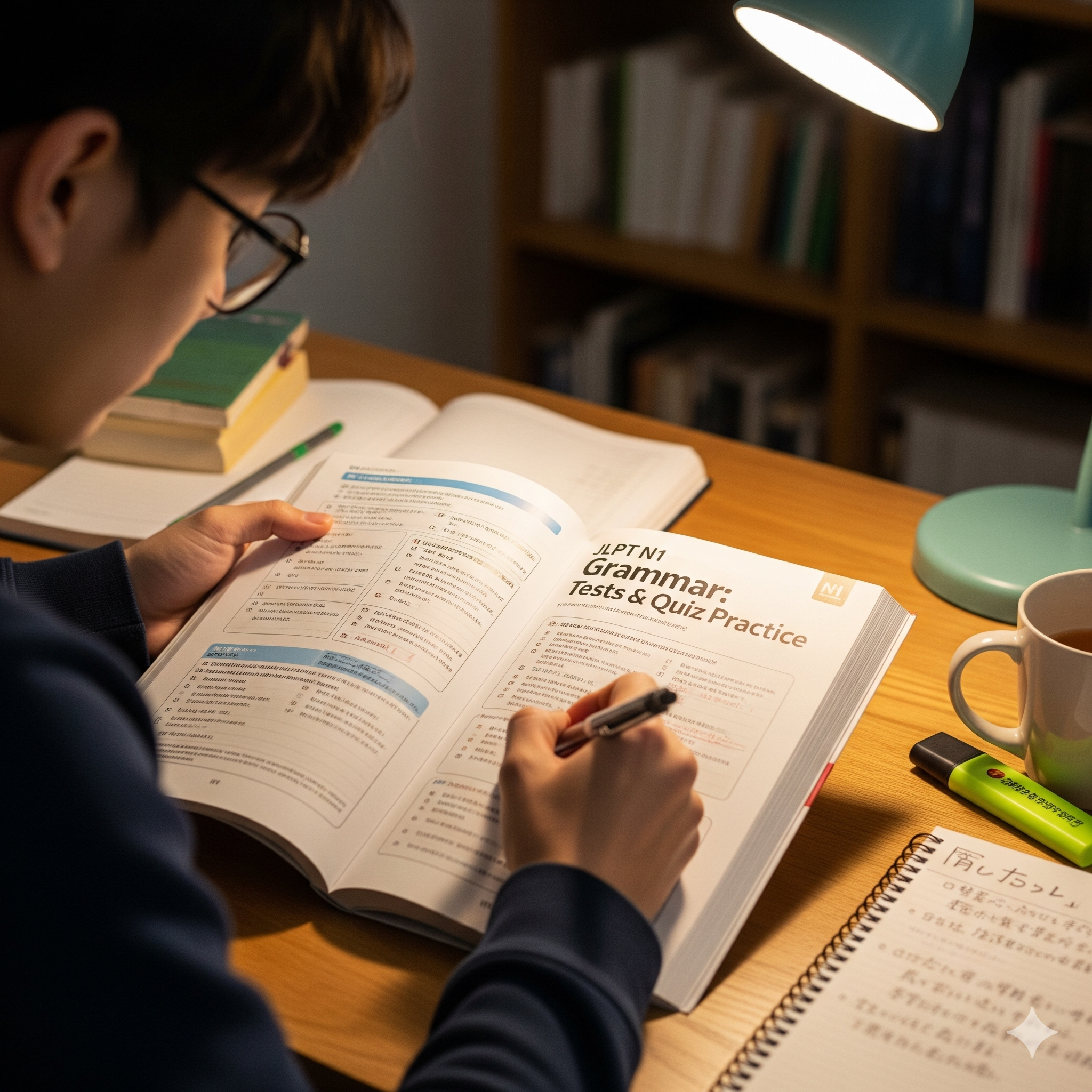
Phase 2: Apply Your Knowledge (The Practice Phase)
Knowledge is useless without application. This is where you move from “knowing” to “understanding.”
- Drill with Purpose: Use the practice questions in your Shin Kanzen Master or So-Matome books. Don’t just guess; for every answer you get wrong, write down why the correct answer is right and yours is wrong. Create an “Error Log.” This document will become your most valuable study tool in the final weeks.
- Simulate the Test Environment: Regularly take full-length practice tests under timed conditions. The <a href=”https://www.jlpt.jp/e/samples/sample12.html” target=”_blank” rel=”noopener”>official JLPT website offers past paper questions</a> for free. This builds stamina and familiarizes you with the pressure of the exam day.
Phase 3: Develop “Test Sense” (The Strategy Phase)
Sometimes, you just won’t know the answer. That’s okay. You can still dramatically increase your odds of guessing correctly.
- Look for Clues in the Sentence: What comes before and after the blank? Is there a specific particle (に、を、で) that only pairs with certain grammar patterns? Does the verb tense give you a hint?
- Eliminate the Impossible: The multiple-choice options are often designed to trick you. Immediately cross out any answer that is grammatically incorrect on its own. Then, eliminate answers that don’t match the sentence’s nuance (e.g., a negative connotation in a positive sentence).
- Trust Your Ear (to a point): If you’ve done enough reading and listening practice, the correct answer might just “sound” right. Don’t ignore that instinct, but always double-check it with the grammatical rules.
Let’s Practice: A Mini N1 Grammar Quiz
Ready to test your mettle? Try these:
1. 彼は、10年もの間、たった一人でこの研究を続けて( )、ついに画期的な発見をした。
a) きた
b) いった
c) おわった
d) しまった
Answer: a) きた
Insight: ~てくる is used to express an action continuing from the past into the present. It perfectly fits the context of continuing research for ten years leading up to the new discovery. ~ていく would imply moving forward from now, which doesn’t fit. ~ておわる and ~てしまう imply completion, which contradicts the “continued” meaning.
2. 環境問題への関心が高まる( )、企業の社会的責任が問われるようになった。
a) に沿って
b) につれて
c) にわたって
d) に基づいて
Answer: b) につれて
Insight: ~につれて means “as~” or “in proportion to~,” indicating two things changing simultaneously. As interest grows, corporate responsibility is being questioned. ~に沿って means “along with,” ~にわたって means “throughout” (a period or range), and ~に基づいて means “based on.” Nuance is key here.
Struggling with the reading section that tests this grammar in context? Our post on Improving Your Reading Speed for JLPT N1 offers practical exercises.
Unique Insights: From a Learner to a Learner
- The Newspaper is Your Best Friend: Make a habit of reading even one Japanese news article a day on <a href=”https://www3.nhk.or.jp/news/easy/” target=”_blank” rel=”noopener”>NHK News Web Easy</a> or the main <a href=”https://www.asahi.com/” target=”_blank” rel=”noopener”>Asahi Shimbun</a> site. You will see N1 grammar patterns used in their natural habitat. This is irreplaceable.
- Listen for Grammar: When watching dramas or listening to podcasts, don’t just listen for vocabulary. Actively listen for grammar patterns. You’ll hear how they are used naturally in speech, which helps with both the listening and grammar sections. For great listening practice, check out our list of The Best Podcasts for Advanced Japanese Learners.
- It’s a Marathon, Not a Sprint: Cramming 20 grammar points a day is ineffective. Your brain needs time to process and internalize this complex information. Consistency—even 30-60 minutes daily—is infinitely more effective than sporadic, long study sessions.
Final Words of Encouragement
The JLPT N1 is a tough exam, but it is not an impossible one. It’s a testament to your dedication and love for the Japanese language. The grammar section, while challenging, is ultimately a puzzle. And like any puzzle, it can be solved with the right pieces, strategies, and a calm mind.
Trust in the process, learn from your mistakes, and remember why you started this journey in the first place. That passion is your greatest asset.
がんばってください!あなたならできるはずです。