Konnichiwa, future JLPT N4 champions!
If you’re reading this, you’ve likely conquered the basics of N5 and are now staring down the path to N4. It’s an exciting step! You’re moving from simple sentences to expressing more complex ideas. But let’s be honest, the jump in kanji can feel a bit… daunting.
As someone who has both taken and tutored for the JLPT, I totally get it. Opening the textbook to a page full of new, intricate characters is intimidating. But here’s the secret I tell all my students: you don’t need to learn every single kanji perfectly. You need to learn the right ones strategically.
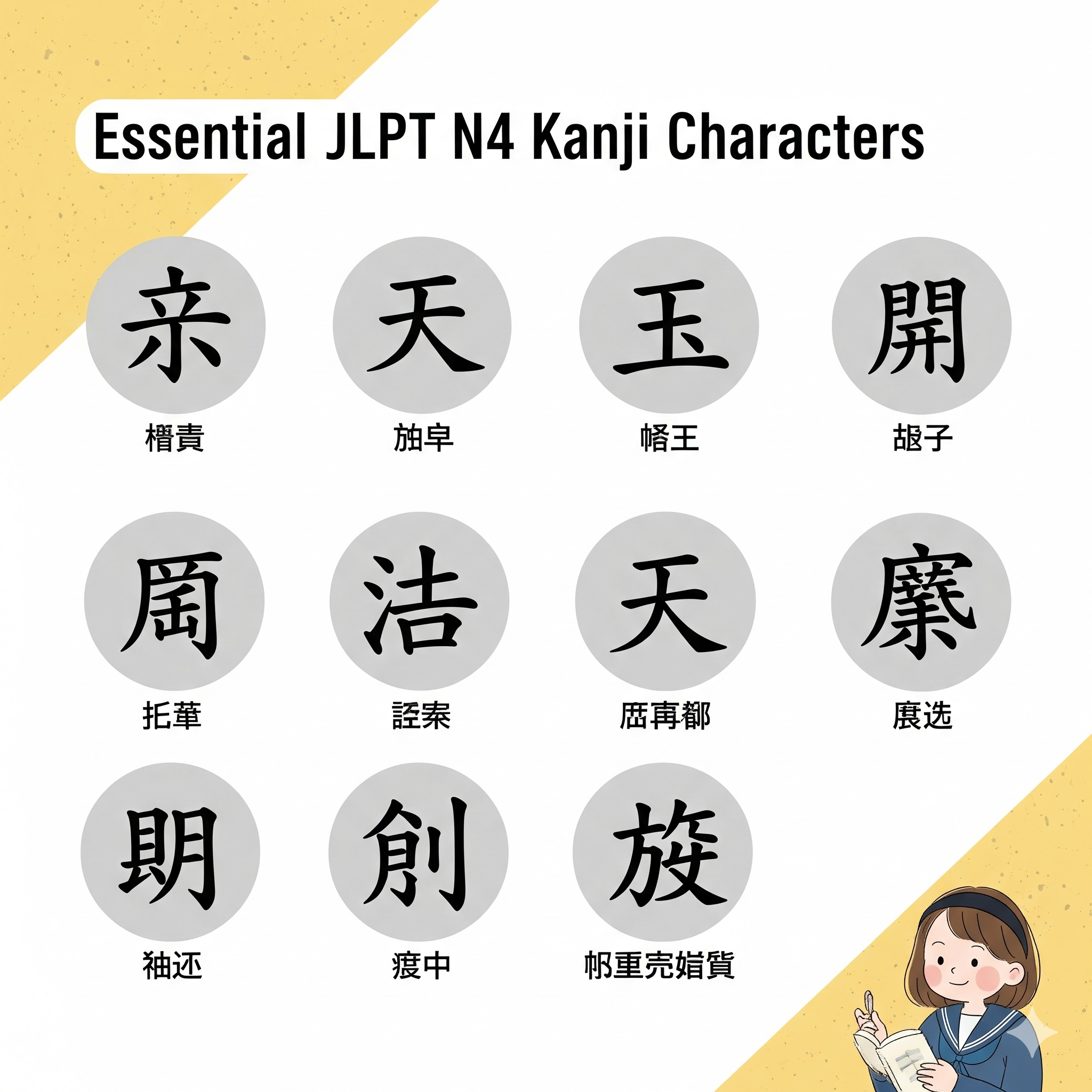
The JLPT N4 exam tests approximately 167 kanji (building on the 100 or so from N5). The goal isn’t calligraphic mastery; it’s functional recognition. Can you read it in a sentence? Can you guess the meaning from context? Can you pair it with the right reading?
Today, we’re going to cut through the overwhelm. I’m breaking down the JLPT N4 important kanji you should prioritize, how they’re tested, and my proven methods for making them stick. Grab your favorite notebook and let’s turn this mountain into a manageable hill.
For more details, please visit Master JLPT N4 Kanji: Complete Guide with Examples and Tips
How is Kanji Tested on the JLPT N4?
Before we dive into the characters, understanding the “enemy” is half the battle. The kanji on the N4 aren’t tested in isolation. You won’t be asked to write them from memory. Instead, they are woven into the fabric of the exam:
- Vocabulary Knowledge (語彙 – Goi): You’ll need to recognize a kanji compound and choose the correct reading or meaning from options.
- Grammar & Reading (文法・読解 – Bunpō, Dokkai): Kanji is the key to unlocking the reading passages. Knowing the core kanji here is what allows you to read quickly and comprehend the text.
- Listening (聴解 – Chōkai): While not written, seeing a kanji in the test booklet while listening to a dialogue can massively aid your understanding.
With that in mind, let’s look at the kanji that appear most frequently and are most critical for success.
The JLPT N4 Important Kanji: Categories to Focus On
Grouping kanji by theme is a powerful learning strategy. It helps your brain create connections, making recall faster. Here are the most high-yield categories for the N4.
1. People & Relationships: The Social Butterflies
These kanji are everywhere in conversations and readings about daily life.
- 親 (おや – oya / シン – shin) – Parent; intimate
- Example: 親切 (しんせつ – shinsetsu) means “kindness.” Think: “parent-like kindness.”
- 兄 (あに – ani / ケイ – kei) – Older brother
- Combines into: 兄弟 (きょうだい – kyōdai) meaning “siblings.”
- 姉 (あね – ane / シ – shi) – Older sister
- 弟 (おとうと – otōto / テイ – tei) – Younger brother
- 妹 (いもうと – imōto / マイ – mai) – Younger sister
- Insight: Notice the common 女 radical in 姉 and 妹? That’s the “woman” radical, a helpful clue for kanji related to females.
- 友 (とも – tomo / ユウ – yū) – Friend
- Crucial compound: 友達 (ともだち – tomodachi), the common word for friend.
For more details, please visit Complete List of All JLPT N4 Kanji You Need to Know (With Practical Tips & Study Guide)
2. Time & Calendar: Mastering Your Schedule
Time is a huge theme on the JLPT. Nailing these is non-negotiable.
- 来 (くる- kuru / ライ – rai) – To come; next
- You know it from N5: 来る (to come). At N4, see it in 来週 (らいしゅう – raishū – next week) and 来年 (らいねん – rainen – next year).
- 去 (キョ – kyo) – To leave; past
- Opposite of 来: 去年 (きょねん – kyonen) means “last year.”
- 勉 (ベン – ben) – Exertion
- The star of the show: It’s almost always found in 勉強 (べんきょう – benkyō – study). Learn this as a block.
- 働 (はたら-く – hataraku / ドウ – dō) – To work
- Example: 仕事 (しごと – shigoto) means “job,” but the verb “to work” is 働く.
For more details, please visit Download JLPT N4 All Kanji PDF – Study the Full Kanji List Easily
3. Places & Directions: Finding Your Way
These kanji are essential for reading signs, maps, and location-based dialogues.
- 駅 (えき – eki) – Station
- Must-know: 駅前 (えきまえ – ekimae) means “in front of the station,” a common meeting spot!
- 町 (まち – machi / チョウ – chō) – Town
- 市 (シ – shi) – City
- Combines into: 市役所 (しやくしょ – shiyakusho) meaning “city hall.”
- 道 (みち – michi / ドウ – dō) – Road; way
- Seen in: 道具 (どうぐ – dōgu – tool) literally “road tool,” i.e., something that paves the way to get a job done.
4. Verbs & Actions: The Engines of Sentences
Many Japanese verbs are written with a kanji stem followed by okurigana (hiragana endings). Knowing the core kanji helps you decipher new verbs.
- 食 (た-べる – taberu / ショク – shoku) – To eat; food
- Key compound: 食堂 (しょくどう – shokudō) means “dining hall” or “cafeteria.”
- 飲 (の-む – nomu / イン – in) – To drink
- 買 (か-う – kau / バイ – bai) – To buy
- 売 (う-る – uru / バイ – bai) – To sell
- Pro Tip: 買 and 売 look similar but are opposites. Spend a little extra time distinguishing them.
- 読 (よ-む – yomu / ドク – doku) – To read
- 聞 (き-く – kiku / ブン – bun) – To hear; to ask
5. Adjectives & States: Adding Description
These kanji form the backbone of many na-adjectives and i-adjectives.
- 便利 (べんり – benri) – Convenient
- Breakdown: 便 (mail/convenience) + 利 (profit/advantage) = advantage = convenient!
- 不便 (ふべん – fuben) – Inconvenient
- 元気 (げんき – genki) – Healthy; energetic
- 大切 (たいせつ – taisetsu) – Important; precious
For more details, please visit JLPT N4 All Kanji You Need to Know – Master List with Readings
From Sensei’s Desk: How to Actually Learn and Retain These Kanji
Cramming doesn’t work. Here’s what does, based on years of experience:
- Learn in Context, Not in a Vacuum: Never study a single kanji. Always learn it as part of a word. Instead of just memorizing 駅, learn 駅 (eki, station), 駅前 (ekimae, in front of the station), and 駅員 (ekiin, station staff).
- Embrace the Radicals: Radicals are the building blocks of kanji. Recognizing the “water” radical (氵) in 泳ぐ (to swim) or the “word” radical (言) in 話す (to speak) gives you a powerful clue to the meaning. I highly recommend using a resource like Jisho.org to check the radical for any new kanji.
- The Power of Spaced Repetition: This is non-negotiable for language learning. Use apps like Anki or Memrise. They use an algorithm to show you flashcards just as you’re about to forget them, cementing them into your long-term memory. Here’s a great Anki deck for JLPT N4 kanji (outbound link) to get you started.
- Read, Read, Read: Seek out beginner-friendly materials. NHK Web Easy (outbound link) offers news articles written in simple Japanese with furigana. Try to read one short article a day and circle the N4 kanji you recognize. It’s a huge confidence booster!
- Make It Physical: Write them out. The physical act of writing engages your brain differently than typing. Keep a dedicated kanji notebook.
If you’re still building your N5 foundation, check out our guide on Best Anki Decks for JLPT N4 Kanji: Download & Study Guide
Practice Makes Perfect: Let’s Test Your Skills!
Ready to apply what you’ve learned? Try to read this simple sentence using the kanji from above:
来週、兄と市の図書館で勉強します。その後、駅前の食堂で昼ご飯を食べます。
(Raishū, ani to shi no toshokan de benkyō shimasu. Sono ato, ekimae no shokudō de hirugohan o tabemasu.)
Did you get it?
- 来週 (raishū) = Next week
- 兄 (ani) = Older brother
- 市 (shi) = City
- 勉強 (benkyō) = Study
- 駅前 (ekimae) = In front of the station
- 食堂 (shokudō) = Cafeteria
- 食べます (tabemasu) = Eat
Translation: “Next week, I will study with my older brother at the city library. After that, we will eat lunch at the cafeteria in front of the station.”
See? You’re already reading N4-level content! For more practice like this, have a look at our post on Take This JLPT N4 Kanji Quiz to Test Your Skills
Final Words of Encouragement
The journey to JLPT N4 success is paved with kanji, but it’s a path countless learners have walked before you. Focus on these high-frequency characters, learn them in context, and use smart tools. Remember, the goal is recognition and understanding, not perfect calligraphy.
You have the plan. You have the resources. Now, all that’s left is to take that first step—or should I say, stroke?
頑張ってください!(Ganbatte kudasai! – Do your best!)