Konnichiwa, fellow Japanese language enthusiasts!
So, you’ve set your sights on the summit: the Japanese-Language Proficiency Test (JLPT) N1. It’s the final boss, the ultimate test of your years of dedication to mastering this beautiful and complex language. And if you’re planning to take it right here in Boston, you’ve come to the right place.
As someone who has both taken and tutored for the JLPT, I know the mix of excitement and sheer terror that comes with registering for the N1. It’s more than just a test; it’s a milestone. It opens doors to careers in translation, academia, and top-tier companies in Japan and beyond.
But let’s be real—navigating the process can feel as tricky as understanding a nuanced 社説 (shasetsu – newspaper editorial) on the first read. Where do you take it? When? And how on earth do you prepare?
Take a deep breath. Brew a cup of green tea. Let’s break down everything you need to know about taking the JLPT N1 in Boston.
Keyphrase: JLPT N1 Boston
Secondary Keyphrases: JLPT test center Boston, JLPT dates 2024, JLPT N1 preparation, Japanese proficiency test Boston
First Things First: Understanding the Beast That is JLPT N1
Before we talk logistics, let’s ensure we’re on the same page about what the N1 actually entails. It’s a common misconception that N1 means “fluency.” It’s closer to “highly proficient comprehension and nuanced understanding.”
The Japan Foundation describes N1 as the ability to:
- Understand Japanese used in a wide variety of contexts.
- Read complex logical or abstract writings and follow their narratives.
- Comprehend spoken Japanese in conversations, news reports, and lectures at natural speed.
In practical terms? You’re expected to know around 10,000 vocabulary words and 2,000 kanji. You’ll be listening to fast-paced news clips and reading academic texts. It’s daunting, but utterly achievable with a solid plan.
JLPT N1 Test Dates for 2024 (And How to Register)
The JLPT is offered worldwide only twice a year, and Boston is no exception. Mark your calendars!
- Sunday, July 7, 2024
- Sunday, December 1, 2024
The registration period for the July test is typically in March-April, and for the December test, it’s in August-September. These windows are short—often just 3-4 weeks—so you must be proactive.
Registration is NOT done through a central website. For test-takers in the US, it is handled exclusively through the American Association of Teachers of Japanese (AATJ). They act as the administrative body for test sites in North America.
🔗 Outbound Link: Bookmark the official AATJ JLPT page right now. This is your source for the exact moment registration opens. They will post the registration link, deadlines, and fees here. Do not wait until the last minute; spots in Boston can fill up!
Keyphrase: JLPT Test Center Boston
Your Test Center: Where Will You Take the JLPT N1 in Boston?
This is the question I get asked the most, and the answer has been consistent for the past several years. The only official test center in Boston is:
Boston Academy of English (BAE)
- Address: 95 Berkeley St, Boston, MA 02116 (South End/Back Bay area)
I’ve had students take the test here, and the feedback is generally positive. The facilities are good, and the proctors are familiar with the JLPT process. It’s easily accessible via the MBTA Orange Line (Back Bay Station) or Green Line (Arlington/Copley).
A crucial piece of advice: While BAE has been the host for years, always double-check the test center on the AATJ website when you register. While it’s highly unlikely to change, confirming the venue a week before the test is a smart anxiety-reducer.
Beyond the “What” and “Where”: How to Prepare for the JLPT N1 in Boston
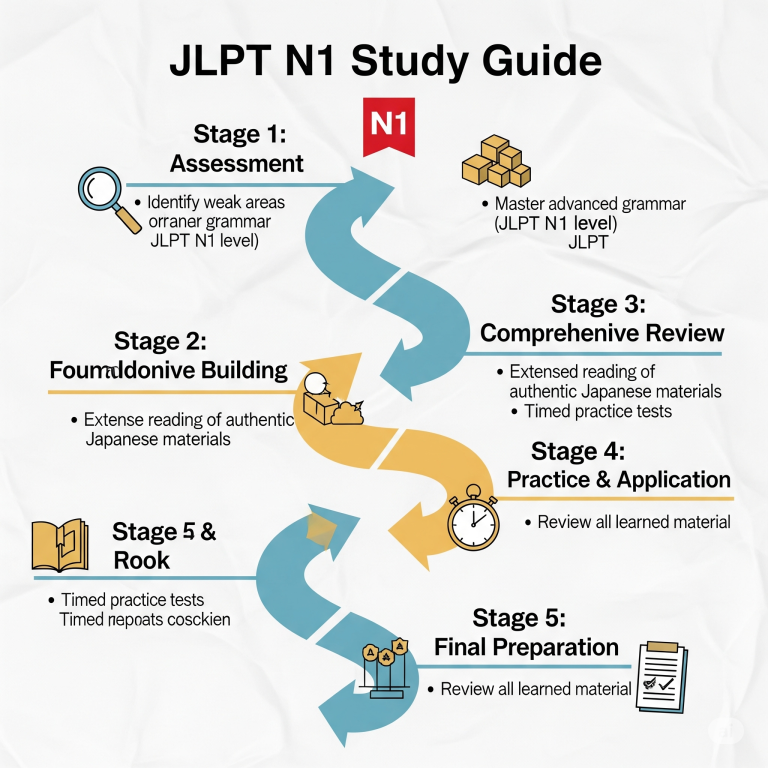
Alright, let’s get to the meat of it. Preparing for the N1 isn’t about cramming; it’s about conditioning. It’s a marathon run at a sprint pace. Here’s how to train effectively.
1. Reading Comprehension (読解 – Dokkai)
This section is brutal. The texts are long, complex, and often philosophically dense. You don’t have time to read every word slowly.
- Unique Insight: Stop reading novels for pleasure. Start reading opinion pieces and editorials. The Asahi Shimbun and Yomiuri Shimbun have excellent 社説 (shasetsu – editorials). Your goal isn’t just to understand the topic, but to follow the author’s logical flow (論理の流れ – ronri no nagare). Why does they use this specific conjunction (しかし、したがって、つまり) at this point? This is what the test asks.
- Practical Application: Set a timer. Give yourself 4-5 minutes to read a medium-length editorial and identify the main argument and the author’s stance. This builds the speed you desperately need.
🔗 Internal Link: Struggling with long-form reading? Check out our deep dive on [How to Improve Your Japanese Reading Speed and Comprehension for the JLPT N1].
2. Listening Comprehension (聴解 – Chōkai)
The listening section can be a nightmare. Voices overlap, audio quality isn’t perfect, and the questions are designed to trick you.
- Unique Insight: The key isn’t just hearing words; it’s listening for context and nuance. You need to understand what is not being said directly. Is the speaker hesitant? Are they using softeners like ~かな or ~かもしれません to express uncertainty?
- Practical Application: Ditch the textbooks for your listening practice. Immerse yourself in authentic content.
- Watch Japanese news on YouTube. NHK News Web Easy is a start, but for N1, move to the regular NHK news. Listen to a full report without subtitles, then watch it again with Japanese subtitles to see what you missed.
- Listen to Japanese podcasts on topics like business, politics, and society. Hitorigoto Company (ひとりごとカンパニー) is a fantastic channel for natural, free-flowing discussion.
3. Vocabulary & Grammar (言語知識 – Gengo Chishiki)
Knowing the kanji is one thing; knowing the precise nuance between similar words is another.
- Unique Insight: At the N1 level, you’re tested on grammar points that express subtle attitudes (〜べく、〜まじき、〜んばかりに). Don’t just memorize the meaning. Memorize the feeling. Is it for criticism? For obligation? For something that was about to happen?
- Practical Application: Create a “Nuance Journal.” When you learn a new grammar point, write down 2-3 example sentences that crystalize its exact usage and emotional connotation. Use a trusted resource like the Shin Kanzen Master or So-Matome series, which are gold standards for a reason.
🔗 Outbound Link: For a fantastic online grammar resource, I constantly recommend JTest4You. It’s a treasure trove of practice quizzes and explanations for all JLPT levels.
The Week Before the Test: Your Boston-Specific Game Plan
- Do a Test Run: Seriously. Get on the T or drive to the test center at the same time your test will be. Know exactly how long it takes. Boston traffic and weekend T schedules are unpredictable.
- Pack Your Pencil Case: You need HB pencils (no mechanical pencils!) and a good eraser. Your admission ticket and a photo ID (passport or driver’s license) are non-negotiable.
- Silence Your Electronics: Your phone must be turned completely off and stored away. Not silent, not vibrate—off. Any noise can lead to immediate disqualification.
You’ve Got This!
The journey to JLPT N1 is long, and there will be days you feel overwhelmed. But remember why you started. Every anime you understood without subtitles, every conversation you had with a friend from Japan, every book you struggled through and finally finished—it all led you here.
Boston, with its rich academic history, is a fantastic place to take this step. Use this guide, make your plan, and trust in the knowledge you’ve worked so hard to build.
頑張ってください (Ganbatte kudasai)! I’m rooting for you.
Taming the Beast: Your Expert Guide to JLPT N1 Example Questions and Practice Exercises
JLPT N1 Full Test Experience: What to Expect on Exam Day
JLPT N1 Full Form & What the Exam Really Means