Welcome! I’m so glad you’re here. You’ve likely read our main post, “Can You Pass JLPT N4 in 4 or 6 Months? A Realistic Study Plan,” and now you’re looking for the how. The truth is, a rigid timetable is just a map—you still need a reliable vehicle to get you there. That’s where your core study strategy comes in.

As someone who’s been down this road, not just as a test-taker but as an educator, I can tell you the biggest pitfall isn’t a lack of time—it’s a lack of sustainable method. Rote memorization will get you a vocabulary score, but it won’t let you actually use the language.
This isn’t about grinding for a certificate; it’s about crafting a learning life that makes Japanese an enjoyable, permanent part of your world. Let’s move beyond the checklist and build a truly effective, human-centric study strategy for N4.
🧭 The Core N4 Challenge: More Than Just ‘More’
If you’ve passed N5 (or are jumping straight to N4), you’ve already learned that Japanese requires dedication. N4, however, isn’t just N5 with a few extra words. It’s the transition from understanding isolated phrases to being able to follow short, connected narratives in daily life.
To pass the N4, you generally need:
| Skill Area | Target Knowledge | The Real-World Application |
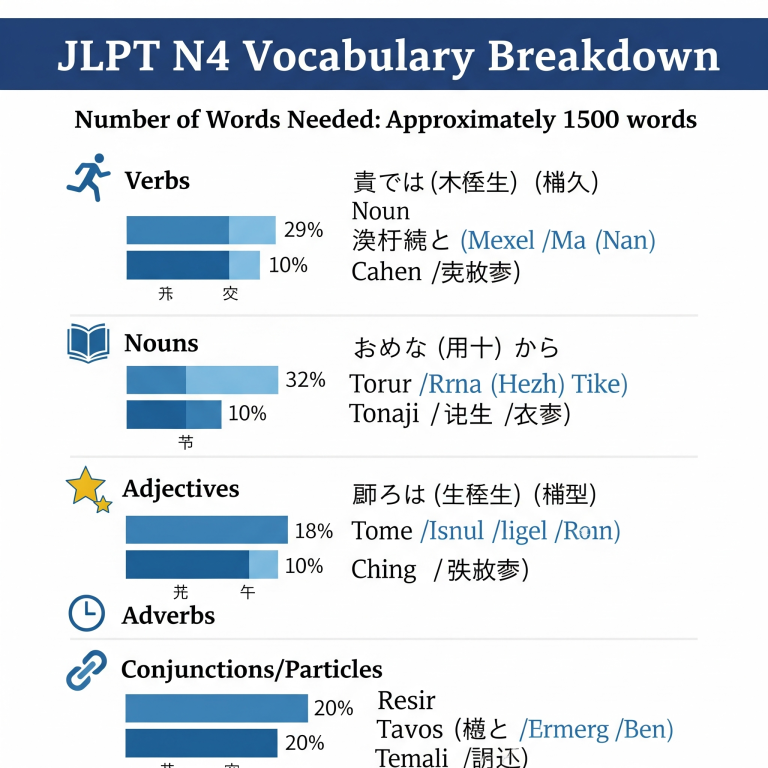
| Vocabulary (語彙) | ~1,500 words (including N5) | Understanding daily conversations, signs, and basic instructions. |
| Kanji (漢字) | ~300 characters (including N5) | Reading short passages, simple emails, and common public notices. |
| Grammar (文法) | 40-50 new key patterns | Expressing intention, ability, giving detailed reasons, and using simple conditional phrases. |
| Listening (聴解) | Understanding slow, clear spoken Japanese in everyday contexts. | Following simple plot points, grasping key information in a dialogue (e.g., meeting time, location). |
The challenge here is integration. You need to be able to use the grammar and kanji to read a passage, and your vocabulary and listening skills to follow a conversation. Your study strategy must reflect this holistic need.
🛠️ Pillar 1: The Balanced Study Week—Consistency Over Cramming
A 4-6 month plan lives or dies by your consistency. We’re aiming for the recommended 1.5 to 2 hours of focused study per day (which totals roughly the 150-300 hours needed for N4). But, let’s face it, life happens. This is a strategy for a human, not a robot.
🗓️ A Sample Human-Friendly Weekly Schedule
The key to a good study strategy is to rotate your focus. Don’t spend one entire day on just kanji. Mix and match to keep your brain engaged and prevent burnout.
| Time Slot | Monday | Tuesday | Wednesday | Thursday | Friday | Saturday | Sunday |
| Morning (30 min) | Anki Review (Vocab/Kanji) | Anki Review (Vocab/Kanji) | Anki Review (Vocab/Kanji) | Anki Review (Vocab/Kanji) | Anki Review (Vocab/Kanji) | Deep Review of the week’s hardest points (1 hr) | Rest / Light Reading (e.g., NHK Easy News) |
| Evening (90 min) | New Grammar (45m) + Example Sentences (45m) | Reading Practice (45m) + Kanji Writing/Mnemonics (45m) | Listening Drills (45m) + New Vocabulary (45m) | Grammar Review (45m) + Reading (45m) | Fun Immersion (90m)—Anime/Podcasts | Mock Test (Full Timed Section) (2 hrs) | Mock Test Review + Weak Area Drill (2 hrs) |
💡 Human Insight: The 15-Minute Rule
If you have days where a full 90-minute session feels impossible, just commit to the 15-minute Anki review. Showing up is 80% of the work. By keeping that daily habit alive, you prevent the knowledge from decaying. Your brain will thank you for the consistent drip-feed.
🧠 Pillar 2: The Integrated Study Strategy for Core Skills
N4 requires you to be proficient in three main pillars of knowledge—Vocabulary, Kanji, and Grammar. Your strategy should make these work together, not in isolation.
1. Vocabulary: Context is King
You need about 700-800 new words for N4. Memorizing a list is tedious and ineffective.
- The Problem with Lists: You know the word ’kiru’ (着る – to wear), but do you know which items of clothing use it versus ’haku’ (履く – to wear/put on lower garments) or ’kakeru’ (かける – to wear glasses)? Context is everything.
- Practical Application: When you learn a new word, don’t just learn the English translation. Learn it in a sentence that you might actually use.
- Bad: 込む (komu) – crowded
- Good: 電車がいつも込んでいますね。 (Densha ga itsumo konde imasu ne. – The train is always crowded.)
- Your Strategy: Use an SRS (Spaced Repetition System) app like Anki or Memrise, but use high-quality decks that include example sentences. When you review a word, say the entire sentence out loud. This connects the vocabulary to its grammatical usage and trains your speaking/listening muscles simultaneously.
2. Kanji: Storytelling for Retention
You need roughly 300 total kanji for N4. This is where many learners start to struggle and where a smart strategy shines.
- The Problem with Rote: Writing the character 50 times in a row feels like work, but often results in short-term memory only.
- Practical Application: Use mnemonics and radicals. Every kanji is a small picture, and you can build a memorable story out of its components (radicals).
- Example: 駅 (えき – Station). It’s made of 馬 (うま – horse) and 役 (やく – duty/service). The station has a service/duty to transport the horse. (This works because train stations replaced horse-drawn carriages).
- Your Strategy: Dedicate a specific Kanji Time (e.g., Tuesday evening) to actively learn the story behind 5-10 new kanji. Use resources like WaniKani (outbound link) or a kanji-specific textbook that focuses on component-based learning. The rest of the week, reinforce it by reading those kanji in your vocabulary and grammar examples. Never learn a kanji in isolation.
3. Grammar: The Glue of Communication
N4 grammar introduces essential, higher-level concepts that allow you to express causality, conjecture, and your will.
- The Problem with “The List”: Simply reading grammar points like 〜たばかり or 〜そうだ will only help you recognize them on the test. It won’t help you use them.
- Practical Application: This is the time to make grammar personal.
- When you learn the pattern 〜たい (want to do), don’t just write パンを食べたい (I want to eat bread). Write something about your life: 「JLPTに合格したいから、毎日勉強する。」 (Because I want to pass the JLPT, I study every day.)
- Your Strategy: Use a structured resource like Shin Kanzen Master N4 or TRY! N4. For every new grammar point, do three things:
- Understand the Nuance: What is the specific feeling or context? (e.g., 〜ながら means ‘while doing two actions simultaneously’.)
- Create 3 Personal Sentences: Write three unique, original sentences about your own life using the pattern.
- Review the Family: How is it similar to or different from an N5 grammar point? (e.g., comparing 〜から and 〜ので for giving reasons).
🎧 Pillar 3: Listening and Reading—Bridging the Gap to Reality
The biggest drop in scores between N5 and N4 often happens in the Listening and Reading sections. Why? Because these sections test your ability to process language in real time and in context. You cannot pass N4 if you only study from flashcards.
A. Active Listening: Beyond Just Hearing
- Strategy: Shadowing & Guessing
- Passive Input (Daily): Listen to Japanese as much as possible—Podcasts (like Nihongo con Teppei or Tofugu’s podcasts), simple YouTube channels, or even just your study audio. Don’t worry about understanding everything; you are training your ear to the rhythm and intonation.
- Active Shadowing (3x Weekly): Pick a short, clear dialogue (from a textbook audio or a simplified news clip). Listen, then immediately repeat what you hear. This is crucial for connecting the sound to your brain’s language production center. You’ll sound awkward at first, but it is one of the best habits you can adopt.
- The “Guessing” Game: In the N4 listening section, you are rarely expected to understand every word. You need to get the gist. Practice listening and trying to answer the question after the first 15 seconds. Train yourself to identify the who, what, and why early on.
B. Smart Reading: The Skimming Skill
- Strategy: Progressive Immersion
- Start Easy: Use resources like NHK Web Easy News (outbound link). These articles are simplified and contain furigana for all kanji, making them the perfect bridge from textbook Japanese to native content.
- Skim and Search: When you read a practice passage, don’t look up every single word. First, read the questions. Then, skim the text for keywords and names. Only look up words that seem absolutely essential to the sentence containing the answer. Your goal is comprehension, not perfect translation.
- Analyse Sentences: If you finish a reading passage, go back and break down one difficult sentence. Identify the grammar patterns, circle the kanji you struggled with, and try to re-write the sentence into a simpler form. This turns passive reading into active, integrated study.
🏆 Pillar 4: The Final Stretch—Mock Tests and Mental Health
For the last 4-6 weeks of your study period (whether it’s 4 months or 6 months), your strategy shifts from learning new material to mastering and testing what you already know.
1. The Mock Test Strategy
You must take at least four full-length mock tests under timed, real-exam conditions.
- Simulate the Stress: Take the test in one sitting, following the official time limits for each section (Language Knowledge (Vocab/Grammar/Reading) and Listening). Put your phone away. Use a pencil. Treat it like the real thing.
- The Post-Test Analysis is Key:
- Don’t just check the score. Check which type of question you failed. Was it a specific grammar point? Was it a kanji reading? A Listening comprehension?
- Create a “Weakness Log”: For every question you get wrong, write down the concept (e.g., “N4 Grammar: Causative Form,” “N4 Vocabulary: Adverbs of Time”) and dedicate the next few days to drilling only those specific areas.
2. Humanizing Your Routine
Language learning is a marathon, and burnout is real. Your study strategy must include self-care.
- Schedule a “Non-Japanese” Day: Give yourself one full day a week (we suggested Sunday morning) where your brain is allowed to completely switch off from textbooks. You can still watch an anime or a Japanese movie with subtitles, but with zero obligation to learn.
- Find a Study Buddy: Connect with another N4 learner, even online. Explaining a difficult grammar point to someone else is a powerful form of active recall and the best way to solidify your own understanding.
- Celebrate Small Wins: Did you use a new grammar pattern correctly in a conversation? Did you read a short article without looking up any words? Give yourself a high-five! Acknowledging progress keeps your motivation tank full.
🌟 Unique Insights: Applying N4 in the Real World
The JLPT is a test, but Japanese is a skill. Here’s how you can make your N4 knowledge useful right now.
- 1. The “Daily Diary” Habit: Spend 15 minutes every night writing a short journal entry in Japanese. Keep it simple and focused on what you did, what you plan to do (using the N4 volitional and intention grammar), and what you want/don’t want (using 〜たい). Don’t worry about perfection; just use what you know.
- 2. Label Your Life: Use your new N4 kanji and vocabulary to label objects around your house or apartment. Seeing the word 冷蔵庫 (reizouko – refrigerator) or 電気 (denki – electricity) on a sticky note every day forces your brain to recognize and recall the kanji and vocabulary passively.
- 3. Talk to Yourself (Seriously): As you go about your day, describe what you are doing in Japanese, even if it’s just in your head. 「コーヒーを飲みます。」 (I’ll drink coffee.) 「今から出かけます。」 (I’m heading out now.) This makes the language an active tool, not just a set of testable rules.
By integrating this balanced, human-focused study strategy—one that rotates through skills, focuses on context, and includes real-world application—you will not just pass the JLPT N4. You will internalize the Japanese language, setting a solid foundation for N3 and beyond.
You’ve got this! 頑張って (Ganbatte)!
🔗 For More JLPT N4 Resources You Might Find Helpful
The Complete JLPT N4 Study Guide: Syllabus, Structure, and How to Pass – JLPT Samurai
Official JLPT N4 Exam Dates 2025: Schedule, Registration, and Deadlines – JLPT Samurai
JLPT N4 vs N5 vs N3: What Level is JLPT N4 and What Can You Do With It? – JLPT Samurai
Where to Find JLPT N4 Anki Decks and Flashcards for Kanji & Vocab – JLPT Samurai
Jobs for Freshers with JLPT N4: Is it Enough to Get Hired? – JLPT Samurai
Ultimate JLPT N4 Kanji List: Free PDF Download & Practice Sheets – JLPT Samurai
The Best JLPT N4 Vocabulary: 1500 Essential Words PDF – JLPT Samurai
Top 5 Recommended Books and Learning Materials for JLPT N4 (Minna no Nihongo & More) – JLPT Samurai
Download All JLPT N4 Past Papers with Answers (2024, 2023, 2022, and Old Questions) – JLPT Samurai
JLPT N4 Mock Test & Practice Exam PDFs (Free Download) – JLPT Samurai
JLPT N4 Listening Practice: Free Downloads and Old Question Audio – JLPT Samurai
How to Calculate Your JLPT N4 Score: Marking Scheme & Minimum Passing Score – JLPT Samurai
What to Expect on Test Day: JLPT N4 Timetable and Paper Pattern – JLPT Samurai