Konnichiwa!
If you’ve made it through the beginner textbooks—maybe you’ve finished Minna no Nihongo I & II or Genki I & II—give yourself a huge pat on the back. You’ve cleared the foundational hurdle, and that’s an incredible achievement.

However, if you’re like most of my students, you’re now at a crucial pivot point: The N4 Wall.
You’ve learned the grammar and the basic vocabulary, but you look at a mock test and suddenly those concepts feel… slippery. The reading passages are a little too long, the listening speed is a little too quick, and the sheer volume of vocabulary you need to juggle is overwhelming.
Why? Because core textbooks like Minna no Nihongo are designed for classroom instruction, which is fantastic for teaching grammar structure. But they are not designed to be the sole source of practice needed to pass a comprehensive, high-stakes exam like the JLPT.
This is where supplementary resources come in.
This blog post is your insider guide, written by a Japanese language expert and JLPT veteran, to the essential resources that transform raw knowledge into test-passing, Japanese-using ability. We are going to go beyond the core books to build a robust, diverse study ecosystem that targets every single section of the N4 exam.
You’ve got the foundation. Now, let’s build the house.
🧱 Category 1: Dedicated JLPT Exam Prep Resources (The “Must-Haves”)
While our main Pillar Post covered the best full-suite textbooks, these resources are specifically designed to solidify your knowledge and practice your exam technique. They take the grammar and vocabulary you learned and put it into a high-pressure, test-format context.
1. The Power Drill: Nihongo So-Matome & Shin Kanzen Master Series
These are the two titans of JLPT-specific preparation, and you should choose one of them to supplement your core textbook study. They are structured not by lesson numbers like Minna no Nihongo, but by the components of the JLPT.
- The “Slow-Burn” Daily Planner: Nihongo So-Matome (日本語総まとめ)
- What it is: A series of small, focused books (one for Grammar, one for Vocabulary, one for Kanji, etc.) that structure your study into a 6-week daily schedule. It breaks down the entire N4 syllabus into manageable, bite-sized chunks.
- Expert Insight: I recommend So-Matome for students who thrive on routine and need a clear finish line. Its presentation is clean, the explanations are straightforward, and the daily structure helps prevent burnout. If you struggle with consistency, the built-in schedule acts as your personal coach.
- Practical Application: Dedicate 30 minutes a day to one section (e.g., the Grammar book) and treat it like non-negotiable homework. By the end of the week, you get a full-length review test. It’s perfect for ensuring you touch every corner of the syllabus.
- The “Deep Dive” Reference: Shin Kanzen Master (新完全マスター)
- What it is: A more comprehensive, dense series of books. It’s less about a strict daily schedule and more about in-depth explanations and numerous practice questions.
- Expert Insight: Shin Kanzen Master is the best resource if your goal is to truly understand the nuances of a grammar point, not just memorize a structure. The reading and listening practice sections are especially lauded for mimicking the true difficulty and format of the official JLPT.
- Practical Application: Use this as your reference book alongside your core textbook. When you are confused by a specific grammar point in Minna no Nihongo, flip to the relevant chapter in Shin Kanzen Master. You will find a clearer, more detailed breakdown and a mountain of practice questions to ensure mastery.
👂 Category 2: Beyond the Textbook Audio (Mastering Listening Comprehension)
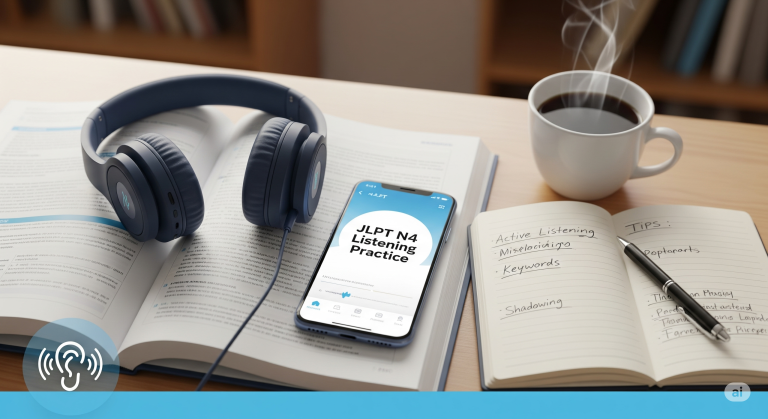
The Listening section (聴解 – Chōkai) is often the most anxiety-inducing part of the JLPT N4. Why? Because the audio in your textbooks is often too slow and too clear. The real JLPT N4 features natural, slightly quick dialogue between native speakers with background noise and varied intonation.
You need to train your ear for the real world!
2. The Daily Dose: Podcasts and NHK Easy Japanese News
This is where you integrate Japanese into your daily life. Forget “studying” for a moment—just listen.
- The Podcast Method: JapanesePod101 (J-Pod)
- What it is: A colossal library of audio and video lessons. Their “Lower Intermediate” or “Survival Japanese” pathways often align perfectly with the N4 level.
- Expert Insight: The key benefit of J-Pod is the sheer volume of authentic conversations. They provide dialogues that are faster and more natural than textbook audio, followed by native English explanations. Your goal isn’t to understand every word, but to train your brain to filter out the noise and latch onto key information.
- Practical Application: Commuting? Working out? Doing chores? Put on a J-Pod lesson. Try the Shadowing Technique: listen to a sentence, then immediately repeat it out loud, trying to match the speaker’s intonation and pace. This drastically improves both listening and speaking.
- The News Resource: NHK Easy Japanese News
- What it is: A free online news source that re-writes daily Japanese news articles using simplified grammar, a limited N4-level vocabulary, and furigana (small reading guides) over all kanji.
- Expert Insight: This is a goldmine. It’s real-world Japanese—not manufactured textbook dialogue—but at your level. More importantly, it features audio read at a slightly slower-than-normal pace. It’s the perfect bridge between textbook Japanese and native-speed media.
- Practical Application: Listen to the news article once without looking at the text. Try to identify the main topic. Then, read the article while listening to the audio. Finally, listen again without the text. Rinse and repeat.
📖 Category 3: Reading and Vocabulary Acquisition Resources
The Reading Comprehension section (読解 – Dokkai) tests your stamina and your ability to process multiple paragraphs under a tight time limit. The key to winning this section is extensive reading (Tadoku – 多読).
3. Extensive Reading with Graded Readers
- What it is: A series of short stories and articles that are specifically written with a restricted vocabulary and grammar set for a given JLPT level. Think of them as Japanese training wheels for reading.
- Expert Insight: If you jump straight into manga or native Japanese novels, you will spend all your time looking up words and burn out. Graded Readers keep your look-up rate low (ideally less than 5% of words), which trains your brain to process Japanese naturally for meaning, not for translation. This is an absolutely indispensable practice that builds both reading speed and vocabulary acquisition.
- Practical Application: I strongly recommend the Japanese Graded Readers series (available from publishers like Ask Publishing). Set a goal to read two short books a week. Don’t look up every single word! Instead, guess the meaning from the context, and only look up a word if it appears multiple times and prevents you from understanding the main idea.
4. The Digital Vocabulary Powerhouse: Anki
The N4 requires knowledge of roughly 1,500 words and around 300 kanji. Relying only on the vocabulary lists at the back of your textbook is a recipe for failure. You need an active, daily review system.
- What it is: Anki is a free (on desktop/Android) Space Repetition System (SRS) software. It’s essentially a smart flashcard app that shows you cards you struggle with more frequently and cards you know well less frequently.
- Expert Insight: Anki is not a substitute for learning, but it is the single best tool for memory retention. The key is to use a high-quality, pre-made JLPT N4 deck, such as one based on the official Tango (単語 – Vocabulary) book series. Do not spend time creating your own cards at this stage—your time is better spent studying the content.
- Practical Application: Do your Anki cards first thing every morning. This is a non-negotiable 15-20 minute commitment. Aim for 15-20 new words a day, max. Consistency crushes intensity in language learning. If you miss a day, don’t try to catch up on all 100+ review cards—you’ll burn out. Just get back to your new cards for the day.
🎮 Category 4: Unique & Unconventional Resources (The Human Element)
To truly humanize your study, you need to step away from the test-prep mindset and start interacting with the language as a living, breathing entity. These resources make the process fun and practical.
5. Learning Through Entertainment
- YouTube Channels:
- Look for channels that teach N4-level grammar and vocabulary, but more importantly, for channels that offer slower-paced vlogs or cultural lessons. You are looking for content that is visually engaging and easy to digest. A personal recommendation is searching for “Japanese ASMR”—it’s excellent for training your ear to subtle sounds and intonation without the pressure of a complex story.
- Outbound Link Example 1 (Cultural Insight): If you want to dive into Japanese food and culture at a slightly slower pace, check out this channel: Discovering Japan’s Everyday Life (Example YouTube Channel)
- Simple Manga & Video Games:
- This is the best kind of real-world reading practice. The N4 level aligns well with shorter children’s stories (絵本 – ehon) or very simple slice-of-life manga. The visual context in manga is a lifesaver—it helps you guess the meaning of unfamiliar words without having to stop and use a dictionary.
- Practical Application: Start with a manga you already know and love! Reading the Japanese version of Pokémon or a simple Shirokuma Cafe manga is highly effective because you already understand the plot.
6. The Practice Environment: Language Exchange Apps
A test is a test, but the goal of language learning is communication. The N4 is all about using Japanese in familiar, everyday contexts. You need to practice this, which means talking to real people.
- What it is: Apps like HelloTalk or Tandem connect you with native Japanese speakers who are learning your native language. You spend time helping them, and they spend time helping you.
- Expert Insight: This is the most effective resource for humanizing your study. Suddenly, those complicated N4 grammar patterns, like “〜たことがあります” (have done something before) or “〜つもりです” (intend to do), become practical tools for sharing your life and making new friends. It turns grammar from a test item into a conversational necessity.
- Practical Application: Set a goal to write one simple, grammatically correct paragraph in Japanese every day. Use the N4 grammar you are currently studying. For example, if you just learned the passive form (〜られる), you could write: 「昨日、友達に誕生日ケーキをあげられました。」(Yesterday, a birthday cake was given to me by my friend.)
📝 Category 5: Official & Mock Test Resources (The Final Push)
Your final cluster of resources must be the ones that simulate the actual exam. No amount of vocabulary study will help if you are surprised by the format of the test on exam day.
7. Official Practice Workbooks & Mock Tests
- The Gold Standard: The Official JLPT Practice Workbooks
- What it is: The Japan Foundation (the organization that administers the JLPT) releases official practice workbooks. These contain questions that were used in past exams and perfectly reflect the question types, difficulty, and format of the test.
- Expert Insight: Nothing beats official materials. They are the benchmark. The vocabulary, kanji, and grammar are guaranteed to be at the correct level, and the audio quality for the listening section is what you will hear on exam day.
- Practical Application: Save these for the last month of your study. Treat them like sacred documents. Do a full, timed mock test, and then spend twice as long reviewing your answers. For every single wrong answer—in any section—determine if you made a mistake due to Knowledge (vocabulary/grammar gap) or Technique (not understanding the question format).
- Online Practice Tests:
- Many reputable sites offer free online mock tests. Use these as supplementary practice once you’ve exhausted your official books. They are great for quick, focused drilling on specific sections.
- Outbound Link Example 2 (Free Practice): To get a feel for the exam format right now, you can try these reputable practice questions: Free JLPT N4 Online Practice Questions
🎯 Unique Insights and Practical Application: The 30/30/30 Rule
My top advice for any N4 student is to stop thinking about your study as “one long session” and break it into three distinct 30-minute blocks using these diverse resources. This mimics the structure of the exam and prevents mental fatigue.
| Time Block | Focus | Recommended Resource(s) | Key Goal |
| Morning (30 mins) | Knowledge Retention | Anki (Vocab/Kanji) + Nihongo So-Matome (Daily Grammar/Vocab Review) | Solidify memorization. Use the SRS to leverage brain power. |
| Afternoon (30 mins) | Input & Exposure | NHK Easy Japanese News (Reading/Listening) or Graded Reader | Build reading speed and train your ear to natural Japanese. |
| Evening (30 mins) | Output & Technique | Official Practice Questions or HelloTalk (Writing/Speaking) | Force yourself to produce the language and practice the test format. |
This “30/30/30 Rule” ensures you hit all three core components of language learning: Memorization, Input, and Output. You are constantly cycling through different resource types, which keeps your brain engaged and prevents that soul-crushing feeling of studying the same thing over and over.
🌟 Final Thoughts: Humanizing Your N4 Journey
Remember, the JLPT N4 is a huge achievement. It signifies that you are no longer a complete beginner; you are an intermediate Japanese speaker capable of understanding and engaging in everyday Japanese.
Don’t let the test format turn learning Japanese into a chore.
Use your core textbook as your anchor, and then use the vibrant ecosystem of resources listed above—from the structured practice books and official mock tests to the fun manga and helpful podcasts—to make the language come alive. Every step you take outside of your textbook is a step closer to fluency and a higher score on exam day.
頑張ってね! (Ganbatte ne!)—You can do this!
Would you like me to find an outbound link for a specific JLPT N4 grammar reference website to complete the third HTML link, or would you like to move on to planning your next cluster post?
The Complete JLPT N4 Study Guide: Syllabus, Structure, and How to Pass – JLPT Samurai
Download All JLPT N4 Past Papers with Answers (2024, 2023, 2022, and Old Questions) – JLPT Samurai
JLPT N4 Mock Test & Practice Exam PDFs (Free Download) – JLPT Samurai
JLPT N4 Listening Practice: Free Downloads and Old Question Audio – JLPT Samurai
How to Calculate Your JLPT N4 Score: Marking Scheme & Minimum Passing Score – JLPT Samurai
-What to Expect on Test Day: JLPT N4 Timetable and Paper Pattern – JLPT Samurai
Can You Pass JLPT N4 in 4 or 6 Months? A Realistic Study Plan – JLPT Samurai
Official JLPT N4 Exam Dates 2025: Schedule, Registration, and Deadlines – JLPT Samurai
JLPT N4 vs N5 vs N3: What Level is JLPT N4 and What Can You Do With It? – JLPT Samurai
Where to Find JLPT N4 Anki Decks and Flashcards for Kanji & Vocab – JLPT Samurai
Jobs for Freshers with JLPT N4: Is it Enough to Get Hired? – JLPT Samurai
Ultimate JLPT N4 Kanji List: Free PDF Download & Practice Sheets – JLPT Samurai
The Best JLPT N4 Vocabulary: 1500 Essential Words PDF – JLPT Samurai