はじめに (Introduction): The N1 Summit is Within Reach
The Japanese-Language Proficiency Test (JLPT) N1 is often seen as the final frontier, the summit of formal Japanese study. It signifies an ability to understand Japanese used in a variety of circumstances, including complex, abstract, and nuance-heavy topics. It’s a huge undertaking, and frankly, a bit of a monster.
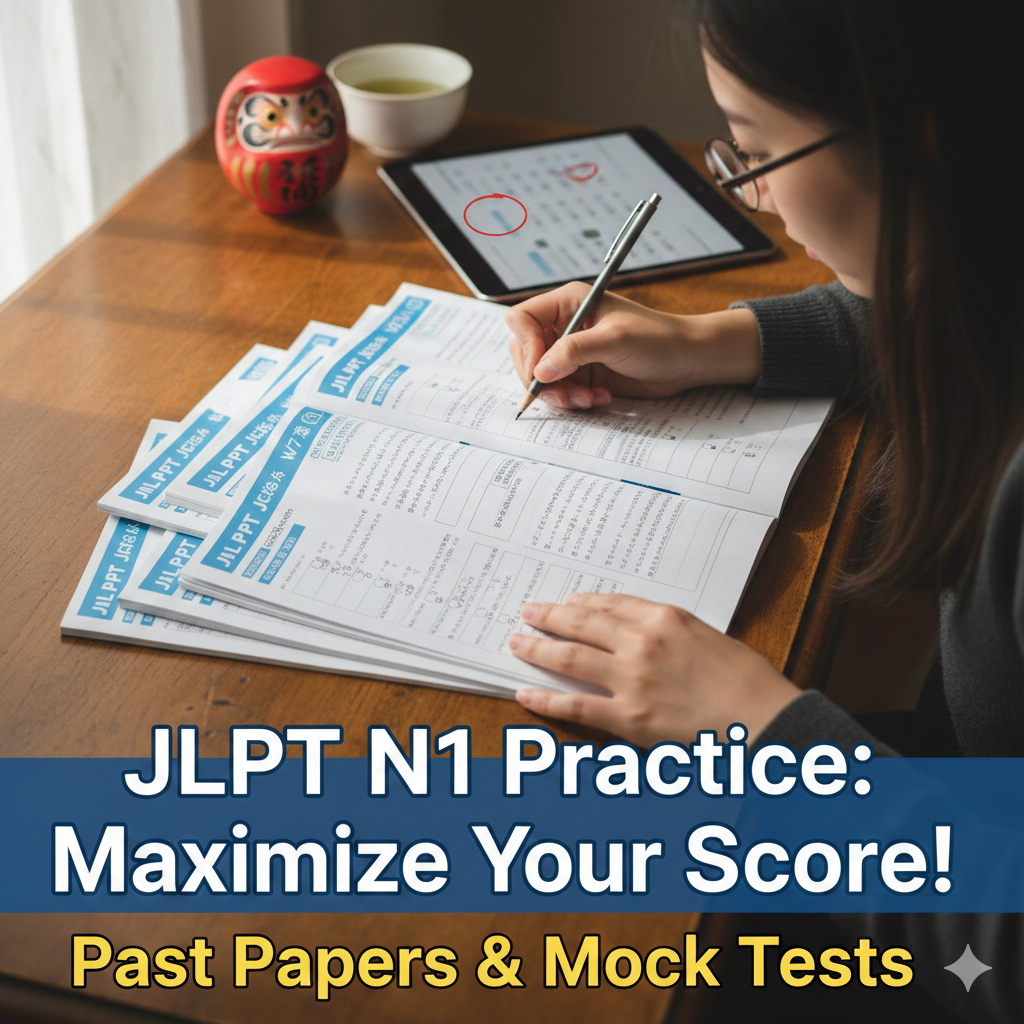
You’ve poured countless hours into mastering advanced grammar, memorizing thousands of Kanji, and immersing yourself in authentic Japanese media. But there’s a huge difference between knowing the material and performing under the intense, timed pressure of the actual exam.
This is where JLPT N1 past papers and high-quality mock tests become your absolute best friends—your secret weapon. They are the bridge between raw knowledge and exam success. As someone who has navigated the murky waters of N1 prep, I know the frustration of sifting through unreliable sources just to find a decent practice test.
In this comprehensive guide, I’m going to cut through the noise. We’ll explore the definitive sources for official papers and reliable mock tests, offer realistic advice on where to find the answers you need (like the JLPT N1 2023 December answer keys), and, most importantly, provide a battle-tested strategy for using these resources to achieve your maximum potential score.
Let’s dive in and turn those intimidating practice papers into your pathway to a passing score.
🔍 Section 1: The Quest for Authentic JLPT N1 Past Papers
When it comes to studying for an exam as high-stakes as the N1, the quality of your practice material is everything. Junk practice material can hurt you more than it helps by instilling bad habits or focusing on irrelevant content.
1.1 The Official, Gold Standard Sources
The absolute best resources come directly from the creators of the JLPT: The Japan Foundation and Japan Educational Exchanges and Services (JEES).
- The JLPT Official Practice Workbook (公式問題集 – Kōshiki Mondai-shū):
- What it is: This is the closest you will get to a real, recent past paper, published specifically for study purposes. It contains one full-length practice test for N1.
- Why it’s crucial: It perfectly replicates the test format, question types, and, most importantly, the feel and difficulty of the actual exam. The vocabulary and grammar patterns are guaranteed to be spot-on.
- Pro Tip: Treat this book like gold. Use it as your diagnostic test before you seriously begin your study, and then use it again a week before the exam for a final score check. Getting a physical copy is highly recommended to simulate the actual test experience—pencil, eraser, and all.
- The Official JLPT Website Sample Questions:
- Where to find it: The official JLPT website provides free sample questions for all levels.
- What it is: While not a full, timed paper, these questions showcase the format and item types for each section (Language Knowledge, Reading, and Listening). They are a great starting point for familiarizing yourself with the structure of the JLPT N1 past papers.
- How to use it: Use this for a quick, low-stakes warm-up or to demonstrate the different types of questions to a study partner.
1.2 Unearthing the Latest Papers: The Reality of JLPT N1 2024 Question Paper
Now, let’s talk about the unicorn: a full JLPT N1 2024 question paper (or any paper from the current or immediately preceding year).
Here’s the hard truth: The JLPT does not officially release the full, actual question papers from recent exams. They do this to maintain a massive pool of secret, validated questions for future tests. If every paper was released, they would constantly have to rewrite the entire exam.
So, when you see a “guaranteed official JLPT N1 2024 question paper” online, be skeptical. It is almost certainly a reconstruction, a mock test, or an unofficial copy shared illicitly.
Instead of chasing the impossible, focus on these reliable alternatives:
- High-Quality Mock Test Books: Publishers like Unicom, Ask Publishing, and ALC produce excellent N1 mock test collections (e.g., Nihongo Sō-Matome series or Try! series often have a separate mock test book). These are created by JLPT experts and are the next best thing to a true past paper.
- Unofficial Reconstructions: After every exam, dedicated Japanese learners and teachers worldwide collaborate to reconstruct the paper from memory. This is often where you find the most accurate unofficial JLPT N1 2023 December answer guides. While helpful, always take these with a grain of salt regarding absolute accuracy. Use them to check your score, not as your primary study material.
1.3 Where to Find the JLPT N1 Mock Test PDF
The demand for a free, downloadable JLPT N1 mock test PDF is huge. While I caution against only using PDFs (a physical book helps with test simulation), a free resource is a free resource.
- Online Japanese Learning Platforms: Many reputable Japanese language schools and bloggers (like this one!) sometimes create or link to free, high-quality sample papers as promotional material. These are often excellent.
- University Resources: Some university Japanese language programs or professors create their own practice tests modeled after the N1. A simple Google search of “University JLPT N1 Practice” can yield great, free results.
- Reliable Forums: Communities like Reddit’s r/LearnJapanese often have threads where users share links to their favorite free JLPT N1 mock test PDF downloads.
💡 My Insight: Don’t get fixated on the paper’s age. An authentic paper from 2012 is infinitely more valuable for understanding the test’s rhythm and difficulty than a poorly constructed “2024” mock test. The core skills tested (high-level reading, nuanced grammar) haven’t changed.
🎯 Section 2: Maximizing Your Practice Score—The N1 Strategy
Finding the papers is only half the battle. The other half is using them correctly. Simply taking a test, scoring it, and moving on is a huge waste of a valuable resource. You need a structured, analytical approach.
2.1 The Full Simulation: Replicating Exam Conditions
You must treat every full mock test like the real deal.
- Time It Strictly: The N1 has two sections: Language Knowledge (Vocabulary/Grammar) & Reading (110 minutes) and Listening (approx. 55 minutes). Use a stopwatch and stick to these times. No checking the dictionary, no pausing the timer. If you finish a section early, you must wait until the time is up, just like in the real exam.
- Use the Right Tools: Use a pencil (HB or 2B) and an eraser. Practice bubbling your answers on a mock answer sheet. Sounds trivial, but fumbling with the answer sheet can cost you precious minutes.
- The Environment: Find a quiet, distraction-free space. Turn off your phone and tell your family/roommates you are busy for the next three hours. A full N1 test is a marathon; you need to train for the endurance.
2.2 The Deep Dive: Post-Test Analysis is King
The real learning begins after the test is over. This is where you transform a score into a learning opportunity.
- Initial Scoring & Section Check:
- Score the paper immediately.
- Crucially, check your section scores. The N1 has a minimum score requirement (19/60) for each of the three sections (Language Knowledge, Reading, Listening). If you pass overall but fail one section, you fail the entire exam. Identify your weak section instantly.
- Error Analysis (The 80/20 Rule):
- Go through every single question you got wrong. Don’t just look at the correct answer; understand why you chose the wrong one and why the correct answer is right.
- Vocabulary/Kanji: Was it a simple lack of knowledge? (Go study that word/Kanji!)
- Interlink to Cluster Post: If you’re struggling with the basic building blocks, it’s time to seriously work on your knowledge base. Check out The JLPT N1 Kanji Checklist: A Printable List, Anki Decks, and the Best Study Methods for a comprehensive approach.
- Grammar: Did you misunderstand the nuance of the structure? Did you mistake it for a similar pattern? (Review the grammar point in context.)
- Reading: Did you misinterpret the main idea? Did you fail to locate the specific piece of information? Was the passage too complex? (Practice reading more complex authentic material.)
- Listening: Did you miss the key trigger word? Was the conversation too fast? Was it a lack of understanding of the situation/relationship? (Practice active listening and note-taking.)
- Time Audit (Especially for Reading):
- If you ran out of time in the Reading section, identify which passages took you too long. Was it the long-form passage (論説文 – ronsetsubun) or the Integrated Comprehension (Tōgō Rikai – 統合理解)?
- Work on a strategy to skim the questions before reading the text. For the N1, this technique is a game-changer. You need to know what you’re looking for before you dive into 800+ characters of academic Japanese.
2.3 Beyond the Test: Targeted Study and Review
Once you’ve identified your weakness (let’s say, complex vocabulary), you stop taking mock tests and dedicate a focused block of time (a week or two) purely to that weakness.
- Vocab & Kanji Grind: Review your mistake log. Create flashcards for every missed word, grammar structure, and Kanji reading. Focus on the context. N1 questions often test nuance, not just definition.
- Interlink to Cluster Post: If expanding your word bank is the priority, dive into Top 3000 JLPT N1 Vocabulary: Free PDF, Book Recommendations, and The Fastest Way to Memorize.
- Active Reading Practice: Instead of reading passively, take challenging articles (e.g., from Japanese news sites like Nikkei or Asahi) and try to summarize each paragraph in one English or simple Japanese sentence. This trains your brain to extract the main idea quickly—a vital N1 Reading skill.
📚 Section 3: Recommended Resources for JLPT N1 Mock Test PDF and Books
Since official recent papers are scarce, your success hinges on the quality of third-party mock tests. Here are my top recommendations, broken down by type:
| Resource Type | Recommended Titles (Example) | Why They Are Good |
| Official/Semi-Official | Nihongo Nōryoku Shiken Kōshiki Mondai-shū (Official Practice Workbook) | The only guaranteed authentic format and difficulty level. A must-have. |
| Mock Test Collections | Gōkaku Dekiru series (合格できるJLPT N1), Tanki Kanzen Masutā series (短期完全マスターJLPT N1) | Offer 3-5 full-length mock tests. Excellent for stamina building and varying the question pool. |
| Digital Practice (for speed) | Nihongo Mori (YouTube/Online Course) | High-quality, reconstructed mock exams and excellent video explanations for tough questions. |
| Listening Practice | Nihongo Chōkai Training N1 (Japanese Listening Training N1) | Focused practice on the difficult, often dense N1 listening scenarios like long lectures and complex task-based conversations. |
3.1 Unofficial Papers and the JLPT N1 2023 December Answer
After an exam is held (e.g., the December 2023 exam), the JLPT doesn’t release the answer key. However, the dedicated Japanese learning community swiftly mobilizes.
- How Unofficial Answers Emerge: Teachers and high-level students often collaborate on forums to reconstruct the questions they remember and agree on the correct answers. These reconstructions are usually very accurate, but they are unofficial.
- Using Unofficial Answers: If you took the exam and want to check your raw score, or if you found a reconstructed JLPT N1 2023 December answer guide online, use it. But remember that the score calculation is complex (it’s scaled), so your raw score won’t be your final score. Use it for a realistic pass/fail indicator.
🧠 Section 4: Unique Insights and Practical Applications
Beyond the mechanics of test-taking, there are higher-level strategies for passing the N1 that only come from experiencing the test environment.
Insight 1: The Reading Section is Not a Test of Comprehension—It’s a Test of Speed and Strategy
At the N1 level, reading comprehension is assumed. The test is really designed to see if you can process dense, academic Japanese under extreme time pressure.
- Practical Application: The “Triage” Method
- Do the Grammar/Vocab First: This is the easiest, fastest section. Get it done quickly and confidently.
- Short Passages (Short and Mid-size): These are straightforward, looking for a main point. Do these next.
- Information Retrieval (The Poster/Flyer): This is usually the easiest reading task, often just a simple search. Save it for the end of the Reading section’s time block if you’re running low on time, as the answer is often clearly stated.
- Long/Integrated Passages Last: These are the longest and most time-consuming. Only dedicate the remaining time to these. If you have 20 minutes left, divide that time among the remaining passages and stick to it. If you spend too much time here, you will fail to finish the easier short passages. You can’t afford to run out of time.
Insight 2: The Listening Section Requires an Active Response
The N1 Listening section (Chōkai) is not background music. It requires you to be a proactive participant.
- Practical Application: Notetaking is Non-Negotiable
- For the longer “Integrated Comprehension” items (where a person talks, then two or three follow-up questions appear), you must take notes.
- Keep it brief: Use shorthand, kanji, and arrows. Don’t try to write full sentences. Use English or your native language if it’s faster.
- Example: A speaker discusses a company’s marketing plan.
- Note: 👨💼: $\text{新商品} \rightarrow \text{ターゲット}$ (20-30 $\text{女性}$) $\text{SNS}$ $\text{広告}$ $\uparrow$ $\text{売上}$ $\sim$ $\text{目的}$
- Example: A speaker discusses a company’s marketing plan.
- These notes will be your lifeline when the multi-part questions appear. Trying to remember a five-minute monologue is impossible.
Insight 3: The Importance of Context in Advanced Grammar
The N1 Grammar section loves to test extremely similar grammar patterns that differ only by a razor-thin margin of nuance (e.g., $\text{~としたら}$ vs. $\text{~とすれば}$).
- Practical Application: Contextual Review
- When you study N1 grammar, don’t just memorize the meaning. Memorize the context it is used in.
- Does it use formal/written Japanese? Does it express an irreversible conclusion? Does it only attach to specific word types (e.g., noun + $\text{~ざるを得ない}$)?
- Find or write 3 unique, full sentences for every grammar point. This will train your intuition to recognize the proper context on the test.
🌐 Section 5: Interlinking and Your Next Steps
The goal of this post was to get you familiar with the necessary N1 practice material and the strategy for using it. However, the papers will only reveal your weaknesses. You need solid resources to fix them.
To ensure your preparation is holistic, make sure you are tackling the fundamental skills required for the N1:
- Kanji Mastery: Can you read and write the core 2000+ characters? A strong Kanji foundation speeds up your reading.
- Click here to learn the most efficient way to study N1 Kanji: The JLPT N1 Kanji Checklist: A Printable List, Anki Decks, and the Best Study Methods
- Vocabulary Depth: Are you learning vocabulary in context and not just as isolated words? N1 vocab is complex and often specialized.
- Click here for your N1 Vocab strategy and resources: Top 3000 JLPT N1 Vocabulary: Free PDF, Book Recommendations, and The Fastest Way to Memorize
For a comprehensive list of all the best study books, apps, and learning guides to complement your practice with JLPT N1 past papers, you should refer to our main resource guide:
🔗 Section 6: Recommended Outbound Resources
While this site offers in-depth guides, it’s always smart to have a few trusted external resources in your study toolkit. Here are a few that I personally recommend for high-level Japanese study:
- Jisho.org Dictionary: For checking the definitions, readings, and example sentences of unfamiliar words and Kanji found in your JLPT N1 past papers. This is an indispensable tool for every serious learner.
- The Japan Foundation’s Official JLPT Website: For the most accurate, up-to-date information on test dates, registration, and official sample questions.
- Nihongo no Tame: A resource offering detailed explanations and practical examples for various grammar points, which is invaluable when reviewing your N1 Grammar mistakes.
結び (Conclusion)
Passing the JLPT N1 is not just about intelligence; it’s about strategy, consistency, and efficient use of resources. Your access to high-quality JLPT N1 mock test PDF resources and JLPT N1 past papers is crucial, but it’s the disciplined, analytical review process that will truly push your score over the passing threshold.
Embrace the difficulty. Analyze your mistakes like a detective. And never underestimate the power of a perfectly simulated practice test. Good luck on your journey to the N1! You’ve got this.