Why Apps Are the Secret Weapon for JLPT Success
Konnichiwa! As a seasoned Japanese language learner and JLPT veteran myself, I understand the sheer volume of material you need to conquer for the Japanese Language Proficiency Test. The most intimidating sections? The vocabulary (Kotoba) and grammar (Bunpou). These two pillars are the bedrock of the entire exam—from the dedicated language knowledge sections to the complex JLPT reading app questions and even the listening comprehension.
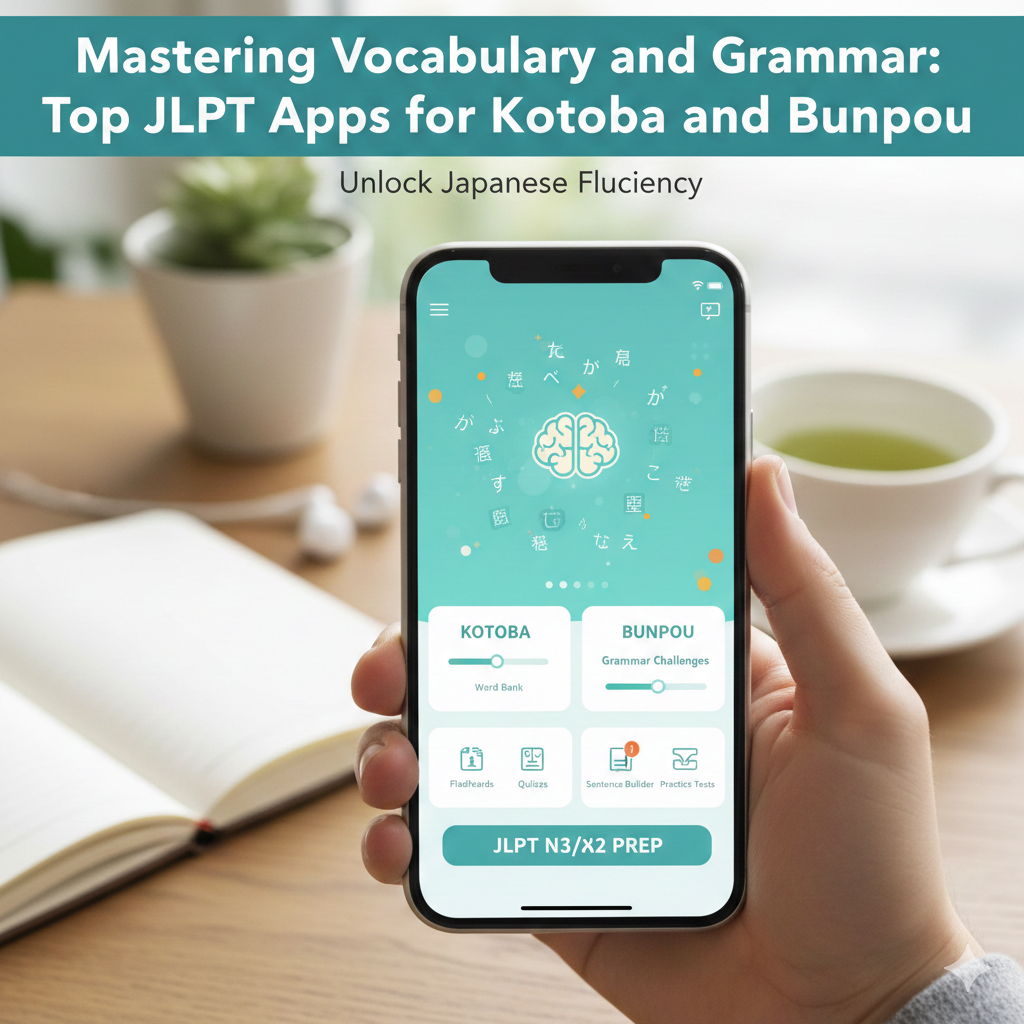
Textbooks are foundational, but let’s be honest: lugging around a heavy Minna no Nihongo or a dense grammar dictionary isn’t always practical. In our fast-paced, connected world, your smartphone is your most powerful study tool. This is where specialized JLPT apps come into play. They transform those dreaded 15 minutes waiting for a train or the 10 minutes before bed into high-impact, focused study sessions.
In this deep dive, we’re going beyond general language apps and focusing specifically on the titans of jlpt kotoba app and jlpt bunpou app categories. We’ll explore which tools genuinely help you not just memorize, but master the required language points, ensuring you walk into test day with confidence.
🔑 Key Pillars of JLPT Preparation: Kotoba and Bunpou
Before we dive into the apps, let’s briefly acknowledge the importance of the two key areas we’re addressing:
1. Kotoba (Vocabulary)
The JLPT requires a massive and ever-growing bank of words. It’s not enough to know the definition; you need to understand the nuances, the correct pitch accent, and the proper context. The best jlpt vocabulary app uses a Spaced Repetition System (SRS) to cycle words back to you just as you are about to forget them—the scientifically proven way to move words from short-term to long-term memory.
2. Bunpou (Grammar)
Grammar is the skeleton of the language. It gives context and meaning to your vocabulary. The challenge with JLPT grammar is two-fold: memorizing the form (how to conjugate or attach it) and understanding the meaning and usage (when and why to use it). A great jlpt bunpou app will provide clear explanations and, crucially, numerous, context-rich example sentences.
🏆 The Champions of JLPT Vocabulary: Top Kotoba Apps
When it comes to vocabulary, you need an app that is efficient, challenging, and relentlessly smart about your memory.
1. Anki: The Undisputed SRS King
If you ask any serious JLPT prep student, they will likely mention Anki. While not a dedicated, pre-packaged jlpt kotoba app, its power lies in its unparalleled customization and the raw efficiency of its Spaced Repetition System (SRS).
What Makes it a Top JLPT Vocabulary App?
- Customization is King: You can download pre-made, high-quality JLPT decks (often based on popular textbooks like Shin Kanzen Master or Sou-Matome) or, for the most potent learning, create your own decks based on the words you encounter in real Japanese content.
- The Best SRS Algorithm: Anki’s algorithm is the gold standard. It’s brutal but effective, ensuring you only review words you are about to forget. This saves you hundreds of hours of wasted review time.
- Integration with Kanji: Most popular decks integrate Kotoba (words) with Kanji readings, forcing you to link the vocabulary word to its kanji and its pronunciation, which is essential for the JLPT.
My Personal Insight:
I honestly believe Anki is indispensable for N3 and higher. However, the initial setup can be daunting. It’s not as “pretty” or gamified as other apps, but the payoff for sheer memorization is unmatched. Think of it as the ultimate learning machine—once you learn how to drive it, you’ll fly.
2. Memrise: Contextual, Real-World Kotoba
Memrise offers a different flavor of vocabulary learning. It’s often built around community-created courses, similar to Anki, but with a strong emphasis on user-submitted mnemonics and native-speaker videos.
Why It Works for JLPT Kotoba
- Video Clips: Seeing and hearing a native Japanese speaker pronounce a word or use it in a short, natural sentence is a huge advantage for retention. It gives the word context and life.
- Gamification: The app is inherently fun and keeps you coming back for daily review with its engaging interface. It’s a softer entry point for beginners.
3. Kotoba Master / JLPT Vocabulary by Minna Studio (Similar Apps)
Apps with titles explicitly mentioning “JLPT” and “Vocabulary” often serve as excellent, straightforward flashcard tools. Kotoba Master (on the App Store) and similar apps like “Japanese Vocabulary: N5-N1” (by Minna Studio) are often clean, dedicated, and follow the official JLPT lists closely.
Practical Application
These apps are fantastic for quick, low-friction study. You open the app, pick your level (N5, N4, N3, etc.), and start quizzing. They are usually great for:
- Targeted Level Prep: Ensuring you haven’t missed a core word from the official list for your specific level.
- Quick Quizzing: Most offer multiple-choice, fill-in-the-blank, or simple flashcard modes, which double as a great jlpt quiz app for quick review.
💡 Humanizing Tip: Don’t just memorize the word alone. Always look at the example sentence. A word without context is like a bicycle without wheels—it won’t take you anywhere! For example, when you learn kotoba $\text{間違える}$ (machigaeru – to make a mistake), you should also learn the pattern $\text{〜を間違える}$ (to make a mistake with/in X). This is the bridge to grammar!
🌉 The Foundation Builders: Top Bunpou (Grammar) Apps
Vocabulary will give you the pieces, but grammar gives you the structure. Here are the apps that excel at teaching, explaining, and drilling Bunpou.
1. Bunpro: The Gold Standard JLPT Grammar App
If there is one app that every serious JLPT test-taker needs for grammar, it is Bunpro. It is specifically designed from the ground up to address the complex nature of Japanese grammar, categorized entirely by JLPT level.
Why It’s the Ultimate JLPT Bunpou App
- Structure by JLPT Level: Every single grammar point—from the simple N5 $\text{〜は〜です}$ to the tricky N1 $\text{〜ざるを得ない}$—is listed and organized by its official JLPT level. This makes your study hyper-focused.
- Context and Examples Galore: The app provides a clear explanation for each grammar point and backs it up with multiple example sentences. Crucially, it provides links to external resources (like Tae Kim’s Guide, Japanese Test 4 You, and other great sites) for deeper understanding—a massive time saver!
- Intelligent Practice: It uses a fill-in-the-blank quiz format within full sentences. You are forced to recall the correct grammatical form and usage in context, which is exactly what the JLPT tests. It even features an intelligent SRS just for grammar.
My Personal Insight:
Bunpro is a game-changer because it moves beyond flashcards. It teaches you to produce the grammar point, not just recognize it. For the higher levels (N2 and N1), where grammar nuance is the whole ballgame, this contextual practice is invaluable.
2. LingoDeer: Structured Grammar for Beginners and Intermediates
LingoDeer is a beautifully structured, course-based app that feels like a full textbook condensed into a fun mobile experience. While it teaches both vocabulary and grammar, its structured lessons are particularly strong for understanding grammatical concepts.
Why It Works as a JLPT Bunpou App
- Clear Explanations: Before you start drilling, LingoDeer provides clear, concise explanations of the grammar point, often with handy comparison charts for similar grammar forms. This is essential for students who need that textbook-style introduction.
- Logical Progression: The course builds logically, ensuring you master foundational concepts before moving on to more complex ones. This is especially helpful for N5 and N4 students.
- Audio Support: Every sentence has high-quality native audio, training your ear to hear the grammar structure as it’s used naturally.
3. Bunpo: The Clean, Quiz-Focused Alternative
Another popular choice, the Bunpo app, offers a sleek, minimal interface focused on clarity. It features grammar notes and an extensive collection of quiz questions organized by JLPT level (N5 to N1).
Practical Application
Bunpo is great for learners who:
- Prefer a clean design: Its interface is easy on the eyes and avoids the visual clutter of some other apps.
- Want immediate quizzing: It’s a great jlpt quiz app for grammar, with thousands of questions to test your knowledge immediately after reading the explanation.
- Interlink with Vocabulary: You can often tap on Japanese words in the example sentences for an instant look-up, turning your grammar study into a vocabulary review session as well!
📚 Beyond Kotoba and Bunpou: The Comprehensive JLPT Suite
While Kotoba and Bunpou are critical, they only make up one section of the JLPT. The best apps often try to integrate all four skills.
Migii JLPT: The All-in-One Contender
If you’re looking for a single app to cover everything, Migii JLPT is often cited. It’s a powerful tool that combines your jlpt vocabulary app and jlpt bunpou app into a cohesive prep ecosystem, adding in listening and jlpt reading app practice.
- The Full Spectrum: It covers all four skills: Vocabulary, Grammar, Reading, and Listening, all categorized by N5 to N1.
- Mock Tests: Its core strength is the sheer number of mock tests and practice questions, simulating the real exam experience. This is crucial for developing timing and stamina.
- Adaptive Learning: Migii claims to use an algorithm to track your weaknesses, personalizing your study path.
(Want to know if the premium subscription is worth it? We dive deep in our full review:) In-Depth Review: Is the Migii JLPT App Worth Your Time and Money?
Todaii: JLPT Reading App Meets Current Events
Todaii is an innovative app that targets your weakest link: real-world application. It offers daily Japanese news articles, categorized by JLPT level.
- Reading in Context: This is the ultimate jlpt reading app. You are forced to encounter vocabulary and grammar in context—the most effective way to learn.
- Integrated Support: The articles come with Furigana (small kana over kanji) that you can toggle on or off, and clicking a word gives you an instant definition and translation. This is an incredible way to bridge the gap between textbook Japanese and natural Japanese.
🛠️ Unique Insights & Practical Application: The Pro Study Strategy
As an expert, I can tell you that simply downloading an app isn’t enough. You need a strategy. Here are my unique insights for maximizing your kotoba and bunpou app usage:
1. The Context-First Rule
Never, ever memorize a vocabulary word in isolation. Always memorize it within a complete, clear sentence.
- Bad Kotoba: $\text{困難 (konnan) – difficulty}$
- Good Kotoba: $\text{新しい文法を理解するのは困難だ。}$ (Atarashii bunpou o rikai suru no wa konnan da.) – It is difficult to understand the new grammar.
Why is this important? Because the JLPT tests your ability to use the word correctly in a sentence (usage), not just its definition. Apps like Bunpro and Todaii force you into this contextual learning.
2. The Grammar-First Focus for Higher Levels (N2/N1)
For N2 and N1, I advise a temporary shift in focus. You know a lot of vocabulary, but the grammar points become increasingly nuanced and similar. Your strategy should be:
- Isolate Similar Grammar Points: Use your jlpt bunpou app (like Bunpro) to group similar-sounding grammar points (e.g., $\text{〜につれて}$ vs. $\text{〜にしたがって}$ vs. $\text{〜とともに}$).
- Compare and Contrast: Instead of drilling them one by one, force yourself to compare their nuances. Why would a native speaker choose one over the other in a specific sentence? This is the core of N1 success.
3. The Cross-Platform Strategy
Don’t be afraid to use different apps for different needs:
- Anki (or your core JLPT Vocabulary app): For daily, relentless vocabulary/kanji review.
- Bunpro (or your core JLPT Grammar app): For structured, contextual grammar drilling.
- A JLPT Reading App (like Todaii): For applying your kotoba and bunpou in real-world Japanese content, which also serves as your jlpt reading app practice.
You can find the right balance for your devices in our dedicated guide: Android vs. iPhone: Finding the Best JLPT App for Your Device (PC Options Included)
➡️ Humanizing the Study Journey: It’s Okay to Struggle
When I was studying for the N2, there were days I felt like I was running into a wall. I would spend an hour on Anki, feel great, and then open a practice test only to realize I couldn’t remember a single nuance of the grammar I had just “mastered.” Sound familiar?
The truth is, learning a language—especially one as complex as Japanese—is a cycle of forgetting and remembering. The apps aren’t magic; they are just highly efficient tools to manage this cycle.
The most “human” thing you can do is be consistent, not perfect.
- Short, Daily Bursts: A quick 15-minute review of your vocabulary app in the morning is far more effective than a three-hour cram session once a week. Consistency beats intensity every single time.
- Celebrate the Small Wins: When you nail a tricky N3 grammar point like $\text{〜ばかりでなく}$ (not only… but also), give yourself a high-five. These small victories are what fuel the long journey.
If you’re unsure about where to even start, check out our guide on finding the perfect tool for your current study level: JLPT N5 to N1: The Best Study Apps for Every Japanese Proficiency Level
🔗 Recommended Resources & Outbound Links
To truly master kotoba and bunpou, you should always cross-reference your app-based learning with high-quality, free resources. Here are three I recommend that will help deepen your understanding of vocabulary and grammar nuances:
- Tae Kim’s Guide to Learning Japanese: This comprehensive, user-friendly guide provides some of the clearest explanations of Japanese grammar available online, often referenced by Bunpro and other apps. It’s a fantastic place to solidify the theoretical concepts behind the grammar points you’re drilling.
- Jisho Online Japanese Dictionary: This is not just a dictionary. When you look up a word (your kotoba), Jisho provides example sentences, links to kanji information, and often even has JLPT level classifications. Use this constantly to provide the context your flashcards might lack.
- Japanese Test 4 You: This website offers countless free, categorized grammar and vocabulary quizzes by JLPT level. It’s a perfect partner to your app-based study, giving you a chance to take an authentic-style jlpt quiz app outside of your core study tool.
📝 Conclusion: Your Path to JLPT Mastery
The journey to passing the JLPT is challenging, but with the right digital toolbox, it’s more manageable than ever before. For Kotoba, prioritize apps with a strong SRS and real-world context like Anki or Memrise. For Bunpou, focus on dedicated platforms like Bunpro or LingoDeer that offer clear explanations and contextual drilling.
Remember, apps are merely tools. You are the expert driving your own learning. Choose the tools that fit your style, be consistent, and keep pushing forward. With focused practice on your jlpt vocabulary app and jlpt bunpou app, you are already on the path to success!
What’s Next on Your Study Plan?
Now that you know which apps are best for Kotoba and Bunpou, are you curious about how to tackle the hardest section of the exam?
Would you like me to recommend the best apps specifically for high-level listening and reading comprehension?
JLPT Reading and Listening: The Best Apps for Comprehensive Practice
Interlinking Cluster Posts
- Read our complete breakdown of the top tools: The Ultimate Guide: 15 Best JLPT Apps to Pass Your Japanese Language Proficiency Test (Pillar Post)
- Need practice tests? Check out: JLPT Reading and Listening: The Best Apps for Comprehensive Practice
- Curious about the cost? We weigh the pros and cons in: Free vs. Paid: Are Free JLPT Apps Good Enough to Pass the Exam?
- Time to start planning: 2025 JLPT Application Guide: Deadlines, Fees, and How to Apply Online