If you have ever stepped into a high-rise office in Marunouchi or a manufacturing plant in Nagoya, you’ve likely witnessed a peculiar ritual: a visitor handing over a beautifully wrapped box with a deep bow, uttering a phrase that—to a literal translator—sounds like they are apologizing for the gift being “boring.”
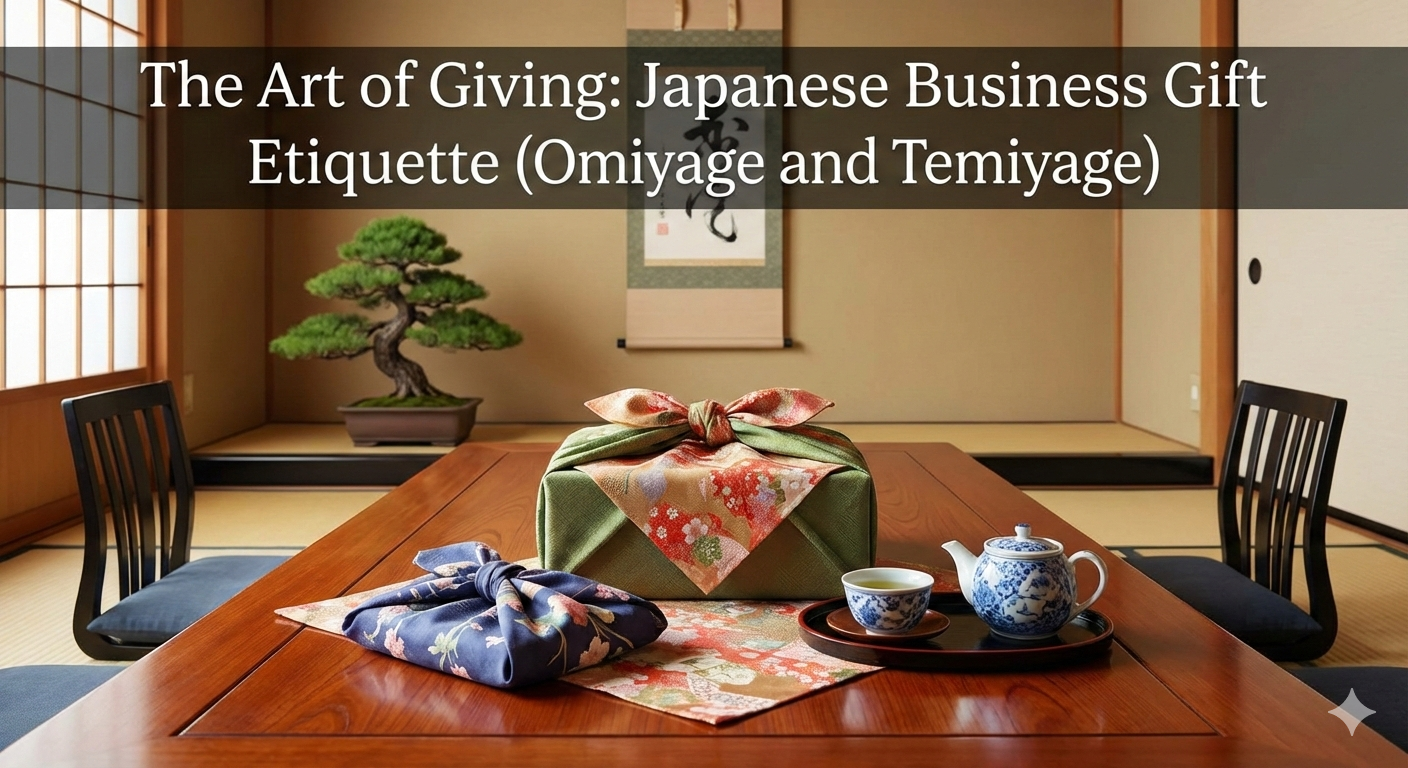
In the West, gift-giving is often an afterthought or a “nice to have.” In Japan, it is a sophisticated language of its own. As a long-time educator in Japanese linguistics and a JLPT (Japanese Language Proficiency Test) coach, I’ve seen many brilliant professionals stumble not because of their spreadsheets, but because they brought the wrong kind of crackers—or worse, presented them in the wrong way.
Understanding Japanese business etiquette gift giving is about more than just being polite; it’s about building Kizuna (bonds). In this guide, we will dive deep into the philosophy of Omiyage and Temiyage, the unspoken omiyage rules, and how to navigate Japanese business culture gifts like a local.
1. The Philosophy: Why Gifts Matter in Japanese Business Culture
Before we look at what to buy, we must understand why we buy. Japanese business culture is built on the concept of Giri (social obligation) and Enryo (restraint/modesty).
A gift isn’t just an object; it is a physical manifestation of your gratitude for the other person’s time and their “care” (Osewa). This is why the act of giving is often called Zoutou (贈答). For those of you studying for the JLPT N2 or N1, you’ll recognize these Kanji—they carry the weight of reciprocal social harmony.
The Two Pillars: Omiyage vs. Temiyage
Many foreigners use these terms interchangeably, but they serve different functions:
- Omiyage (お土産): This refers to “souvenirs.” You bring these when you return from a trip (either a business trip or a vacation). The key here is regionality. If you went to Hokkaido, your Omiyage should be something famous from Hokkaido (like Shiroi Koibito cookies).
- Temiyage (手土産): This is a “hand gift” brought when visiting someone’s office for a meeting, a thank-you gesture, or a first-time introduction. It is less about where you’ve been and more about the “now.”
To truly master the environment, you should also be familiar with Beyond the Bow: Formal Greetings and Body Language in Japanese Business, as the physical delivery of the gift is just as important as the gift itself.
2. The Golden Rules of Omiyage: More Than Just a Box of Cookies
When we talk about omiyage rules, we are talking about a set of social expectations that ensure no one feels “burdened” or “slighted.”
Rule 1: The “Individually Wrapped” Mandate
This is perhaps the most practical rule in Japanese business etiquette gift giving. Never bring a cake that needs to be sliced or a large bag of loose chips. Offices are busy. People want something they can put on their desk and eat later without needing a plate or a fork.
- Expert Tip: Ensure there are enough individual pieces for the entire department. If there are 20 people in the team, buy a box of 24.
Rule 2: Regionality is King
Japanese people have a deep appreciation for Meibutsu (famous local products). If you are visiting from the United States, bringing high-quality local chocolates from your specific city is better than a generic brand. In the context of Japanese business culture gifts, the effort you took to bring something “special” from your home reflects your commitment to the partnership.
Rule 3: Avoid the “Numbers of Death”
In Japanese culture, the number 4 (Shi) sounds like the word for death, and 9 (Ku) sounds like the word for suffering. Never give a set of four items. Stick to prime numbers or common sets like 5, 8, or 12.
3. The Ritual of Presentation: A Step-by-Step Guide
The “how” is often more important than the “what.” In the West, we might toss a gift bag on a desk and say, “Hey, hope you like it!” In Japan, that would be a significant faux pas.
The Timing
Do not give the gift at the very beginning of the meeting before everyone is settled. Usually, the gift is presented at the end of the meeting or once the formal introductions (Meishi exchanges) are completed. If you are unsure about the business card ritual, see our guide on .
The “Boring” Phrase (Kenson)
As a JLPT expert, I find this the most fascinating part of the language. When handing over a gift, the traditional phrase is:
“Tsumaranai mono desu ga…” (つまらないものですが…) Translation: “This is a boring/trifling thing, but…”
Why say this? It’s called Kenson (humility). You are implying that the recipient is so important that no gift could possibly be “good enough” for them. However, modern business etiquette is shifting slightly. A more contemporary and positive phrase is:
“Kokoro bakari no mono desu ga…” (心ばかりのものですが…) Translation: “This is just a small token of my heart/appreciation…”
The Two-Handed Delivery
Always present and receive gifts with both hands. This shows that the object has your full attention and respect. Ensure the “front” of the gift (the logo or the top of the wrapping) is facing the recipient so they can read it immediately.
4. Wrapping and Aesthetics: The “Noshi” Factor
In the world of Japanese business culture gifts, the wrapping is the first thing the recipient evaluates.
- Wrapping Paper: Never give a gift in its store plastic bag. It should be wrapped in high-quality paper. Most Japanese department stores (like Takashimaya or Isetan) excel at this.
- The Paper Bag (Te-sage bukuro): You carry the gift to the office in a clean paper bag. Before you present the gift, take it out of the bag, and then hand the gift over. You should then fold the bag and take it home with you (don’t leave your “trash” with the client), unless they specifically offer to dispose of it.
For formal occasions, you might see a Noshi—a special decorative paper strip. For standard business visits, a simple, elegant wrap is sufficient. However, if you are attending a formal celebration or a funeral (which are rare in initial business contexts but happen in long-term partnerships), the style of the ribbon (Mizuhiki) changes entirely.
For more on navigating formal settings, check out .
5. What to Buy: Practical Recommendations
If you are currently staring at a shelf wondering what fits Japanese business etiquette gift giving standards, here is a breakdown of “safe” vs. “risky” items.
If you are invited to a dinner after the gift exchange, make sure you’ve read to avoid any social slips over drinks.
6. The Seasonal Gifts: Ochugen and Oseibo
If your business relationship lasts longer than a year, you will encounter the “Big Two” of Japanese gifting:
- Ochugen (お中元): Given in mid-July. It’s a mid-year gift to thank people for their support in the first half of the year. Often involves refreshing items like jelly, beer, or cold noodles.
- Oseibo (お歳暮): Given in late December. This is the more important of the two, signifying a “closing” of the year’s obligations.
Following these omiyage rules seasonally shows your partners that you are not just a “visitor,” but a committed stakeholder in the Japanese market. To ensure you look the part during these seasonal visits, refer to .
7. Insights for the JLPT Student: The Language of Giving
As a Japanese language expert, I encourage students to look at the “Keigo” (honorific language) used in these exchanges. Gifting is the perfect playground for Sonkeigo (respectful language) and Kenjougo (humble language).
When you receive a gift, you should say:
“O-kizukai itadaki, arigatou gozaimasu.” (お気遣いいただき、ありがとうございます。) Meaning: “Thank you for your thoughtfulness/consideration.”
Notice the use of Kizukai (気遣い). This word is central to Japanese culture. It means “to use one’s spirit/energy to care for another.” This is the “Art of Giving” in a nutshell.
For those preparing for the N1 exam, understanding the cultural nuance behind the word Giri-choko (obligation chocolate) or Okaeshi (the return gift) is essential for the listening and reading sections that deal with social dynamics.
8. Common Mistakes to Avoid (The “Human” Side)
Even with all the rules, mistakes happen. I once saw a CEO bring a beautiful bottle of wine to a client, only to realize the client was a Buddhist monk who didn’t drink.
- Don’t Overspend: If the gift is too expensive, it creates “uncomfortable pressure” for the recipient to return the favor with something equally expensive. Keep it between 3,000 and 10,000 Yen.
- Don’t Give “Body” Gifts: Items like soap or neckties are often considered too personal unless you have a very close, multi-year relationship.
- The “Email” Follow-up: Always send a follow-up email after the meeting. If you need help with the phrasing, see .
Conclusion: It’s the Thought (and the Wrapping) That Counts
Mastering Japanese business etiquette gift giving might seem daunting, but it is ultimately an exercise in empathy. You are showing your Japanese counterparts that you respect their culture enough to learn its “silent” languages.
Whether it’s following the strict omiyage rules or understanding the deep-rooted history of Japanese business culture gifts, your efforts will be noticed. In Japan, business is personal. A box of cookies is never just a box of cookies—it’s a bridge.
For a comprehensive overview of how these gifting traditions fit into the broader professional landscape, please read our cornerstone article: .