Reaching the N3 level is, without a doubt, the most exhilarating and frustrating milestone in any Japanese learner’s journey. You’ve moved past the “survival” basics, and suddenly, you’re drowning in nuance, kanji compounds, and grammar that sounds suspiciously similar. You’ve hit the intermediate plateau, and you’re probably wondering, “How do I actually make these words stick?”
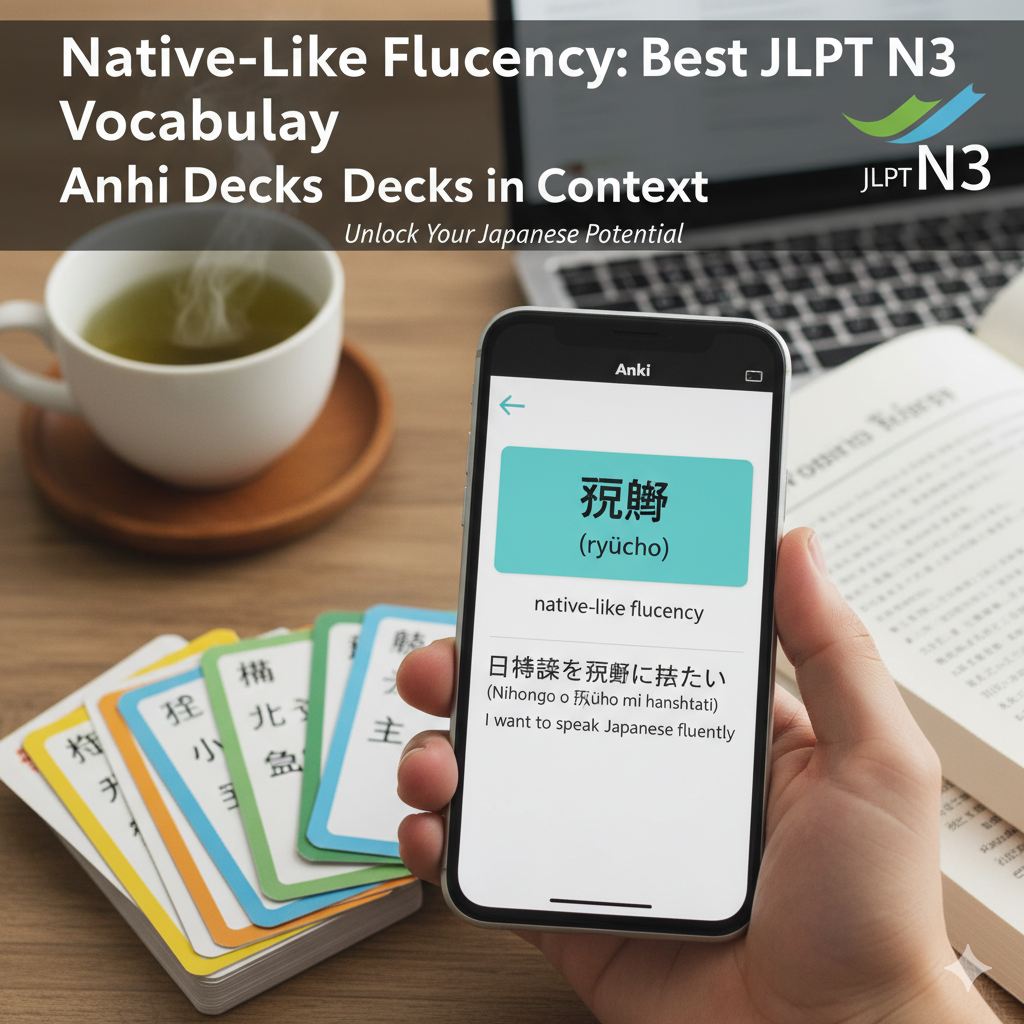
If you’re stuck, you aren’t alone. The secret isn’t just memorizing more words—it’s learning them in a way that mimics how your brain naturally acquires language. That means context, active recall, and the right tools.
This guide is dedicated to getting you past that wall. If you want a deep dive into the broader strategy, check out our pillar post: Breaking the Intermediate Plateau: The Ultimate N3 Anki Guide.
Why Isolated Vocabulary is Your Enemy
We’ve all been there: staring at a flashcard that says “Preparation = 準備 (Junbi).” You memorize it, you pass the card, and then three days later, you see it in a news article and… blank.
Why? Because your brain didn’t learn how to use it. It only learned the translation. To achieve native-like fluency, you need to understand collocations, verb transitivity, and the emotional weight of a word. This is why using Anki decks that feature vocabulary in context is not just recommended; it’s mandatory.
The Anatomy of a Perfect N3 Anki Card
Not all decks are created equal. Before you download the first deck you see on AnkiWeb, look for these three pillars of a high-quality card:
- The $i+1$ Principle: The sentence should contain only one word you don’t know (your target word) and everything else should be familiar. This prevents cognitive overload.
- Native Audio: You need to hear the rhythm, the pitch accent, and the natural flow of the sentence.
- Active Recall Fields: Don’t just look at a word and hope for the best. Good cards force you to recognize the word within a full sentence, often using cloze deletion to blank out the target term.
Top Recommended N3 Decks & Resources
While there are hundreds of decks, these types of resources consistently rank highest among successful learners:
- Tango N3 Deck: Based on the popular Tango series, these decks are specifically curated to pair vocabulary with example sentences that feel natural rather than textbook-stiff.
- Core 6k (N3 Subset): If you are already using a Core deck, filtering it for N3-level content is a classic, battle-tested approach. It offers high-frequency vocabulary that ensures you’re learning what’s actually useful.
- Custom Sentence Mining: The ultimate deck is the one you build yourself. When you read a book or watch a show and encounter an N3 word, turn that specific sentence into a card. Your emotional connection to the source material will make it infinitely easier to remember.
For more on mastering the building blocks, see our companion posts:
- [Grammar] Expressive Japanese: Mastery of JLPT N3 Grammar Points with Anki
- [Kanji] 600+ Kanji Challenge: Best Intermediate Anki Decks for N3 Kanji
Practical Application: How to Use These Decks Effectively
Having a great deck isn’t the same as having a great study habit. Here is how to actually integrate these into your daily life:
1. The 10-Minute Rule
Don’t try to learn 50 new words a day. It leads to burnout, and you won’t retain them. Start with 10–15 new cards daily. Consistency is the magic ingredient in Spaced Repetition.
2. Speak it Out Loud
Every single time you see a card, say the sentence out loud. If you can’t say it smoothly, you haven’t truly “learned” it. This bridges the gap between passive reading knowledge and active conversational fluency.
3. Contextualize, Don’t Just Translate
When you look at the back of the card, don’t just read the English translation. Look at the kanji, notice the grammar structure around it, and try to think of a situation where you would actually use that phrase in your own life.
Moving Beyond the Flashcards
Anki is your foundation, not your entire language experience. You need to see these words “in the wild.”
- Read NHK News Web Easy: It’s free, it’s updated daily, and it’s perfectly paced for N3 learners. Read a few articles and see if your Anki words start jumping off the page at you.
- Shadowing: Take the audio from your best Anki cards and mimic it. Match the speed, the intonation, and the emotion.
Final Thoughts: Consistency Over Intensity
The leap from N4 to N3 is significant, but it is entirely manageable if you stop treating Japanese as a list of words to be conquered and start treating it as a language to be lived. Stick to your daily reviews, prioritize context, and don’t be afraid to customize your deck until it feels like it belongs to you.
You’ve got this. The plateau is just a temporary state—the view from the top of the N3 mountain is well worth the climb.