Let’s be honest: moving from N4 to N3 feels like hitting a brick wall. You’ve mastered the basics, you can navigate a convenience store, and then suddenly—BAM—the JLPT expects you to internalize over 600 kanji. It’s no longer about simple pictures like “mountain” or “river.” Now, we’re dealing with abstract concepts, complex radicals, and readings that seem to change every time you blink.
If you are feeling overwhelmed, you are in good company. This is the “Intermediate Plateau.” But here is the secret: the difference between those who pass the N3 and those who get stuck is systematic immersion.
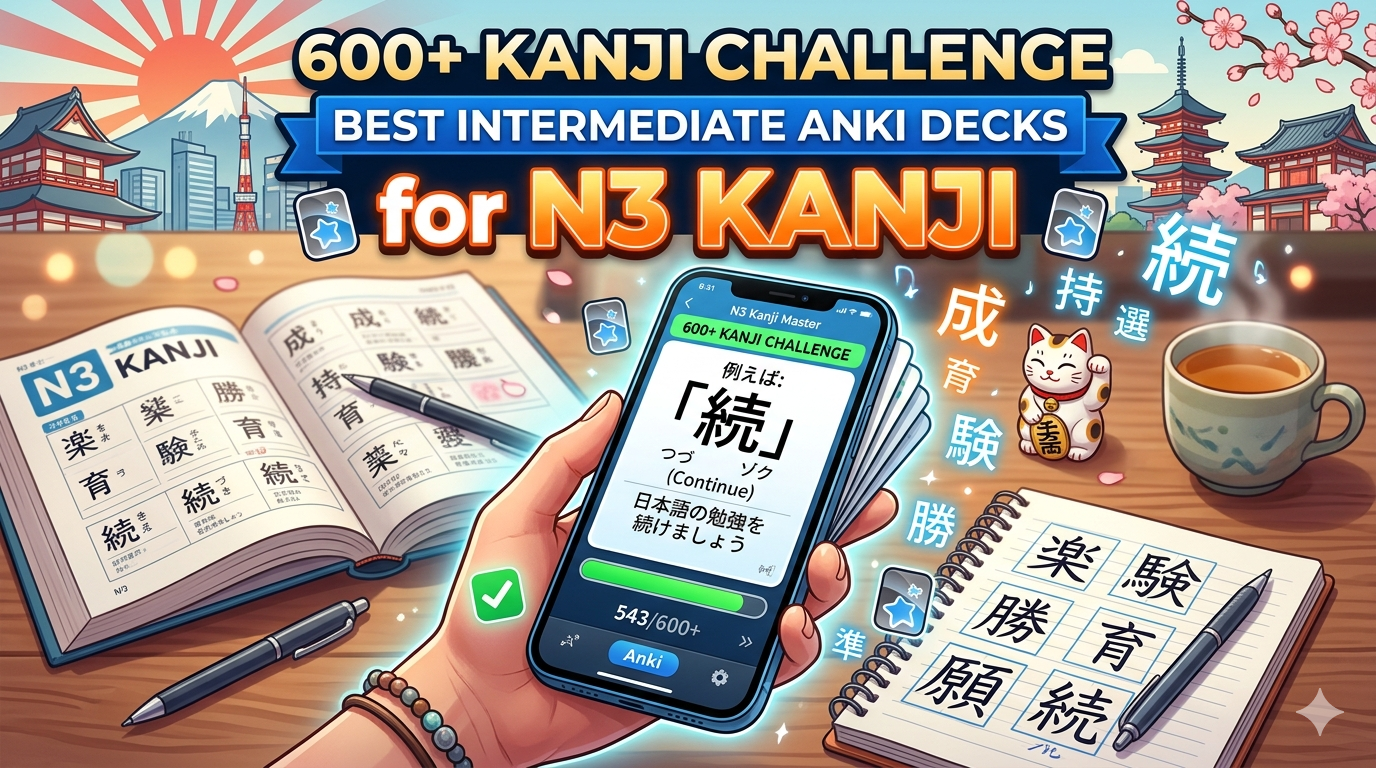
In this guide, we aren’t just looking at “any” flashcards. We are tackling the 600+ Kanji Challenge using high-efficiency Anki decks specifically designed for the intermediate learner.
Why the N3 Kanji Jump Feels So Different
At the N5 and N4 levels, you learn approximately 300 kanji. For N3, that number doubles. You are expected to know around 650 kanji in total.
But it’s not just the quantity; it’s the quality of the knowledge.
- Compound Words (Jukugo): You’ll start seeing kanji appear in four-character compounds (Yojijukugo) or complex business terms.
- Nuance: You’ll encounter different kanji that have similar meanings but different usages, like kaeru (to change/replace/exchange) which can be written as 変える, 代える, or 換える.
- Visual Similarity: Kanji like 練 (practice) and 運 (transport) or 練 and 線 (line) start looking dangerously similar when you’re tired.
This is where Anki becomes your best friend—or your worst enemy if you use the wrong deck.
Top Recommended Anki Decks for the 600+ Kanji Challenge
When choosing a deck for N3, you want something that provides context. Rote memorization of a single kanji character is a recipe for failure. You need sentences.
1. The Core 2k/6k Optimized Japanese Vocabulary
While technically a vocab deck, the Core 6k is the “Gold Standard” for intermediate learners.
- Why it works: It introduces kanji through high-frequency sentences. You learn the N3 kanji by seeing how they actually function in the wild.
- Unique Insight: Don’t just look at the kanji. Listen to the audio. N3 requires you to recognize kanji by sound during the listening section as well.
2. JLPT N3 Kanji (With Stroke Order & Examples)
There are several community-made decks specifically labeled “JLPT N3 Kanji.” Look for ones that include Stroke Order Diagrams.
- The Practical Application: Even if you aren’t writing by hand, understanding stroke order helps your brain “map” the kanji visually, making it easier to distinguish between similar-looking radicals.
3. Kanji Garden (Anki Integration)
While Kanji Garden is a separate app, many users export their “leech” (difficult) kanji into Anki.
- Pro Tip: If you find yourself failing the same kanji 10 times, move it to a “Death Row” deck in Anki and study it with a custom mnemonic.
The “600 Kanji Challenge” Strategy: How to Study
Simply downloading a deck isn’t enough. You need a protocol. Here is how I recommend tackling the 600+ Kanji load:
Phase 1: The Recognition Phase (The First 200)
Focus on the 300 kanji you already know from N4. Yes, review them. You’d be surprised how many “easy” kanji slip through the cracks when you start adding N3 complexity. Ensure your Breaking the Intermediate Plateau: The Ultimate N3 Anki Guide settings are dialed in for a high retention rate (aim for 80-90%).
Phase 2: The Radical Breakdown
N3 kanji are often combinations of N4 and N5 kanji.
- Example: 願 (Request/Wish) contains 原 (Original/Meadow) and 頁 (Page). If you know the components, the “Challenge” becomes a game of Lego rather than a mountain of memorization.
Phase 3: The Jukugo Sprint
Stop learning On-yomi and Kun-yomi in isolation. It is a waste of time. Instead, learn the most common words associated with the kanji.
- Instead of learning that 政 is SEI, learn 政治 (Seiji – Politics) and 政府 (Seifu – Government).
Practical Application: Beyond the Flashcard
If you only look at Anki, you will develop “Anki Brain”—where you recognize a word in the app but are totally lost when you see it in a book. To avoid this, you must engage in Active Reading.
- NHK News Web Easy: This is perfect for N3 learners. It uses N3-level kanji but provides furigana. As you get better, try to hide the furigana.
- Manga for N3: Look for “Seinen” manga or more complex “Shonen” like Death Note or Fullmetal Alchemist. The vocabulary is surprisingly close to N3/N2 levels.
For more resources on how to structure your overall N3 journey, check out the comprehensive lists at JLPT Study or browse the official JLPT Homepage for test patterns.
Humanizing Your Progress: It’s Okay to Be Slow
There is a trend in the language community to “Speedrun” the JLPT. You see videos titled “How I learned 2,000 Kanji in 3 months.”
Ignore them.
Language learning is not a race; it’s an acquisition of a new perspective. If you can only manage 5 new kanji a day, that is fine. In four months, you’ll have covered the 600+ challenge. Consistency beats intensity every single time.
If you feel burnt out, decrease your “New Cards” to zero and just do your reviews. The most important thing is that you don’t break the chain.
Essential Keywords for Your Journey
- JLPT N3 Kanji List: The official set of 650 characters.
- SRS (Spaced Repetition System): The logic behind Anki.
- Jukugo: Kanji compounds—the secret to N3 vocabulary.
- Furigana: The small kana over kanji—your training wheels.
Summary & Next Steps
Mastering the 600+ Kanji Challenge is the single biggest hurdle to becoming a fluent Japanese speaker. By using the right Anki decks and focusing on context rather than rote memorization, you turn a daunting task into a manageable daily habit.
Quick Checklist:
- Download a high-quality N3 deck with sentences.
- Set your “New Cards” to a sustainable number (5-10).
- Interlink your study with reading—don’t just stay in Anki.