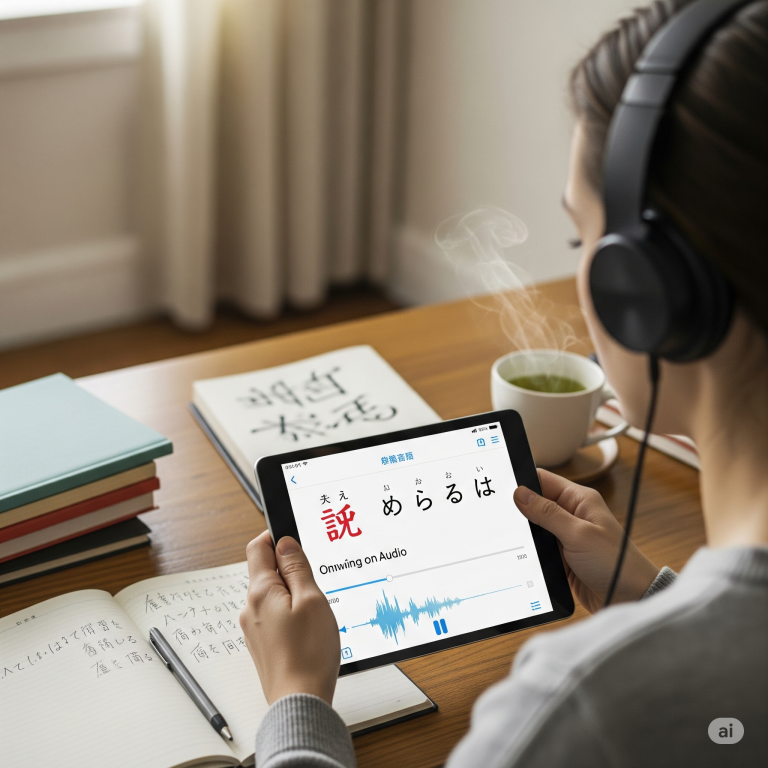
Passing the JLPT N2 isn’t just about adding a certificate to your resume; it’s the moment you stop “studying” Japanese and start “living” it. At the N2 level, the language shifts from classroom phrases to the complex, nuanced expressions used in Japanese boardrooms, news broadcasts, and daily professional life.
However, the leap from N3 to N2 is notorious. You aren’t just learning more words; you are learning how to distinguish between five different ways to say “although” or “because,” each with a specific level of formality. To manage this mountain of information without burning out, you need more than just a textbook—you need a high-performance Spaced Repetition System (SRS) strategy.
The N2 Challenge: Why Traditional Rote Memorization Fails
The N2 syllabus covers approximately 1,000 kanji and 6,000 vocabulary words. If you try to memorize these using traditional “write-it-until-you-remember” methods, you’ll likely hit a plateau.
The human brain is wired to forget. Ebbinghaus’s Forgetting Curve shows that we lose roughly 70% of new information within 24 hours unless it is reinforced. This is where SRS tools like Anki or Bunpro become your best friends. They track your individual memory strength for every single grammar point and kanji, showing you the material exactly when you are about to forget it.
Building Your Advanced SRS Architecture
To master N2 for a professional environment, your SRS shouldn’t just be a list of words. It needs to be a dynamic ecosystem.
1. The Power of Sentence Mining
At the N2 level, context is king. Instead of making a card that says “把握 (Haoku) = Grasp/Understand,” you should mine a sentence from a business news article:
- Front: 弊社の現在の状況を正確に把握する必要があります。
- Back: 把握 (はあく): To grasp or have a thorough understanding of a situation. (Professional context).
By learning through sentences, you naturally absorb the collocations (which words go together) and the “feel” of professional Japanese.
2. Optimizing Kanji Retention
You cannot skip the kanji. By N2, many characters look remarkably similar. Your SRS should focus on “Production” (writing/recalling) and “Recognition” in compounds. For a deep dive into the specific decks that work best, check out our guide on The 1000 Kanji Milestone: High-Efficiency N2 Kanji Anki Decks.
Mastering N2 Grammar: Beyond the Meaning
The biggest hurdle in N2 grammar isn’t understanding the definition—it’s understanding the nuance. For example, both ~ものなら and ~ようものなら deal with conditionals, but they are used in very different emotional contexts.
How to SRS Grammar Patterns
Don’t just flip a card and say “I know what this means.” Use the “Cloze Deletion” method in Anki.
- Prompt: 彼は、一度決めたら最後までやりぬかずには( )。
- Answer: おかない (Won’t stop until/Must do).
This forces your brain to produce the grammar rather than just passively recognizing it. If you’re looking for a structured way to set this up, see our breakdown on Formal Nuance: How to Memorize N2 Grammar Patterns using Anki.
Practical Application: The “Professional” Edge
If your goal is to work in a Japanese company or handle Japanese clients, your vocabulary needs to be sharp. N2 is where you learn “Keigo” (honorifics) transitions and “Hard” vocabulary found in editorial pieces.
Integrating SRS with Real-World Media
To make your SRS truly “Advanced,” you should supplement your decks with content from NHK News Web Easy (for transition) and eventually the standard NHK News for full N2/N1 immersion. When you see a word on the news that you just reviewed in your Anki deck, that “click” moment creates a permanent neural pathway.
The Specialized Vocabulary Deck
Standard JLPT decks are great, but they lack the industry-specific terminology you might need in fields like IT, Finance, or Manufacturing. We recommend creating a “Sub-Deck” specifically for your professional niche. You can find inspiration and pre-made lists in our article on Advanced Lexicon: Top JLPT N2 Vocabulary Decks for Work & Life.
Pro-Tips for Long-Term SRS Success
- Never Miss a Day: SRS relies on algorithms. Skipping three days creates a “backlog” that is the #1 cause of learner burnout. Even if you only do 5 minutes, keep the streak alive.
- Delete Ruthlessly: If a card is “leeching” (you’ve missed it 10+ times), delete it or rewrite it. It’s better to learn 10 new useful words than to struggle with one obscure kanji that won’t stick.
- Use High-Quality Audio: Always include native audio on your cards. Professional Japanese is about pitch accent and rhythm as much as it is about vocabulary.
Conclusion
Mastering the JLPT N2 is a marathon, not a sprint. By using an Advanced SRS strategy, you turn a chaotic sea of information into a manageable, daily habit. This transition from N3 to N2 is where you truly become a Japanese-speaking professional.
For more official resources on test dates and registration, be sure to visit the official JLPT (Japanese-Language Proficiency Test) website.