
Introduction
If you’re learning Japanese, you’ve probably heard of the Japanese Language Proficiency Test (JLPT). The JLPT N4 is the second-lowest level, designed for beginners who have a basic grasp of the language. But how does it compare to international standards like the Common European Framework of Reference for Languages (CEFR)?
Understanding where JLPT N4 fits in the CEFR scale (A1, A2, B1, etc.) can help you gauge your skills for study abroad, work, or personal goals. In this post, we’ll explore:
- What JLPT N4 tests
- How it aligns with CEFR levels
- Practical applications for learners
- Tips to bridge the gap between N4 and higher levels
Let’s dive in!
What is the JLPT N4?
The JLPT N4 is an intermediate-beginner exam that tests:
✅ Vocabulary (~1,500 words)
✅ Kanji (~300 characters)
✅ Grammar (basic sentence structures)
✅ Listening (everyday conversations)
✅ Reading (short passages on daily topics)
Passing N4 means you can:
- Understand simple written materials (e.g., signs, emails).
- Follow slow, clear conversations about familiar topics.
- Introduce yourself, ask for directions, and handle basic transactions.
But how does this translate to CEFR?
Understanding CEFR Levels
The CEFR (Common European Framework of Reference for Languages) is a global standard used to measure language ability. It has six levels:
| CEFR Level | Description |
|---|---|
| A1 | Beginner (basic phrases) |
| A2 | Elementary (simple conversations) |
| B1 | Intermediate (daily discussions) |
| B2 | Upper Intermediate (fluent conversations) |
| C1 | Advanced (professional use) |
| C2 | Mastery (near-native) |
So, where does JLPT N4 fit?
JLPT N4 vs. CEFR: The Official Comparison
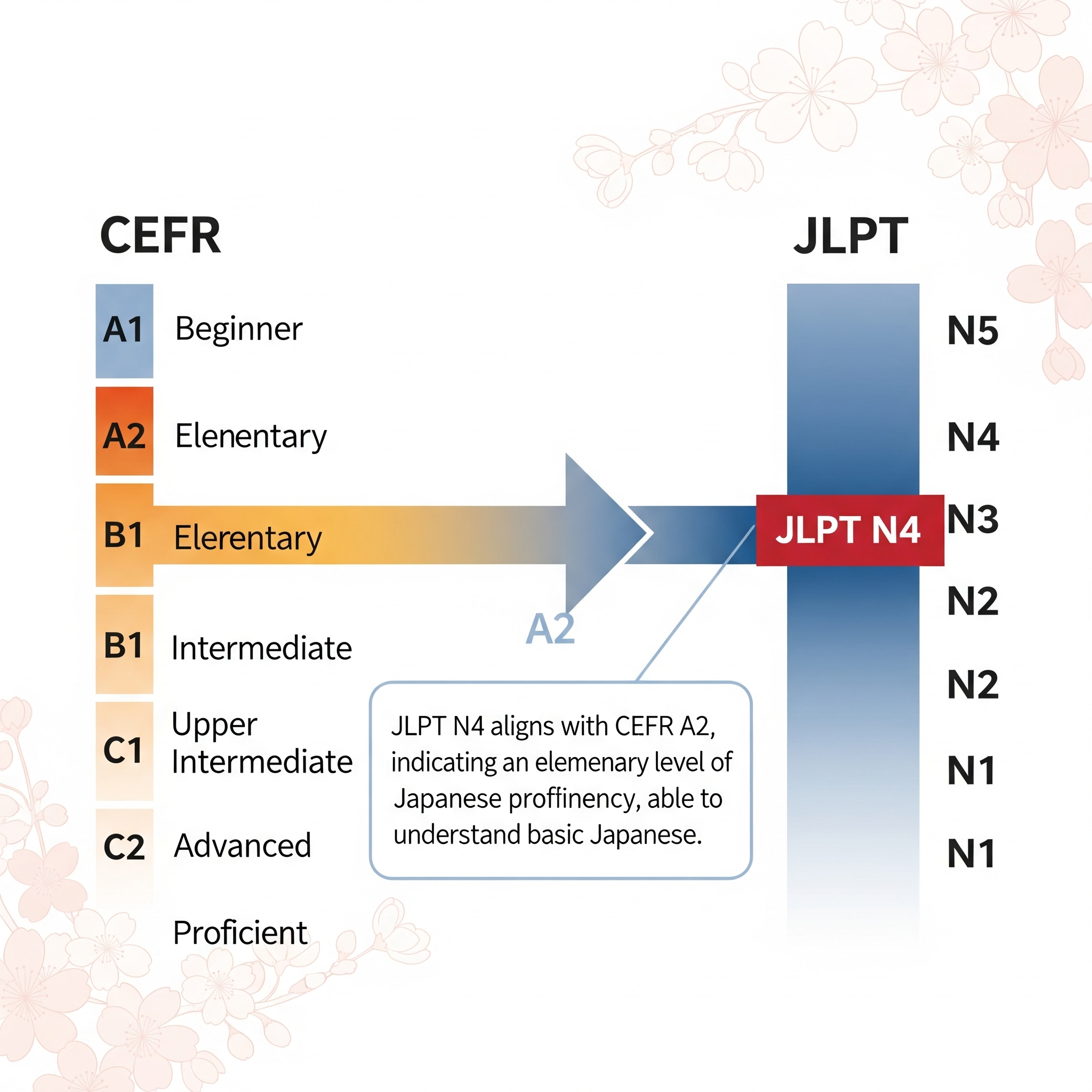
The Japan Foundation, which administers the JLPT, provides a rough CEFR comparison:
| JLPT Level | Approx. CEFR Level |
|---|---|
| N5 | A1 |
| N4 | A2 |
| N3 | A2/B1 (transitional) |
| N2 | B2 |
| N1 | C1/C2 |
Key Insight:
- N4 is considered A2—meaning you can handle routine tasks but lack fluency.
- N3 bridges A2 and B1, where you start understanding more complex sentences.
However, some argue JLPT N4 is closer to A1+ because:
- It focuses on memorization rather than spontaneous speaking.
- CEFR A2 expects slightly more conversational ability than JLPT N4 tests.
Practical Implications: What Can You Do with N4?
1. Study Abroad & Work Opportunities
- Some Japanese language schools accept N4 for beginner courses.
- Working Holiday Visa programs may require at least N5/N4.
- However, most jobs require N2 or higher.
2. Self-Assessment & Goal Setting
If you’ve passed N4:
✔ You’re at a basic conversational level (A2).
✔ Next goal: Aim for N3 (B1) to improve fluency.
3. Gaps in JLPT vs. Real-World Skills
- JLPT N4 doesn’t test speaking or writing—CEFR does.
- To truly reach A2, practice speaking (e.g., language exchange, apps like HelloTalk).
How to Move from N4 (A2) to N3 (B1)?
If you want to progress beyond N4, here’s what to focus on:
1. Expand Vocabulary & Kanji
- N4: ~1,500 words → N3: ~3,750 words
- Use apps like Anki or WaniKani for kanji.
2. Improve Listening & Speaking
- Watch Japanese dramas (with subtitles).
- Try shadowing exercises (repeat after native speakers).
3. Master Grammar for Complex Sentences
- Study conditional forms (~たら, ~ば) and indirect speech (~と言う).
- Recommended book: “Tobira: Gateway to Advanced Japanese”.
4. Take Mock Tests & Track Progress
- Use JLPT practice books or online tests like JPDrills.
Final Thoughts: Is JLPT N4 Enough?
JLPT N4 (CEFR A2) is a solid foundation, but not yet “fluent.” If you want to:
- Work in Japan → Aim for N2 (B2).
- Study at a Japanese university → N1 (C1/C2) may be required.
Pro Tip: Combine JLPT prep with real-world practice (speaking, writing) to match CEFR expectations fully.
FAQs
1. Can I get a job in Japan with JLPT N4?
Most jobs require N2 or higher, but some manual labor or hospitality roles may accept N4.
2. How long does it take to pass JLPT N4?
Typically 6-12 months of consistent study (depending on prior knowledge).
3. Does JLPT N4 expire?
No, JLPT certificates do not expire, but some institutions may prefer recent results.
Conclusion
The JLPT N4 aligns roughly with CEFR A2, marking you as a basic independent user of Japanese. While it’s a great milestone, advancing to N3 (B1) and beyond will open more doors.
Need help preparing for JLPT? Check out our JLPT Study Guide for expert tips!
What’s your JLPT goal? Share in the comments!
Further Reading:
- JLPT N5 vs. N4: Which Should You Take First?
- How to Improve Japanese Listening Skills for JLPT
- Official JLPT Website


