
Konnichiwa, fellow Japanese language learners!
So, you’ve conquered the JLPT N5. You can introduce yourself, ask for directions, and order a coffee like a pro. That’s an incredible achievement! But now, you’re looking at the next step: the JLPT N4. This is where things get truly exciting. The N4 is the crucial bridge between basic survival Japanese and actually starting to live in the language.
As a sensei who has guided many students through this journey, I can tell you that the single biggest factor in crossing this bridge is vocabulary. It’s not just about memorizing more words; it’s about unlocking a new layer of conversation, understanding manga and anime without subtitles, and reading simple stories.
In this guide, we’re going to dive deep into the essential vocabulary for the JLPT N4. I won’t just throw a massive list at you (though I will give you a structured one!). We’ll explore how to learn it effectively, how to use it practically, and I’ll share some insider insights that most textbooks forget to mention. Let’s get started!
Please check out How Many Words Do You Need for JLPT N4? Vocabulary Breakdown
What Makes JLPT N4 Vocabulary Special?
The jump from N5 to N4 is significant. While the N5 focuses on concrete, everyday objects and simple phrases, the N4 introduces you to more abstract concepts, connecting words, and common compound verbs. You’re moving from “This is a pen” to “I think I left my pen because I was in a hurry so that I wouldn’t be late for my part-time job.”
The N4 syllabus expects you to know approximately 1,500 words (around 300 new kanji). But don’t let that number scare you. Many of these words are built upon the foundation you already have.
Key Categories of N4 Words:
- Abstract Nouns: Words like 理由 (riyuu – reason), 可能性 (kanousei – possibility), and 自由 (jiyuu – freedom).
- Connectors (Conjunctions): This is huge! Words like だから (da kara – so/therefore), しかし (shikashi – however), and それに (sore ni – besides) are what make your sentences flow naturally.
- Compound Verbs: Japanese loves combining verbs. You’ll learn things like やり直す (yarinaosu – to redo) and 引き出し (hikidashi – to withdraw [money], but literally “to pull out”).
- Common Adverbs: These add color and nuance, like ぜひ (zehi – by all means), かなり (kanari – fairly/considerably), and もっと (motto – more).
For in depth please visit JLPT N4 Vocabulary Master List: Essential Words You Must Know
The Essential JLPT N4 Word List: A Curated Starter Pack
While a full list would be pages long (and you can download a comprehensive one here), here’s a powerful sample of must-know words organized by function. Seeing them in context is key, so I’ve included examples for each.
1. Powerful Verbs (動詞 – Doushi)
- 運転する (unten suru) – to drive
- Example: 父は車を運転します。(Chichi wa kuruma o unten shimasu.) – My father drives a car.
- 手伝う (tetsudau) – to help, to assist
- Example: 母の仕事を手伝います。(Haha no shigoto o tetsudaimasu.) – I help with my mother’s work.
- 探す (sagasu) – to search for, to look for
- Example: 新しいアパートを探しています。(Atarashii apaato o sagashite imasu.) – I am looking for a new apartment.
- なる (naru) – to become
- Example: 医者になりたいです。(Isha ni naritai desu.) – I want to become a doctor.
2. Key Nouns (名詞 – Meishi)
- 理由 (riyuu) – reason
- Example: 遅れた理由を教えてください。(Okureta riyuu o oshiete kudasai.) – Please tell me the reason you were late.
- 可能性 (kanousei) – possibility
- Example: 明日は雪が降る可能性があります。(Ashita wa yuki ga furu kanousei ga arimasu.) – There is a possibility it will snow tomorrow.
- 社会 (shakai) – society
- Example: 社会の問題について話し合いました。(Shakai no mondai ni tsuite hanashiaimashita.) – We talked about society’s problems.
3. Crucial Adjectives (形容詞 – Keiyoushi / 形容動詞 – Keiyoudoushi)
- 得意 (tokui – na adjective) – skilled, good at
- Example: 私は数学が得意です。(Watashi wa suugaku ga tokui desu.) – I am good at math.
- 苦手 (nigate – na adjective) – poor at, dislike
- Example: 弟は野菜が苦手です。(Otouto wa yasai ga nigate desu.) – My younger brother is not good with vegetables (dislikes them).
- ずるい (zurui – i adjective) – sly, cunning
- Example: それはずるい!(Sore wa zurui!) – That’s unfair/sly!
4. Connecting Words (接続詞 – Setsuzokushi)
- だから – so, therefore
- しかし – however
- それに – besides, moreover
- 例えば (tatoeba) – for example
Insight from a Sensei: Don’t just memorize these connectors; feel their difference.
だからis a casual, logical “so.”しかしis a formal “however,” often used in writing. Mastering these will make your Japanese sound incredibly natural.
For a deeper dive into making your sentences flow, check out our guide on JLPT N4 Important Vocabulary & Must-Know Words for Success
How to Actually Learn and Retain N4 Vocabulary
A list is useless if it just sits on your phone. Here’s how to make these words stick.
1. Ditch the Rote Memorization: Our brains aren’t designed to remember isolated words. Instead, learn words in chunks or sentences.
- Bad: 理由 (riyuu) = reason.
- Good: 理由がない (riyuu ga nai) = There is no reason.
2. Embrace Spaced Repetition Systems (SRS): Tools like Anki or Memrise are game-changers. They use a smart algorithm to show you words just as you’re about to forget them. I recommend creating your own deck with example sentences.
3. Get Listening: The N4 listening section can be tricky. Incorporate listening practice into your study routine. NHK Web Easy offers news articles in simple Japanese with audio, which is perfect for N4 learners.
4. Read, Read, Read: Seek out graded readers or manga aimed at children. Series like よつばと! (Yotsuba&!) are fantastic because they use everyday language and have furigana for all kanji. Every time you spot a word you’re learning “in the wild,” it reinforces it far more powerfully than any flashcard.
If you’re looking for reading resources, we’ve curated a list of [The Best Manga for Japanese Learners at Every Level].
For more details, please visit 1500 Essential Vocabulary for JLPT N4 PDF: Free Download & Study Guide
Practical Application: Using N4 Vocab in Real Life
The goal isn’t to pass a test; it’s to communicate. Here’s how to practice:
- Shadowing: Find a short audio clip (a podcast dialogue, an anime scene). Listen and try to repeat exactly what they say, mimicking their intonation and speed. This builds muscle memory for words and phrases.
- Think in Japanese: When you’re walking down the street, try to describe what you see in your head using the words you know. “あの店はよく混んでいるね。” (Ano mise wa yoko konde iru ne.) – “That store is often crowded.”
- Find a Language Partner: Websites like HelloTalk connect you with native speakers. Try to use your new connectors like
それに(besides) or例えば(for example) in a real conversation.
Beyond the List: Unique Insights for N4 Success
- Watch for “Paired Words”: Japanese often uses words in pairs. For example, you’ll frequently see 理由 (reason) paired with 原因 (gen’in – cause). Learning these together helps.
- Synonyms are Your Friend… and Foe: Words like たくさん (takusan – many) and 多い (ooi – many) seem similar but are used differently (多い is an adjective, たくさん is a noun/adverb). Pay attention to these subtle differences.
- The Power of する Verbs: Many N4 nouns can become verbs by adding
する(suru – to do). 勉強 (benkyou – study) becomes 勉強する (to study). 運転 (unten – driving) becomes 運転する (to drive). This pattern is a massive vocabulary multiplier!
Preparing for the test format is just as important as knowing the material. To understand the structure of the exam, read our breakdown of Essential Vocabulary for the JLPT N4: Complete Word List.
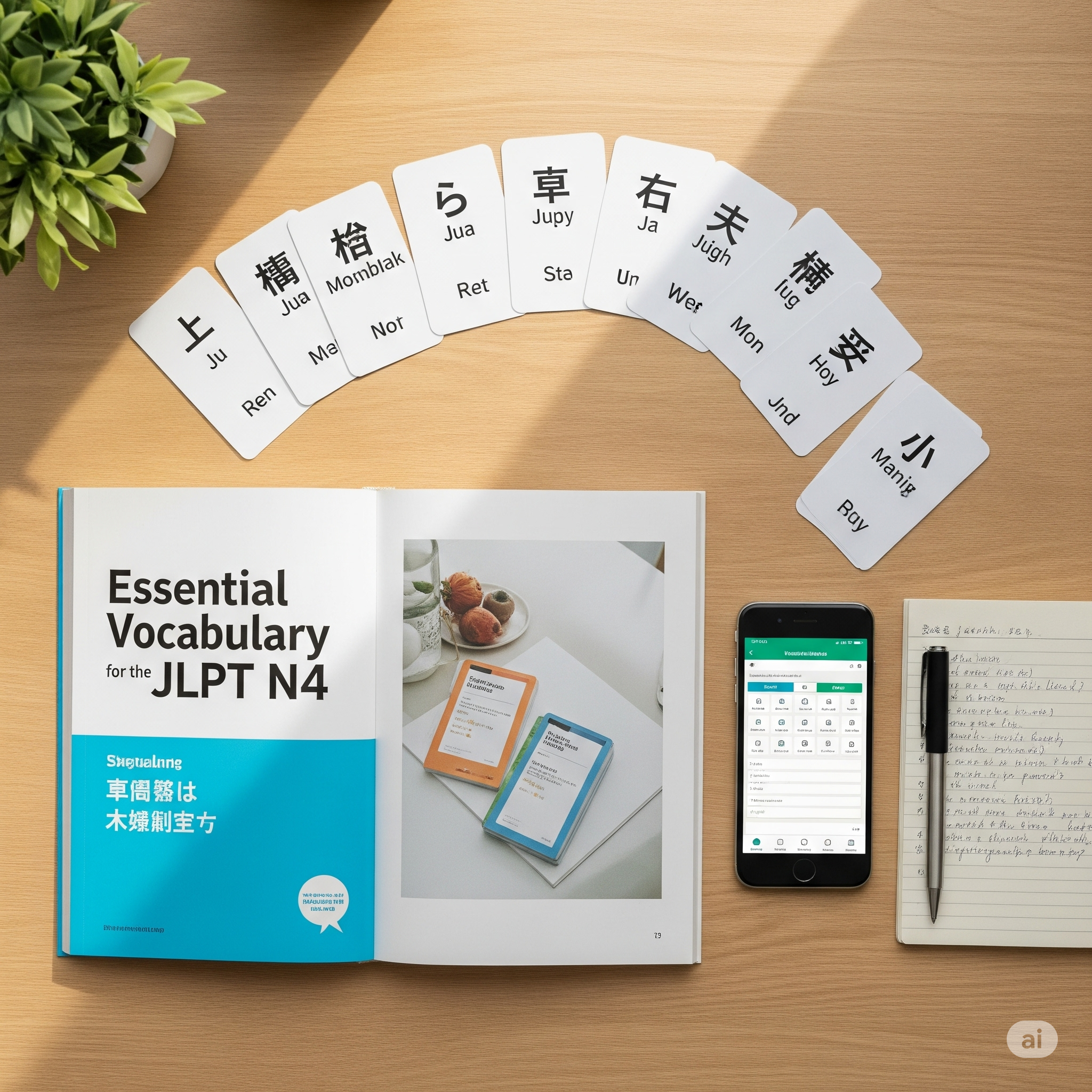
Your Journey Across the Bridge
The path to JLPT N4 is challenging but immensely rewarding. Every new word you learn is a new tool that allows you to express a more complex thought, understand a deeper joke, and connect with Japanese culture on a more meaningful level.
Use the word list as your map, but use the strategies here as your vehicle. Download your list, fire up Anki, find a manga you love, and start building those sentences.
For more in dept JLPT N4 Vocabulary Mastery: 800 Words You Need to Know
頑張ってください!(Ganbatte kudasai!) Do your best! I believe in you.
And I’d love to hear from you! What’s the most interesting Japanese word you’ve learned recently? Share it in the comments below!
For more resources, please visit Download JLPT N4 Vocabulary List PDF: Study On the Go


