
Konnichiwa, future JLPT test-taker!
So, you’ve decided to take the plunge and aim for the JLPT N5, the first exciting step on your Japanese language journey. First off, congratulations! It’s a fantastic goal that will open doors to understanding anime, traveling in Japan, or simply connecting with a beautiful culture on a deeper level.
But now, the big question looms: How many words do I actually need to know to pass the JLPT N5?
You’ve probably scoured the internet and found numbers ranging from 500 to 800. It can be confusing, right? As a sensei who has guided hundreds of students through this exam, I’m here to cut through the noise. We won’t just talk about a number; we’ll explore what those words are, how to learn them effectively, and how they function in the real world of the test.
Let’s get started.
The Official Answer: How Many Words for JLPT N5?
Let’s address the headline figure first. The Japan Foundation, the body that administers the JLPT, does not publish an official, exact vocabulary list. However, through years of analysis of past papers and curriculum standards, the widely accepted and most accurate figure is:
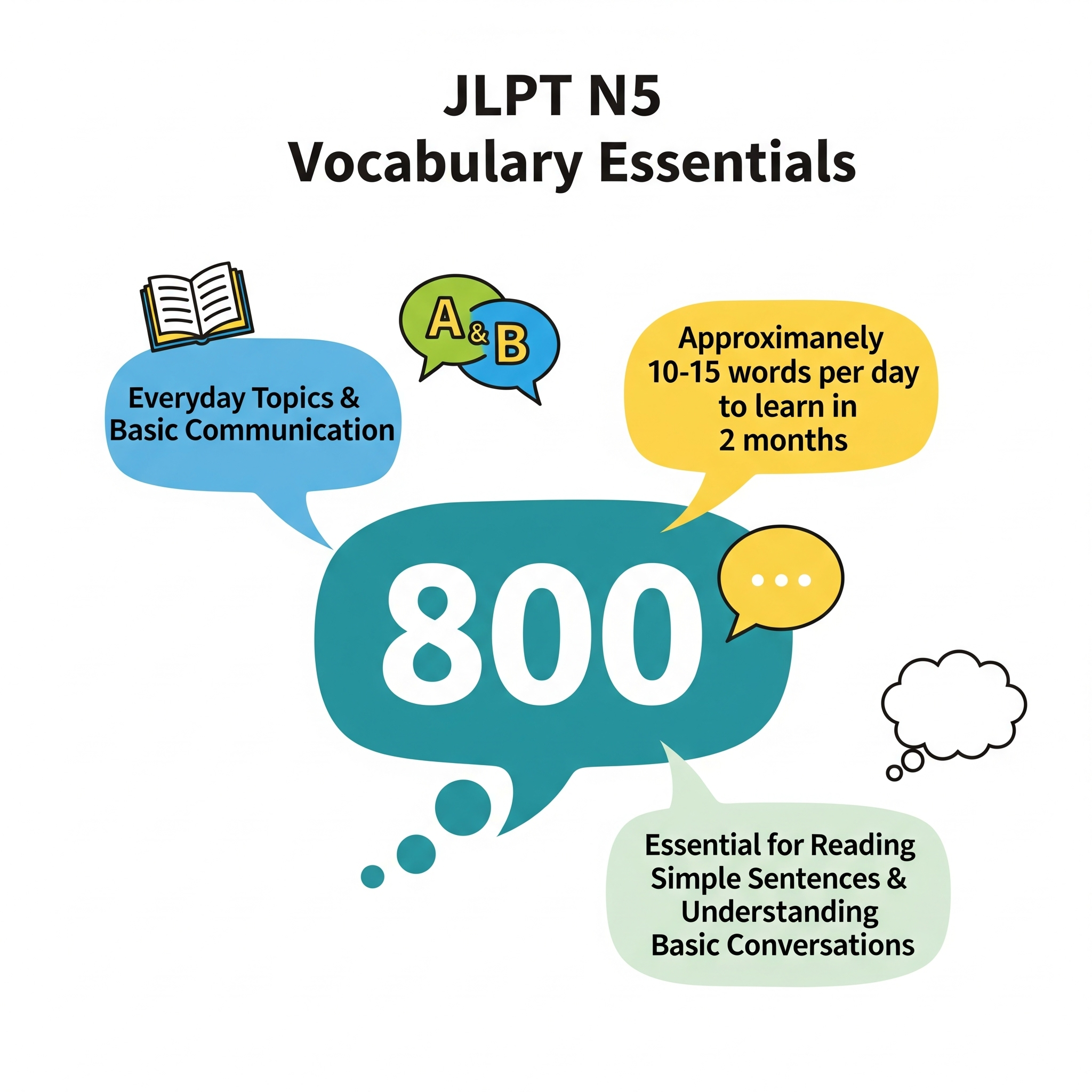
Approximately 700-800 words.
Now, before you panic or breathe a sigh of relief, hear me out. This number isn’t just a random collection of words. It’s a carefully curated set that forms the absolute foundation of the language. Think of it not as a mountain to climb, but as a toolkit you’re about to assemble. Each word is a useful tool that will help you build basic sentences, ask for directions, or order a delicious bowl of ramen.
This vocabulary list is built around roughly 100 kanji characters (which often represent multiple words themselves) and essential grammar patterns. For a deeper dive into what those kanji are, check out our guide on JLPT N5 Kanji: Your First 100 Characters.
Beyond the Number: What Kinds of Words Are on the JLPT N5?
Knowing the number is one thing; understanding the nature of these words is what will truly help you prepare. The N5 vocabulary isn’t about complex idioms or business jargon. It’s made up of high-frequency, everyday words that you would use from your very first day in Japan.
Here’s a breakdown of the categories you’ll need to master:
- Everyday Nouns: The names of people, places, and things. This includes:
- People: わたし (I), あなた (you), せんせい (teacher), いしゃ (doctor)
- Places: ここ (here), きっさてん (cafe), がっこう (school)
- Things: ほん (book), てがみ (letter), みず (water), とけい (clock/watch)
- Essential Verbs: The action words that make sentences work. These are primarily learned in their dictionary (masu-stem) form.
- Ex: します (to do), いきます (to go), たべます (to eat), のみます (to drink), みます (to see), よみます (to read)
- Key Adjectives: Words to describe things. Japanese has two types: い-adjectives (like おおきい – big) and な-adjectives (like しずか – quiet). You’ll need to know the conjugation rules for both.
- Adverbs and Expressions: Words that modify verbs and add nuance.
- Time: きのう (yesterday), まいにち (every day)
- Frequency: いつも (always), よく (often)
- Manners: ゆっくり (slowly), はやく (quickly)
- Counters: This is a unique aspect of Japanese. You’ll need to know a few basic counters like ~人 (for people), ~つ (for generic objects), and ~さい (for age).
- Greetings and Set Phrases: The glue of social interaction. おはようございます (Good morning), ありがとうございます (Thank you), すみません (Excuse me/I’m sorry).
For a complete list sorted by category, the JLPT Official Website (outbound link to jlpt.jp) provides a summary of linguistic competencies, which is a great starting point.
A Unique Insight: It’s Not About the Word Count, It’s About “Word Families”
Here’s a piece of advice you might not read elsewhere: focus on word families, not just individual words.
Many students get fixated on hitting that magic “800 words” mark using a flashcard app. But the JLPT doesn’t just test your ability to recall a single meaning. It tests your ability to recognize and use words in different contexts.
Let me give you an example. You learn the word ききます (to listen). Great! But did you also learn:
- 聞いてください (Please listen)
- 聞きました (I listened)
- 聞きません (I don’t listen / won’t listen)
Each of these is a different form of the same “word family.” Understanding how the core word changes based on grammar is far more valuable than memorizing 10 isolated nouns. When you study a new verb, immediately practice conjugating it into its negative, past, and polite forms. This multiplies the utility of every word you learn.
Your Practical Plan to Conquering N5 Vocabulary
Okay, so how do you actually learn and retain these 800 words? Drowning in flashcards is a fast track to burnout. Here’s a human, sustainable strategy:
1. Use a Curated List (But Don’t Be Its Slave)
Start with a trusted N5 vocabulary list. The Tanos UK JLPT Resources (outbound link) is a community-driven classic. Use it as a checklist, not a bible. It’s a map, but you decide the route.
2. Context is King: Learn in Sentences
Never, ever learn words in isolation. Always learn them within a simple sentence. Instead of just memorizing “たべます (to eat),” learn “わたしはりんごをたべます (I eat an apple).” This teaches you grammar particles (は, を) and makes the memory stronger. This approach is central to the Most Effective Way to Learn Japanese Grammar.
3. Leverage SRS (Spaced Repetition Systems)
Apps like Anki or Memrise are powerful because they use algorithms to show you words just as you’re about to forget them. This is scientifically proven to boost long-term memory. Spend 15-20 minutes a day on this.
4. Get Listening
Words on a page are silent. Words in your ears are alive. Listen to beginner podcasts like Japanese Pod 101 (outbound link) or the audio from your textbook. Your goal is to recognize the words when spoken by a native speaker at natural speed—a key skill for the listening section of the JLPT.
5. Embrace the Kanji Early
Yes, you only need about 100 kanji for N5. Learning the kanji for a word isn’t an extra burden; it’s a superpower. The character often gives you a clue to the meaning, helping you distinguish between homophones (words that sound the same). For instance, はし can be 橋 (bridge) or 箸 (chopsticks). The kanji makes it instantly clear.
How Vocabulary is Tested on the JLPT N5 Exam
Understanding the test format will show you why our “word family” approach is so crucial. Vocabulary is primarily tested in two sections:
- 言語知識 (文字・語彙) – Language Knowledge (Characters & Vocabulary): This section explicitly tests your word knowledge. You’ll be asked to:
- Choose the correct reading for a kanji word.
- Choose the correct kanji for a hiragana word.
- Choose the right word to complete a sentence based on context.
- 読解 (Reading) & 聴解 (Listening): This is the implicit test. You can’t understand a simple reading passage or a listening dialogue if you don’t know the keywords. Here, recognition and speed are key.
You Can Do This!
The journey to 800 words might seem long, but broken down into just 10 new words a day, you’ll get there in less than three months. And remember, many of these words will be ones you pick up naturally through your studies.
The JLPT N5 is an achievable and rewarding goal. It’s not about perfection; it’s about building a solid foundation. Focus on understanding how words work together, immerse yourself in the language through listening, and most importantly, enjoy the process of unlocking a new way of seeing the world.
If you’re feeling overwhelmed by where to start with your studies, our Step-by-Step JLPT N5 Study Guide for Busy Learners can help you create a manageable and effective plan.
頑張ってください!(Ganbatte kudasai! – Do your best!)
Your Japanese sensei,


