
Konnichiwa, future JLPT N4 champions!
If you’re here, you’ve likely conquered the basics of hiragana and katakana and are now staring down the next great challenge in your Japanese learning journey: kanji. And the big question on everyone’s mind is: “Just how many of these intricate characters do I need to memorize for the JLPT N4?”
It’s a daunting thought. You might have images of spending months with flashcard apps, your hand cramping from writing the same character over and over. But what if I told you that mastering N4 kanji is not only completely achievable but can also be genuinely enjoyable?
As someone who has both taken and prepared students for the JLPT levels, I’m here to cut through the noise. Today, we’re not just going to give you a number. We’re going to explore what that number means, how the test actually uses these kanji, and—most importantly—I’m going to give you a realistic, step-by-step study plan to get you there without the burnout.
Let’s jump right in.
So, How Many Kanji Are on the JLPT N4?
The official answer, according to the Japan Foundation and past test patterns, is approximately 200 kanji.
Now, before you panic or breathe a sigh of relief, let’s put that number into context.
The JLPT N5 covers about 100 kanji. So, N4 effectively doubles that. But wait! There’s a crucial insight many beginners miss: You are not starting from zero. The N4 test assumes you know all the N5 kanji. So, your total active “kanji vocabulary” for the N4 will be around 300 characters (100 from N5 + 200 new for N4).
But here’s the most important thing I tell all my students: Don’t get fixated on the number. The JLPT doesn’t publish an official definitive list. Instead of thinking “I need to memorize 200 characters,” shift your mindset to: “I need to learn to read and understand around 200 common kanji as they appear in everyday words.”
The goal is recognition and comprehension, not necessarily flawless calligraphy.
What Does “Knowing” a Kanji for N4 Really Mean?
For the JLPT N4, “knowing” a kanji involves several layers:
- Reading (Yomikata): You’ll need to know both the onyomi (Chinese-derived reading) and kunyomi (Japanese reading). The test will often ask you to choose the correct reading for a kanji within a specific word. For example, knowing that 人 can be “jin” (as in 日本人 –
nihonjin) or “hito” (as in 人 –hito). - Meaning (Imi): You should understand the core meaning(s) of the character. 食 means “eat” or “food.” 駅 means “station.”
- Vocabulary (Goi): This is the biggest key to success. Kanji are rarely used alone. The test will assess your knowledge of compound words (jukugo). For the kanji 食, you need to know words like:
- 食堂 (
shokudou) – cafeteria - 食事 (
shokuji) – meal - 食べ物 (
tabemono) – food (using its okurigana form)
- 食堂 (
Focusing on vocabulary, rather than isolated kanji, is the secret weapon of efficient study. You kill two birds with one stone: learning the kanji and the vocab you’ll be tested on.
Beyond the Number: How Kanji Are Tested on the JLPT N4
Understanding the format helps you study smarter. Kanji knowledge is primarily tested in the Vocabulary (Goi) and Grammar (Bunpou) sections of the exam.
- Language Knowledge (Vocabulary): This section may have questions where you need to choose the correct kanji for a word written in hiragana, or vice-versa. For example: Choose the kanji for
がっこう. The answer would be 学校. - Language Knowledge (Grammar & Reading): Here, your kanji knowledge is essential for reading the sentences and short passages. You won’t be directly tested on writing a kanji, but you must be able to read and comprehend them quickly to answer questions about the passage.
You won’t be asked to write kanji from memory on the JLPT N4. The test is multiple-choice, so your focus should be overwhelmingly on recognition.
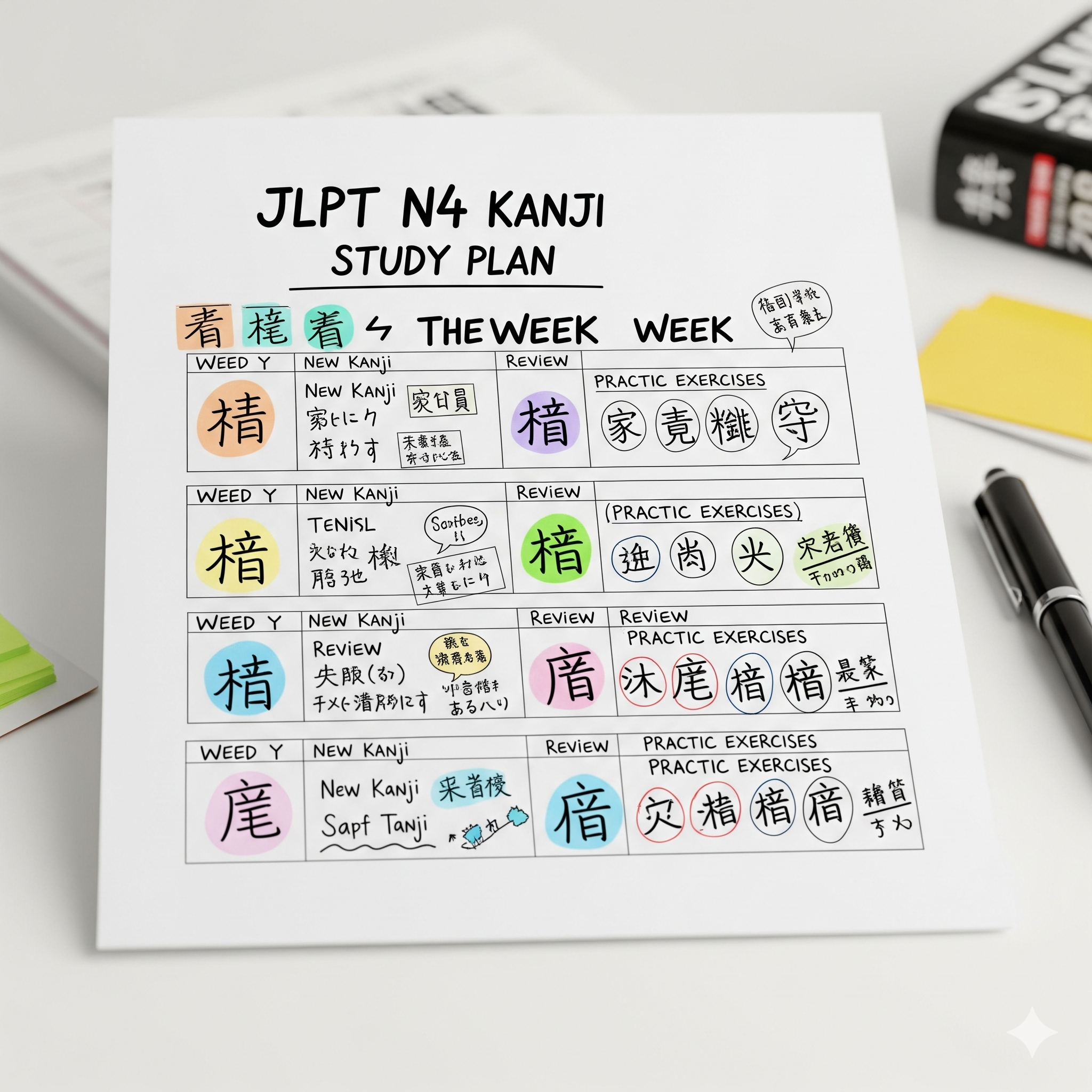
Your 8-Week Practical Study Plan to Conquer N4 Kanji
Trying to cram 200 kanji right before the test is a recipe for failure and frustration. The key is consistent, manageable practice. Let’s break this down into a sustainable plan.
Total Kanji: ~200
Timeline: 8 weeks
Weekly Goal: ~25 kanji
Daily Goal: ~4-5 kanji
This is completely doable! Here’s how to structure your weeks.
Essential Study Tools & Resources
- Anki or Quizlet: For digital flashcards. Spaced repetition is your best friend. You can find pre-made N4 kanji decks, but I recommend creating your own for better retention.
- A Good Notebook: For writing practice and noting down vocabulary.
- Resources:
- Jisho.org: The best online dictionary. Use it to look up kanji, see example words, and check stroke order.
- Tofugu’s Learn Kanji Guide (Outbound Link): A fantastic resource for understanding how to learn kanji effectively.
- “Kanji Look and Learn” ( textbook): A brilliant book that groups kanji by theme and provides memorable illustrations.
The Weekly Study Routine
Day 1-5 (Weekdays): Learn & Engage
- Learn 5 New Kanji: Don’t just memorize the character. For each one:
- Look it up on Jisho.org. Observe the stroke order and animate it. Write it 5-10 times while saying its meanings and readings out loud.
- Find 2-3 common vocabulary words that use this kanji. Write them down. For example, for 電 (electric), learn 電気 (
denki– electricity/light), 電車 (densha– train). - Create Anki cards for both the individual kanji and the vocabulary words.
- Review: Spend 15-20 minutes reviewing your old Anki cards. This is non-negotiable! The spaced repetition system will ensure you don’t forget what you’ve learned.
Day 6 (Weekend 1): Review & Apply
- Do a comprehensive review of the 25 kanji you learned this week. Use your flashcards.
- Read something! This is the most crucial step. Find a simple Japanese text—like a NHK News Web Easy article (Outbound Link) or a children’s story—and try to spot your newly learned kanji in the wild. This cements the knowledge like nothing else.
Day 7 (Weekend 2): Rest!
- Seriously. Take a day off. Let your brain process the information. Watch an anime, listen to a Japanese podcast, or cook some Japanese food. Passive exposure is still learning.
Internal Blog Links:
For more on building good habits, check out our post on “How to Create a Sustainable Japanese Study Routine.” And if you’re still shaky on the foundations, our “N5 Kanji Quick Review Guide” is the perfect place to start.
Pro Tips & Unique Insights from a Language Coach
- Group by Radical: Kanji are made of smaller parts called radicals. Learn the radicals! For instance, once you know that 氵 is the “water” radical, it becomes easier to learn and guess the meaning of kanji like 池 (pond), 海 (ocean), and 泳 (swim). This turns a random list into a logical system.
- Embrace the Stories: Our brains remember narratives better than abstract shapes. Use the stories from “Heisig’s Remembering the Kanji” or create your own silly mnemonics. For 休 (rest), it’s a 人 (person) leaning against a 木 (tree). Easy to remember!
- Context is King: You will forget readings if you try to memorize them in isolation. Always, always learn kanji within the context of a word. Remembering that 先生 is
sensei(teacher) is easier than trying to memorize that 先 can be “sen” and 生 can be “sei” among a dozen other readings. - Prioritize the “Jukugo” (Compound Words): The JLPT N4 heavily features 2-kanji compounds. Spend more time drilling words like 勉強 (
benkyou– study), 電話 (denwa– phone), and 旅行 (ryokou– travel) than on single-kanji words.
Internal Blog Links:
Dive deeper into this strategy with our article on “Using Radicals to Hack Your Kanji Learning.”
Recommended Resources & Final Words of Encouragement
You don’t have to do this alone. Here are my top resource recommendations:
- Books: “Kanji Look and Learn” (as mentioned) and the “So-Matome N4” series are excellent for structured learning.
- Websites: WaniKani (Outbound Link) is a paid but incredibly effective SRS-based system that teaches kanji and vocabulary through mnemonics.
- Practice Tests: Before the exam, absolutely get an “JLPT N4 Practice Test”. This is the best way to simulate the test environment and identify your weak spots.
Mastering the ~200 kanji for the JLPT N4 is a significant milestone. It’s the point where written Japanese truly starts to open up to you. You’ll begin to read signs, menus, and simple stories, and that feeling is incredibly rewarding.
Remember, consistency over cramming. Understanding over memorization. You’ve got this!
頑張ってください!(Ganbatte kudasai! – Do your best!)
What’s the one kanji you always struggle to remember? Share your experiences and questions in the comments below—let’s learn from each other!


