Konnichiwa, future Japanese speaker!
So, you’ve decided to take the plunge and aim for the JLPT N5. That’s fantastic! As your guide on this journey, let me be the first to say: welcome to one of the most rewarding challenges you’ll ever undertake. I remember the mix of excitement and overwhelm I felt staring at my first Japanese textbook. The characters looked like beautiful, intricate art—but how was I supposed to read them?
The answer, and the absolute, non-negotiable first step for every single successful learner, is Hiragana mastery.
Forget fancy grammar or complex kanji for a moment. If you want to build a house that lasts, you pour a solid foundation. For Japanese, that foundation is Hiragana. It’s the heartbeat of the language, especially at the N5 level. In this guide, we’re going to go beyond just a simple chart. We’ll dive into why it’s so crucial, how to learn it effectively (and enjoyably!), and how it directly connects to your JLPT N5 success.
Why Hiragana is Your JLPT N5 Superpower
Let’s get one thing straight: you cannot pass the JLPT N5 without being intimately familiar with Hiragana. It’s not an exaggeration. The entire exam, from the instructions to the answer choices, is written in it.
Think of Hiragana as the alphabet of Japanese. But it’s more than that. It’s used for:
- Native Japanese words where no Kanji is used (e.g., です – desu – “is”)
- Grammatical particles (e.g., は – wa, を – *o*) that are the glue of every sentence.
- Okurigana, the endings of verbs and adjectives written after the Kanji (e.g., the く in 白い – shiroi – “white”).
- Furigana, the small Hiragana written above Kanji to show its reading, which is a lifesaver on the JLPT.
Mastering Hiragana isn’t just about memorizing shapes; it’s about unlocking your ability to read, pronounce, and understand the core structure of the language. When you look at a page of Japanese and can effortlessly sound out the Hiragana, a massive cognitive load is lifted. You can then focus your brainpower on understanding the meaning, which is what the JLPT is all about.
The 46 Core Characters: Your New Best Friends
The basic Hiragana chart consists of 46 primary characters, representing all the fundamental sounds in Japanese. It’s organized logically in a grid of 5 vowels (a, i, u, e, o) and 9 consonants (k, s, t, n, h, m, y, r, w).
Here’s a clean, simple chart for reference. Pro Tip: Don’t just stare at it. Copy it by hand. Say each character out loud as you write it.
| a | i | u | e | o | |
|---|---|---|---|---|---|
| – | あ (a) | い (i) | う (u) | え (e) | お (o) |
| k- | か (ka) | き (ki) | く (ku) | け (ke) | こ (ko) |
| s- | さ (sa) | し (shi) | す (su) | せ (se) | そ (so) |
| t- | た (ta) | ち (chi) | つ (tsu) | て (te) | と (to) |
| n- | な (na) | に (ni) | ぬ (nu) | ね (ne) | の (no) |
| h- | は (ha) | ひ (hi) | ふ (fu) | へ (he) | ほ (ho) |
| m- | ま (ma) | み (mi) | む (mu) | め (me) | も (mo) |
| y- | や (ya) | ゆ (yu) | よ (yo) | ||
| r- | ら (ra) | り (ri) | る (ru) | れ (re) | ろ (ro) |
| w- | わ (wa) | を (o) | |||
| n | ん (n) |
But wait! There’s more. You’ll also need to know:
- Dakuon (だくおん): The voiced consonants (e.g., か
kabecomes がga). - Handakuon (はんだくおん): The half-voiced consonants (e.g., は
habecomes ぱpa). - Yōon (ようおん): The contracted sounds (e.g., き
ki+ やya= きゃkya).
Don’t let these terms scare you. In practice, they are simple modifications that are easy to pick up once you know the main set.
How to Actually Learn Hiragana (And Have Fun Doing It)
Anyone can memorize 46 characters. The trick is to move them from your short-term memory to your long-term memory. Here’s the strategy I used and have taught to hundreds of students.
1. The “Write, Don’t Type” Method
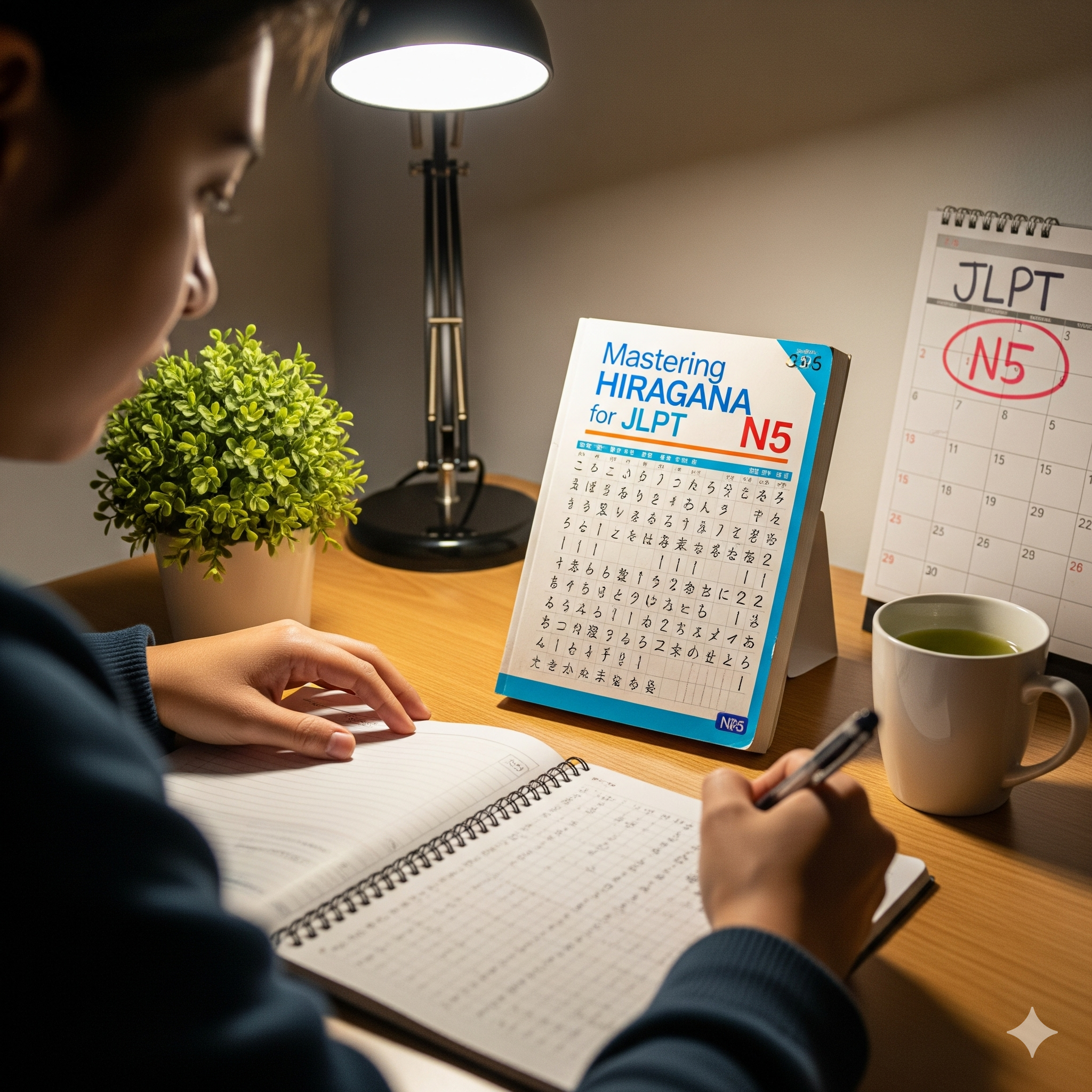
There is no substitute for putting pen to paper. The physical act of writing engages your brain in a way typing never will. Buy a grid notebook (genkō yōshi) and practice. Focus on the stroke order—it’s designed to make writing characters flow naturally. Tofugu’s Learn Hiragana Guide is a legendary, free resource that uses mnemonics and has practice sheets. It’s a brilliant place to start.
2. Embrace the Mnemonic
Our brains love stories. Associate the shape of the character with something it looks like.
- く (ku) looks like a cooking bird’s beak. “Coo” sounds like “ku”.
- へ (he) looks like a hedge on a hill.
- け (ke) looks like the key on a keychain.
Create your own! The sillier and more personal, the better you’ll remember it.
3. Use Spaced Repetition Systems (SRS)
Apps like Anki or Memrise are powerful tools. They use a algorithm to show you characters you’re about to forget, cementing them in your memory. You can find pre-made Hiragana decks or make your own.
4. Start Reading Immediately
This is the most important step. The moment you know a handful of characters, start reading. Find resources for absolute beginners.
- Children’s books are great, but can be hard to find.
- My absolute favorite method is to find a list of Hiragana-only words and practice reading them. For example: さくら (sakura – cherry blossom), ともだち (tomodachi – friend), せんせい (sensei – teacher).
- Look at the Hiragana version of song lyrics for artists you like. Try to pick out the characters you know.
The JLPT N5 Connection: Hiragana in the Wild
How does this directly help you pass the test? Let’s break it down by section:
- Vocabulary (語彙 – Goi): You’ll see words written in Hiragana. Knowing them instantly is crucial for speed. For instance, distinguishing between ここ (koko – here), そう (sou – like that), and こそ (koso – indeed) requires instant character recognition.
- Grammar (文法 – Bunpō): This section is all about particles and verb conjugations—all written in Hiragana. You need to instantly recognize that は is the topic particle (wa), not the sound “ha”, and that を is the object particle (o), not the sound “wo”. Confusion here will sink you.
- Reading (読解 – Dokkai): The short passages will be filled with Hiragana. Slow, labored reading will eat up your precious time. Fluency allows you to focus on comprehension.
- Listening (聴解 – Chōkai): While not a reading test, knowing Hiragana helps immensely when you practice. As you listen to audio, try to visualize the Hiragana spelling in your head. This reinforces the sound-character connection.
Insight from a JLPT Proctor: I’ve spoken to people who have administered the test. The most common panic they see from beginners is the sheer volume of text. Students who are slow at reading Hiragana often can’t finish the reading section. Don’t be that person. Mastery gives you the speed and confidence to succeed.
Beyond the Chart: Practical Application and Common Pitfalls
Learning the chart is one thing; applying it is another. Here are some real-world applications and things to watch for:
- Particle Power: Pay special attention to the particles. は (wa), へ (e), and を (o) are classic examples of Hiragana that have a special grammatical role and are not pronounced as written in the chart. Drill these until they are second nature.
- The Small っ (Sokuon): This small “tsu” is a game-changer. It represents a slight pause or a doubled consonant sound. For example, いま (ima) means “now,” but いっかい (ikkai) means “one time.” Misreading this changes the word entirely.
- Long Vowels: Know how to extend vowel sounds. おばさん (obasan) is “aunt,” but おばあさん (obaasan) is “grandmother.” The JLPT will test this.
To practice these nuances in context, I highly recommend reading our guide on Building Your First JLPT N5 Study Plan which integrates Hiragana practice into a full schedule.
Free Resources to Launch Your Journey
You don’t need to spend money to master Hiragana. The internet is your sensei.
- Tofugu’s Learn Hiragana Book: The gold standard. Fun, free, and effective.
- Real Kana: A clean, simple website for drilling recognition.
- Anki: For SRS flashcard review on your computer or phone.
- YouTube: Search for “Hiragana pronunciation” to hear native speakers. JapanesePod101 has excellent videos.
For a deeper dive into the best tools available, check out our curated list of The Best Free Resources for JLPT N5 Preparation.
Your Action Plan: From Zero to Hiragana Hero
You can do this. Seriously. With dedicated focus, you can achieve fluency in a week, maybe even a weekend.
- Days 1-2: Learn the 5 vowel columns (あ, か, さ, た, な, は, ま, や, ら, わ). Write them out fifty times each. Use mnemonics.
- Days 3-4: Learn the remaining columns. Use Anki to review all you’ve learned so far.
- Day 5: Tackle Dakuon, Handakuon, and Yōon. They are logical extensions, not new characters.
- Day 6: Intensive reading practice. Find a list of common words and read them aloud until it’s fluid.
- Day 7: Final review. Do timed drills online. Test yourself. Celebrate your success!
Remember, this isn’t a race. The goal is permanent knowledge. Once you have it, you have it for life. And this knowledge is the key that unlocks everything else, including your first foray into the world of JLPT N5 Kanji: The 100+ Essential Characters.
You’ve Got This!
Mastering Hiragana is the single most empowering step you can take in your Japanese journey. It transforms the language from an indecipherable code into something you can actively engage with. It’s the first major milestone, and passing it will fill you with the confidence to tackle everything that comes next on the JLPT N5.
So, grab a piece of paper, and let’s start with あ (a). I’ll be right here with you.
頑張ってください!(Ganbatte kudasai! – Do your best!)