
So, you’ve conquered the basics. You can order a delicious bowl of ramen without pointing, ask for directions to the station, and maybe even have a simple chat about the weather. Now, you’re staring down the next big hurdle on your Japanese language journey: the JLPT N3.
And a question pops into your head: “Is this even worth it?”
It’s a fantastic and crucial question. Pursuing the N3 isn’t just about passing a test; it’s a significant investment of your time, money, and energy. Before you commit, be sure you understand the comprehensive nature of the exam. For a full guide on structure, scoring, and successful strategies, read our pillar post: [Your Ultimate JLPT N3 Full Test Guide: Structure, Scoring, and Success Strategies]
As someone who has both taken and prepared students for all levels of the JLPT, I’m here to give you a no-nonsense, human look at the real costs and the real benefits. Let’s figure out if the N3 is the right goal for you right now.
What Exactly is the JLPT N3, Anyway?
Before we talk money and time, let’s align on what the N3 represents. Think of the JLPT levels like this:
- N5 & N4: The “Tourist” Levels. You understand basic phrases and can survive simple situations.
- N3: The “Bridge”. This is where you transition from a textbook beginner to a functional intermediate user. You’re moving beyond survival and into actual conversation and comprehension.
- N2 & N1: The “Business & Fluency” Levels. This is for advanced comprehension used in professional and academic settings.
The N3 is special. It’s the first level where you start to feel truly capable. You can follow the main points of a slower-paced anime or drama without subtitles, read blog posts or simple news articles, and have conversations that go beyond your pre-rehearsed scripts.
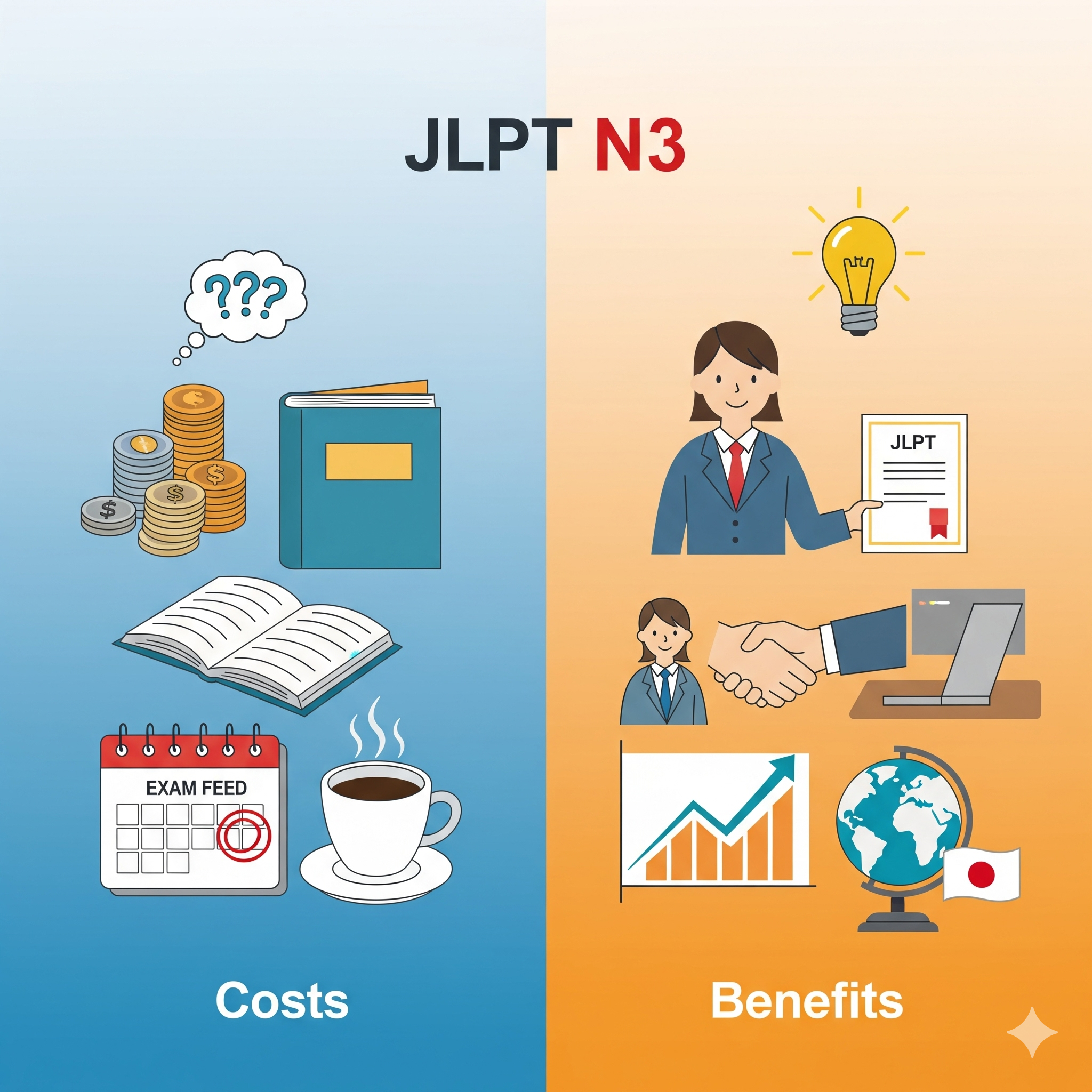
The Investment: Breaking Down the True Cost of the JLPT N3
When we talk about “cost,” we need to look beyond just the price tag on the registration form. The true cost has three components:
1. The Financial Cost (The Hard Numbers)
- Registration Fee: This varies by country. In the US, it’s typically around $65. In other countries, like Japan, it’s about $7,500 (roughly $65-70). It’s not a bank-breaker, but it’s not nothing.
- Internal Link: For a detailed breakdown of global test fees, consult our guide: [JLPT N3 Exam Fee & Registration Costs Worldwide]
- Study Materials: This is where costs can add up. You’ll likely want:
- A dedicated textbook series like the Shin Kanzen Master or So-Matome (approx. $20-$30 per book for Reading, Listening, Grammar, etc.).
- A dedicated Kanji book or app subscription.
- The official JLPT practice workbooks ($10-20).
- Online resources or subscription sites like WaniKani (for kanji) or Bunpro (for grammar).
- A reasonable estimate for a full self-study setup is ~$100 – $150.
- Supplementary Costs: Consider any classes or tutors you might hire for guidance. This can range from a few dollars for an online iTalki session to hundreds for a structured course.
Total Financial Investment: For most self-studiers, you’re looking at ~$200 once all is said and done.
2. The Time Cost (The Big One)
Money is one thing, but time is your most precious resource. This is the real investment.
The JLPT organizers estimate that moving from N4 to N3 takes about 375 hours of study. Let that sink in.
If you study for a solid 1.5 hours every single day, that’s roughly 8 months of consistent work. If you have a busy job or school life and can only manage an hour a day on weekdays and more on weekends, you’re looking at a year or more.
- Internal Link: To help you structure this time, see our guides on preparing for the key test dates: [JLPT N3 Exam Date 2025: Registration, Schedule, and Deadlines]
- Internal Link: And for a deep look at the time commitment on test day: [JLPT N3 Duration & Exam Time: How Long Does It Really Take?]
3. The Emotional & Mental Cost
This is rarely discussed but so important. Studying for the JLPT can be grueling. It can lead to:
- Burnout: The pressure to pass can suck the joy out of learning Japanese.
- Frustration: Hitting plateaus where it feels like you’re not improving is common.
- Neglect of Other Skills: The JLPT doesn’t test speaking or writing. If you focus only on the test, you might become lopsided—great at reading and listening but unable to string a sentence together in conversation.
Acknowledging these “soft costs” is vital. You have to protect your passion for the language while preparing for the test.
The Return: What Are the Tangible Benefits of Passing the JLPT N3?
Now, let’s talk about the payoff. Why do people put themselves through this?
1. Career and Academic Advantages (The Practical Payoff)
- In Japan: For those seeking to work in Japan, the N3 is often seen as the minimum baseline for many service industry or entry-level technical jobs where some Japanese is required. It shows you’re serious and moving beyond beginner stage. It won’t get you a job on its own, but it gets your foot in the door. For certain types of visas, like the Specified Skilled Worker (SSW) visa, N4 is sometimes acceptable, but N3 is stronger evidence of your ability to integrate.
- Outside of Japan: An N3 certificate on your resume demonstrates dedication, commitment, and a tangible skill to potential employers, especially companies with Japanese clients or parent companies. It’s a concrete data point that says “I can handle basic business communications in Japanese.”
2. A Massive Boost in Confidence (The Psychological Payoff)
This, for many, is the single greatest benefit. Passing the N3 is proof. It’s external validation that your hundreds of hours of work paid off. That confidence is rocket fuel for the rest of your language learning journey, making the daunting task of aiming for N2 feel achievable.
3. Solidified and Structured Foundation
The process of studying for the N3 forces you to fill in the gaps in your knowledge. You’ll systematically learn the essential ~650 kanji and ~1,500 vocabulary words that form the bedrock of intermediate Japanese. This structured approach ensures you’re not just “kind of” knowing things, but truly understanding them. The grammar patterns you master at this level are the workhorses of everyday conversation.
- Internal Link: If you want to know exactly what is tested, read: [JLPT N3 Format Explained: Your Ultimate Guide to Sections, Time, and Question Types](Cluster 1: Exam Format & Time Link).
4. Enhanced Enjoyment of Japanese Media
This is where the fun begins. At the N3 level, you can start to:
- Read manga like よつばと! (Yotsuba&!) or しろくまカフェ (Shirokuma Cafe) with minimal look-ups.
- Follow the plot of slice-of-life anime and dramas without being glued to the subtitles.
- Understand song lyrics, blog posts, and video game menus much more easily.
The language stops being a barrier and starts being a gateway to deeper cultural enjoyment. If you’re looking for resources to help with this, check out our post on [The Best Native Materials for JLPT N3 Practice].
The Unique Insight: It’s Not About the Certificate
Here’s the truth that many JLPT veterans know: The real value isn’t in the piece of paper; it’s in the person you become while earning it.
The certificate is a byproduct. The true benefit is the discipline you cultivated, the study habits you formed, the countless hours you spent engaging with the language, and the measurable jump in your actual ability.
The exam is a goal—a motivator. Without a goal, it’s easy to drift and plateau forever at the beginner level. The JLPT N3 provides a clear, structured, and internationally recognized target to aim for.
So, Is the JLPT N3 Worth It? A Checklist for You.
The answer is: It depends entirely on your goals.
YES, the JLPT N3 is worth the investment if:
- You need a concrete goal to structure your learning and prevent plateauing.
- You plan to work in Japan in a role that requires daily, practical Japanese.
- You thrive on external validation and certificates motivate you.
- You want to prove to yourself that you’ve truly reached an intermediate level.
- You’re aiming for N2/N1 eventually and want a stepping stone to build confidence.
Maybe reconsider the investment right now if:
- Your primary goal is to speak fluently. You might be better off investing your money in a conversation tutor or a language exchange program.
- The financial cost is a significant burden.
- The pressure of a test will kill your joy for the language.
- You’re only doing it because you think you “should,” not because you have a personal desire to.
If you’re still on the fence about which level to aim for, our guide on [Choosing the Right JLPT Level: N5, N4, or N3?] can help you decide.
How to Maximize Your Return on Investment
If you decide to go for it, be smart about it:
- Set a realistic timeline. Don’t try to cram 375 hours into 3 months unless you’re a full-time student.
- Mix it up. Don’t only study from JLPT books. Watch Netflix shows, read NHK Easy News, and try to have conversations. Keep it fun!
- Focus on your weaknesses. The JLPT is a standardized test. If you’re terrible at listening, you need to double down on that section to pass.
- Take practice tests. The best way to prepare is to simulate the real experience. This is non-negotiable. For a deep dive on this, read our article on [How to Use JLPT Practice Tests Effectively].
The Final Verdict
The JLPT N3 is a significant investment, but for most serious learners, the benefits far outweigh the costs. The key is to shift your perspective: view the journey of studying for the exam as the primary benefit. The certificate at the end is simply the trophy that proves you completed the journey.
It’s a challenging, rewarding, and ultimately transformative step that bridges the gap between being a beginner and becoming a confident intermediate user of the Japanese language. If you’re ready for the commitment, it is absolutely worth it.
がんばってください!(Ganbatte kudasai! – Do your best!)


