So, you’ve decided to take the plunge and challenge the Japanese-Language Proficiency Test, starting with the N5. はじめまして (Nice to meet you)! And congratulations—taking that first step is the biggest hurdle. Now, your mind is probably buzzing with questions, but one of the most practical ones is: “Just how many questions are on this thing, anyway?”
It’s a brilliant question. Knowing the test’s structure isn’t just about a number; it’s about strategy. It’s about pacing yourself, knowing what to expect, and walking into that exam room with the confidence of a samurai walking onto a familiar battlefield.
As someone who has both taken and tutored students for the JLPT for years, I’m here to give you more than just a simple tally. I’ll break down the JLPT N5 question count section by section, explain what each part truly tests, and share some insider tips on how to manage your time and energy effectively. Let’s demystify this together!
First, a Quick JLPT N5 Reality Check
Before we dive into the numbers, let’s set the stage. The JLPT N5 is the lowest level of proficiency. It’s designed for beginners who have roughly 200-250 hours of study under their belt. Think of it as a celebration of your first few months of learning Japanese!
The goal of the N5 is to test your ability to understand some basic Japanese that you’ve learned in a classroom environment. You’re not expected to understand rapid-fire anime dialogue without subtitles just yet. This test is your foundation, and a strong N5 pass sets you up perfectly for the N4.
Key Phrase: JLPT N5 structure
The JLPT N5 Blueprint: Breaking Down the Question Count
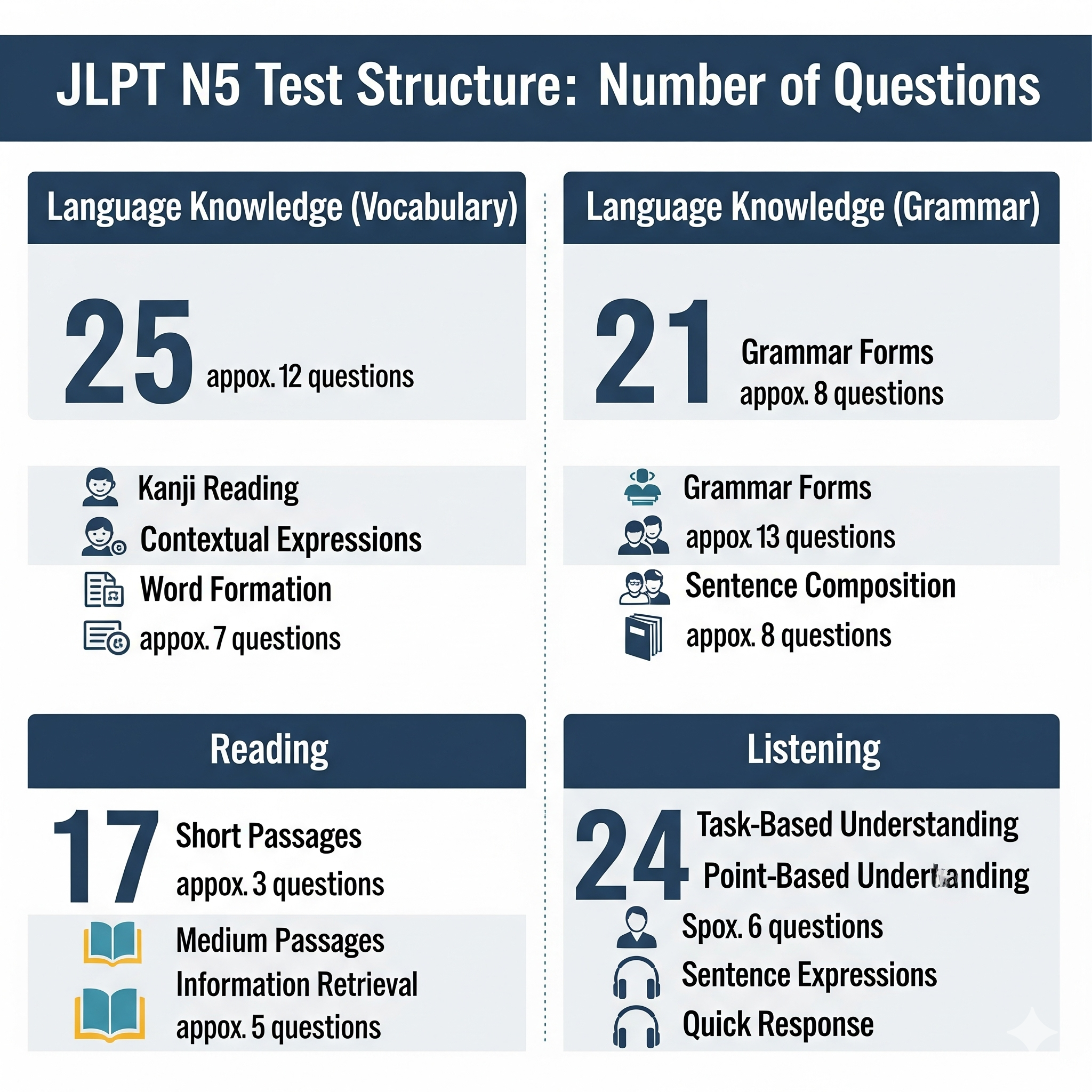
The JLPT N5 is divided into three main sections, each with a set number of questions and a strict time limit. Here’s the official blueprint:
| Section | Test Time | Number of Questions |
|---|---|---|
| Language Knowledge (Vocabulary) | 25 minutes | ~35 questions |
| Language Knowledge (Grammar) & Reading | 50 minutes | ~32 questions |
| Listening | 30 minutes | ~24 questions |
| TOTAL | 105 minutes | ~91 questions |
Note: The exact number of questions can vary by a few points from test to test, but this is the standard format you can rely on.
Now, let’s pop the hood and see what each of these sections really entails.
Section 1: Language Knowledge (Vocabulary) – ~35 Questions / 25 Minutes
This section is your first sprint. It’s all about recognition and understanding of basic words. You’ll need to be quick here. The 25 minutes fly by! This section is typically broken down into a few question types:
- Kanji Reading (汉字读法): You’ll see a word written in kanji and need to choose the correct hiragana reading from the options. This tests if you can “decode” the basic kanji you’ve learned.
- Orthography (表记): The opposite! You’ll see a word written in hiragana and need to choose the correct kanji from the options. This tests if you can “write” (conceptually) the word.
- Contextually Appropriate Expressions (上下文规定): You’ll have a short sentence or phrase with a blank and need to choose the most logical word to fill it in.
- Paraphrases (言换言换): This tests your understanding of synonyms. You’ll be given a word or short phrase and asked to find another phrase that means the same thing.
- Usage (用法): You’ll be given a word and must choose the sentence where it is used correctly. This is fantastic because it tests practical application, not just memorization.
Insider Tip: Don’t get stuck! If you’re hesitating on a kanji reading question, move on. The questions often get more time-consuming as you go, so you need to save minutes for the usage questions at the end.
Key Phrase: JLPT N5 vocabulary
Section 2: Language Knowledge (Grammar) & Reading – ~32 Questions / 50 Minutes
This is a two-part section that tests your understanding of Japanese sentence structure and your ability to comprehend short written passages.
Part A: Grammar (~18 questions)
This isn’t about defining grammatical terms. It’s about using them. You’ll see:
- Sentence Composition: Choosing the correct grammatical particle (は, が, を, に, etc.) or verb conjugation to form a grammatically correct sentence.
- Word Order: You’ll be given a set of words and phrases and must arrange them in the correct order to create a logical sentence. This is a fantastic test of your intuitive grasp of Japanese syntax (which is very different from English!).
Part B: Reading (~14 questions)
The readings are short, digestible, and practical. You’ll encounter:
- Short Passages: One or two paragraph texts on everyday topics (notices, emails, simple descriptions).
- Information Retrieval: The most important skill here! You won’t need to infer deep meaning. You just need to scan the text to find specific information, like a time, a place, or a reason something happened.
Insider Tip: Reverse engineer the reading section. Read the questions first. Then, scan the text looking for the answers. This will save you an enormous amount of time. The answers are always literally in the text.
Key Phrase: JLPT N5 grammar and reading
If you’re wondering what grammar points you absolutely must know, I’ve compiled a complete list in my Ultimate Guide to JLPT N5 Grammar.
Section 3: Listening – ~24 Questions / 30 Minutes
Ah, the listening section. For many, this is the most daunting part. You’ll hear audio clips played only once, so focus is key. The pace is deliberately slow and clear for N5. The section is divided into four task types:
- Task-Based Comprehension (課題理解): You’ll listen to a short dialogue and a question (played both before and after the dialogue). The question is usually about what the speaker will do next. (“What will the man buy at the store?”)
- Point Comprehension (ポイント理解): Similar to the first, but you’re given a visual cue with options on your answer sheet. You need to listen for a specific point or reason. (“Why is the woman tired?”)
- Verbal Expressions (発話表現): You’ll see a picture of a situation and listen to a short monologue. You must choose the most appropriate thing to say in that situation. This tests your practical, everyday Japanese.
- Quick Response (即時応答): This is the speed round! You’ll hear a short phrase or question (e.g., “はじめまして”) and must choose the most natural response from three options (e.g., “よろしくお願いします”). This tests your automatic, conversational reflexes.
Insider Tip: Use the time given to look at the answers! Before each audio clip plays, there is a silence. Use those precious seconds to quickly look at your answer sheet’s options. This primes your brain to listen for specific keywords.
Key Phrase: JLPT N5 listening practice
For those who need to sharpen their ears, check out my post on The Best Free Resources for JLPT N5 Listening Practice.
Beyond the Numbers: Your Strategy for Success
Knowing there are ~91 questions is one thing. Developing a strategy to tackle them is another.
- Pace Yourself: Do the math. For the 25-minute vocabulary section, you have less than a minute per question. For the 50-minute grammar/reading section, you have about 1.5 minutes per question. Skim the easy ones fast to buy time for the harder ones.
- Master the Answer Sheet: The test is designed with an separate answer sheet. Practice filling in those bubbles quickly and accurately. A smudge or mistake can cost you points.
- There’s No Penalty for Guessing: This is crucial! You do not lose points for a wrong answer. Never leave a question blank. If you’re out of time, pick a letter and bubble it in for all remaining questions. You have a 25% chance of being right!
- Simulate the Real Thing: The best preparation is to take a full, timed practice test. The official JLPT website offers sample questions, and you can find full-length practice exams online or in books. This builds your mental stamina for the real 105-minute challenge.
Wondering what textbook can best guide your studies? I’ve reviewed the most popular options in my breakdown of Genki vs. Minna no Nihongo for JLPT N5.
Final Thoughts: You’ve Got This!
The JLPT N5, with its ~91 questions, is a very achievable goal. It’s not designed to trick you; it’s designed to reward your hard work. View it not as a scary exam, but as a structured milestone on your Japanese language journey. It’s the first certificate of many that will adorn your wall, a testament to your dedication.
So, study those kanji, drill those particles, and listen to as much simple Japanese as you can. Understand the structure, practice your timing, and walk in with a plan.
頑張ってください (Ganbatte kudasai)! Do your best! I’m rooting for you.