Konnichiwa, future Japanese speakers!
So, you’ve decided to take the plunge and sign up for the Japanese-Language Proficiency Test, starting with the N5 level. First off, let me say: omedetou gozaimasu! (Congratulations!). This is a fantastic first step on a incredibly rewarding journey.
But now, a familiar panic might be setting in. “Where do I even start?” “What textbooks should I buy?” “Is three months even enough?!”
Take a deep breath. Inhale… exhale…
I’ve been where you are. I’ve taught hundreds of students who have been where you are. And over the years, I’ve seen one universal truth: the students who pass—and, more importantly, those who actually retain the language—aren’t the ones who cram mindlessly. They are the ones who build a strong foundation with a clear, simple plan.
The JLPT N5 isn’t a test of genius; it’s a test of consistency. It checks if you have a solid grasp of the absolute basics. And that’s exactly what we’re going to build together.
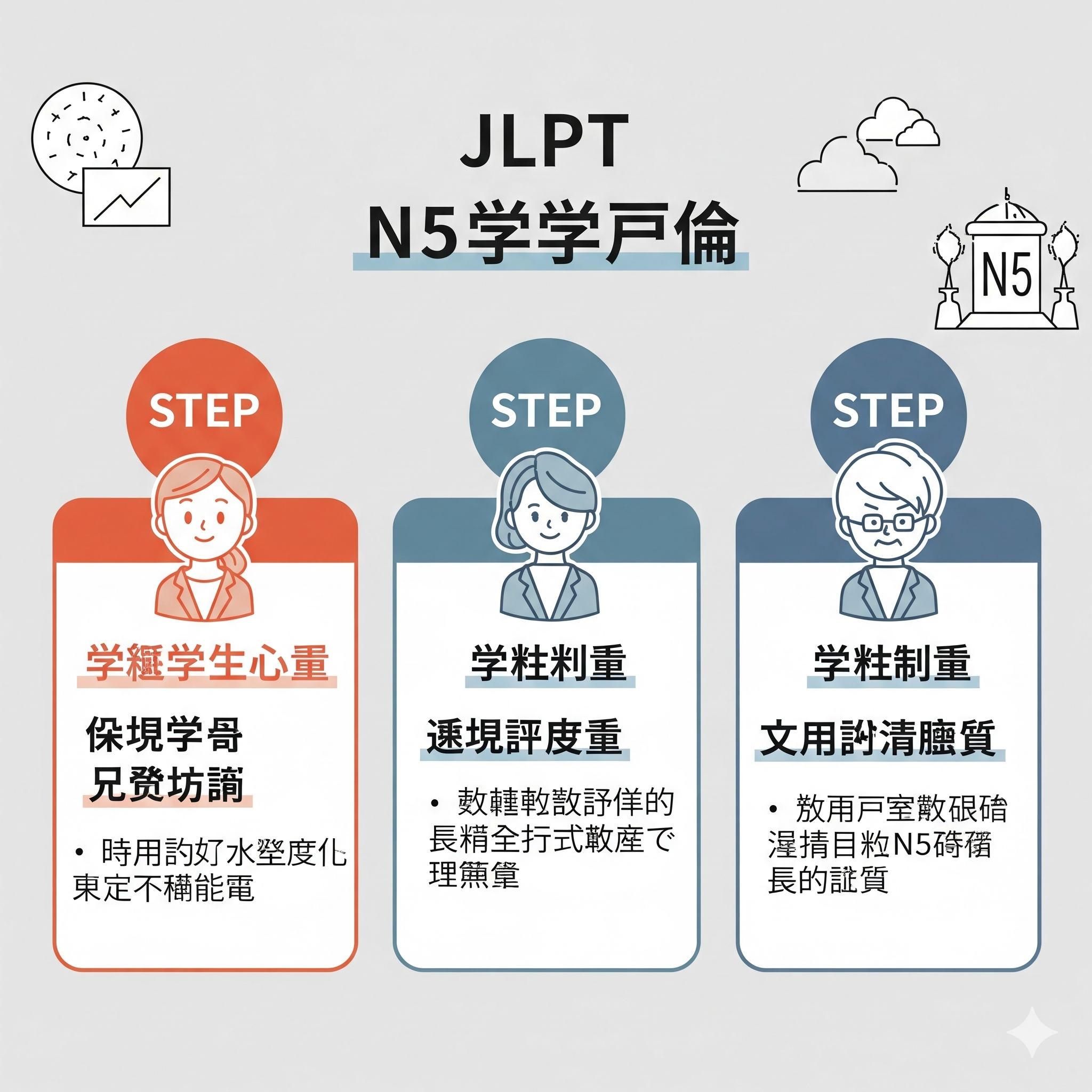
Forget the overwhelm. Let’s break this down into three utterly simple, profoundly effective steps.
Step 1: Lay the Foundation – Master Hiragana, Katakana, and Your First 100 Kanji
I can already hear the groans. “The squiggly lines! The dreaded K-words!” But trust me, this is the single most important step, and conquering it early will make everything else 100% easier.
Think of kana (hiragana and katakana) as the ABCs of Japanese. You wouldn’t try to read English without knowing the alphabet, right? Japanese is the same. Trying to study with romaji (Japanese written in the Roman alphabet) is a one-way ticket to confusion and a terrible accent.
Your Mission: Be able to read and write all hiragana and katakana characters without hesitation. No exceptions.
How to Do It (The Human Way):
- Ditch the Romaji, Immediately: From day one, force your brain to engage with the real script. It’s like ripping off a band-aid—painful for a week, but then you’re free!
- Use Mnemonics, Not Just Rote Memory: Don’t just stare at the chart. The character の (no) looks like a slack nose. く (ku) looks like a cooking bird’s beak. シ (shi) and ツ (tsu) are tricky, but remember: shi drops down and tsu drops across. Making silly little stories makes them stick. Websites like Tofugu’s Learn Kana Guide are legendary for this very reason.
- Practice with Real Words: Once you know the basics, start reading everything. Look at a Japanese menu online and try to sound out the katakana words (ハンバーガー – hanbāgā – hamburger). It’s satisfying and practical!
Now, about Kanji: Yes, N5 has kanji. About 100 of them. But please, don’t see them as scary drawings. See them as little puzzles. Each one has a meaning and common readings.
- Focus on Recognition, Not Calligraphy: The JLPT is multiple-choice. You need to recognize the kanji and its meaning, not necessarily produce it from memory with perfect stroke order (though learning the correct order is good practice for the future!).
- Start with the Simple, High-Frequency Ones: Learn the kanji for numbers (一、二、三), days of the week (月、火、水), and simple nouns like person (人), mountain (山), and river (川). These appear everywhere.
- Use Spaced Repetition Systems (SRS): This is your secret weapon. Apps like Anki (free and powerful) or Memrise use a smart algorithm to show you flashcards right before you’re about to forget them. 10-15 minutes with an N5 kanji deck each day does wonders.
Insight from a Pro: The goal here isn’t perfection; it’s familiarity. By the end of this step, you should be able to look at a simple Japanese sentence and not feel a sense of dread. You’ll see a mix of hiragana, a katakana word, and a kanji or two, and your brain will start to process it. That moment is pure magic—and it’s the fuel for the rest of your studies.
(Internal Link: Feeling unsure about kanji? Read our beginner-friendly post, Demystifying Kanji: How to Start Learning Japanese Characters Without Fear)
Step 2: Build Your Core – Vocabulary and Grammar in Tandem
With your script foundation solid, it’s time to start building the house. This is where most textbooks start, and for good reason. Vocabulary and grammar are two sides of the same coin; you need to learn them together.
Your Mission: Learn the core N5 vocabulary (~800 words) and grammar patterns (~70-80) through context and sentences, not just lists.
How to Do It (The Human Way):
- Pick One Primary Resource: The biggest mistake is buying ten textbooks and getting overwhelmed. Choose one. I highly recommend the “Genki I” textbook or the “Minna no Nihongo” series. They are the gold standard for a reason. They present grammar and vocabulary in a logical, structured order, with exercises and dialogues. Work through it from Chapter 1 to Chapter 12 (or the equivalent for Minna). Do all the exercises. Seriously.
- Learn Grammar with Example Sentences: Don’t just memorize that “〜ます is the polite form.” Memorize a whole sentence: “私は本を読みます (I read a book).” This gives you context, vocabulary, and particle usage (は, を) all at once. Create your own sentences! “I eat sushi” becomes “私は寿司を食べます.”
- Vocabulary in Context: When you learn a new word like “切手 (kitte – stamp),” don’t just flashcard it alone. Put it in a sentence flashcard: “私は手紙に切手を貼ります (I put a stamp on the letter).” This builds connections in your brain.
- Listen from Day One: Your textbook will have audio dialogues. Listen to them until your ears bleed. Listen while reading the script. Then listen without reading. Shadow the speakers—repeat what they say out loud, trying to mimic their intonation. This is brutal but incredibly effective for your listening comprehension section.
Practical Application is Key: Why are you learning “〜たい” form (want to do)? Because you can finally say what you want! “日本に行きたいです (I want to go to Japan)!” “ラーメンを食べたいです (I want to eat ramen)!” Use the grammar on yourself. This transforms dry study into active communication.
(Internal Link: See our review of the best resources to find your perfect fit: Genki vs. Minna no Nihongo: Which Japanese Textbook is Right for You?)
Step 3: Practice Makes Permanent – Mock Tests and Skill Integration
You’ve built your foundation and your core. Now it’s time to put up the walls and make sure everything is sturdy. This final step is about moving from “I know this” to “I can use this under exam conditions.”
Your Mission: Simulate the exam environment and identify your weak spots through targeted practice.
How to Do It (The Human Way):
- Take a Full-Length Mock Test: About a month before the real exam, find a quiet afternoon and take a full practice test from start to finish, timing each section strictly. The official JLPT website provides an sample test which is the most authentic resource. This isn’t to scare you; it’s to de-mystify the exam. You’ll learn the format, the question styles, and, most importantly, how it feels to concentrate for the full 105 minutes.
- Analyze Your Mistakes: This is the most crucial part. Got a listening question wrong? Go back and listen to it until you understand why. Was it a key vocabulary word? Was the speaker too fast? Missed a grammar point? Figure out why you got it wrong and then review that specific concept. This turns every mistake into a powerful learning moment.
- Section-Specific Drills:
- Language Knowledge (Vocabulary/Kanji): Use dedicated JLPT N5 drill books or apps. They often have questions formatted exactly like the exam.
- Language Knowledge (Grammar): Practice choosing the correct particle (は vs. が is a classic N5 struggle!) and sentence structure.
- Reading: The N5 readings are very short—notices, short emails, etc. Practice skimming for the main idea and scanning for specific information (like a time, a place, a person’s name).
- Listening: This is where people get nervous. The key is to get used to the speed. Listen to Japanese podcasts for beginners, like NHK’s Easy Japanese News Podcast. Even if you don’t understand everything, you’re tuning your ear. Watch kids’ shows on YouTube; the speech is slower and clearer.
Unique Insight: The listening section is played only once. You can’t go back. During your practice, emulate this. Train yourself to listen for the gist, not for a perfect, word-for-word translation. Often, the answer is hidden in a key phrase or the tone of the conversation.
(Internal Link: Conquer the section everyone fears with our dedicated guide: 5 Tips to Ace the JLPT Listening Section)
Your 3-Month JLPT N5 Study Plan (A Sample Roadmap)
Let’s make this practical. Here’s a realistic 3-month plan using our 3 steps:
- Month 1: Foundation (Step 1)
- Weeks 1-2: Devote yourself to Hiragana and Katakana. 30 minutes daily. Use flashcards, apps, and writing practice.
- Weeks 3-4: Start your textbook (e.g., Genki I, Ch. 1-2) and begin learning the first 30-40 N5 kanji with Anki. Focus on the vocabulary and grammar in those chapters.
- Month 2: Core Building (Step 2)
- Weeks 5-8: Systematically work through your textbook. Aim for 1-2 chapters per week. For each chapter:
- Learn all new vocabulary and kanji.
- Study the grammar points and create your own example sentences.
- Do all the workbook exercises.
- Listen to the chapter dialogue daily.
- Weeks 5-8: Systematically work through your textbook. Aim for 1-2 chapters per week. For each chapter:
- Month 3: Practice & Integration (Step 3)
- Week 9: Finish the final chapters of your textbook. Do a comprehensive review of all vocabulary and grammar.
- Week 10: Take your first full-length mock test. Analyze your mistakes thoroughly.
- Week 11: Targeted practice. Drill your weak areas identified from the mock test.
- Week 12: Take a second mock test. See your improvement. Review lightly. Rest the day before the exam!
You’ve Got This!
Preparing for the JLPT N5 is less about cramming information and more about building a sustainable, consistent habit. It’s about showing up for your Japanese practice every day, even if it’s just for 20 minutes.
Remember, the ultimate goal isn’t just a certificate; it’s the ability to understand and interact with a language and culture that fascinated you enough to start this journey in the first place. That certificate is just a beautiful byproduct.
How Many Questions in the JLPT N5 Test?
JLPT N5 Hiragana Mastery: Essential First Step
How to Study for the JLPT N5: Your Blueprint for Success
Ganbatte kudasai! (Do your best!)