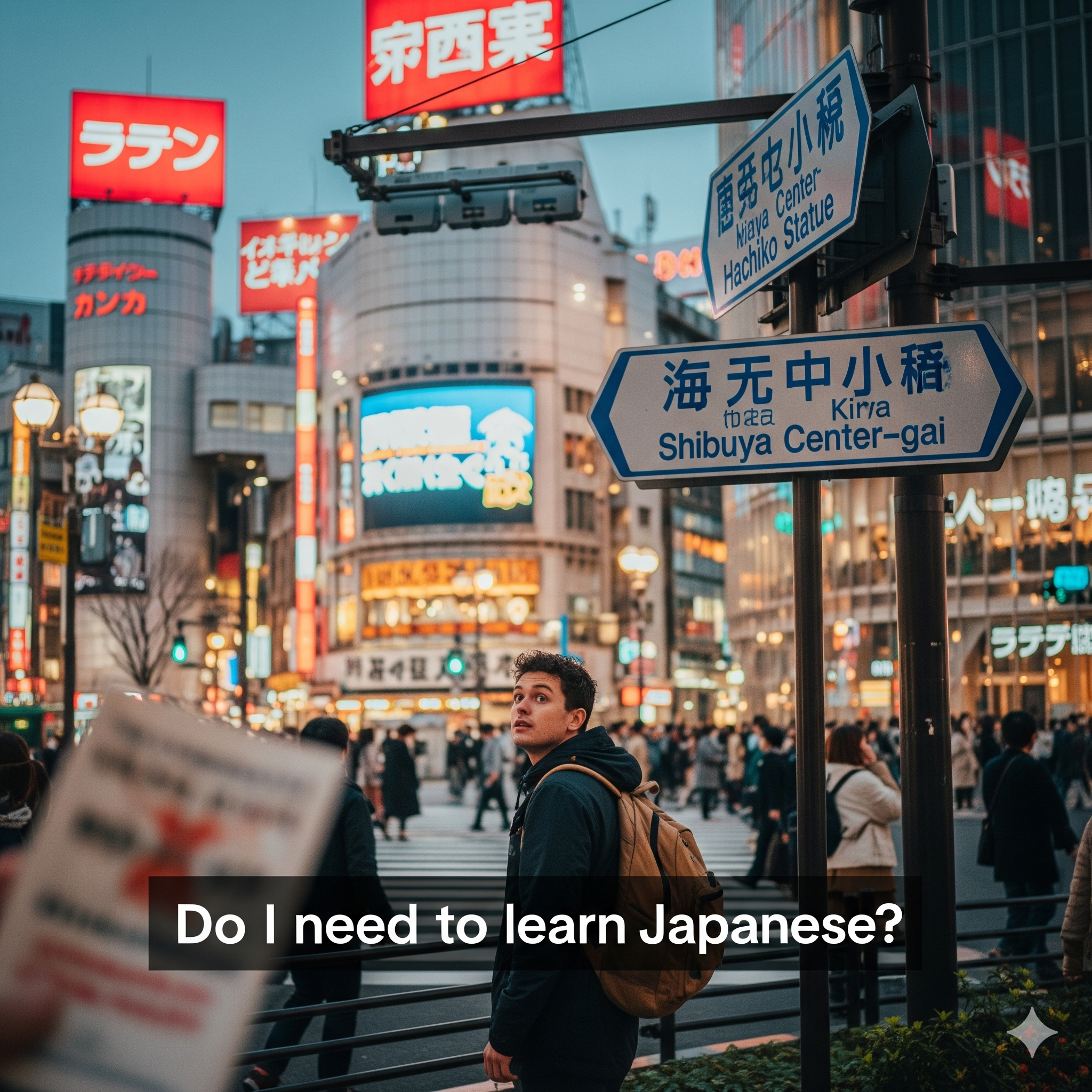
Let’s cut to the chase. You’ve booked your tickets, you’re dreaming of sushi, sakura, and shinkansen rides, and then it hits you: “Wait… I don’t speak a word of Japanese.”
A wave of anxiety washes over you. Will I get lost? Will I be able to order food? Will I accidentally offend someone because I used the wrong bow?
Take a deep breath. As someone who has spent years studying this beautiful language and guiding others through the JLPT (Japanese-Language Proficiency Test), I’m here to give you the real, unfiltered answer.
The short answer is no, you do not need to learn Japanese to have an incredible, smooth, and fulfilling trip to Japan. Millions of tourists visit each year with zero language skills and have the time of their lives.
But the long answer? Learning even a little bit of Japanese will transform your trip from a standard tourist experience into something deeper, more rewarding, and genuinely magical.
Let’s break it down.
The Reality of Traveling in Japan Without Japanese
First, let’s ease your mind. Japan is one of the most accessible non-English-speaking countries you can visit. Here’s why:
- Technology is Your Best Friend: Google Translate (especially the camera function for menus and signs) and apps like Japan Travel by Navitime are absolute game-changers. You can point your phone at a menu and get a rough translation instantly.
- Signage is Often in English: In major cities like Tokyo, Kyoto, and Osaka, train stations, subway lines, and major attractions have clear Romanized lettering (romaji) alongside Japanese. You’ll see signs for “Exit,” “Ticket Gate,” and platform numbers in English.
- The People are Incredibly Helpful: Japanese people are famously polite and hospitable. Even if they speak no English, they will often go to incredible lengths to help a lost tourist. Don’t be surprised if someone walks you five blocks out of their way to show you the right direction.
- Vending Machines and Pointing: A huge amount of transactions can be handled without a single word. From ordering food via ticket machines in ramen shops (with picture menus) to simply pointing at what you want in a bakery, you can get by.
So, if you’re just planning to hit the major tourist spots, you’ll be absolutely fine. But “fine” isn’t why we travel, is it?
Why Learning Even a Little Japanese is a Game-Changer
This is where I, as a language enthusiast, get excited. You don’t need fluency. You need a few key tools. Learning some basics does three critical things:
- It Shows Respect: This is huge in Japanese culture. Attempting the language shows that you respect their culture and are making an effort. It immediately breaks down barriers and often leads to smiles and warmer interactions.
- It Grants You Access: The second you step off the beaten path—whether it’s a tiny family-run izakaya (pub) in a back alley, a beautiful onsen town in the countryside, or a local market—English disappears. Your phrasebook or basic skills become your golden ticket to these authentic experiences.
- It Builds Confidence: Navigating a foreign country can be intimidating. Knowing you can say “Thank you,” “Hello,” and “Where is the train?” empowers you to explore more freely and confidently.
The Practical Traveler’s Japanese Toolkit: What to Learn Before You Go
Forget trying to master kanji. Focus on these practical categories. I’ve structured this like a mini, hyper-focused JLPT N5 (the most basic level) crash course for travelers.
1. The Absolute Non-Negotiables (The Polite Magic Words)
These are your most important tools. Pronounce them clearly and use them often.
- Arigatou gozaimasu (ah-ree-gah-toh go-za-ee-mas): Thank you (polite). Use this everywhere, all the time.
- Sumimasen (soo-mee-mah-sen): The Swiss Army knife of Japanese. It means “Excuse me,” “I’m sorry,” or “Pardon me.” Use it to get someone’s attention, to apologize for a minor bump, or to say “thank you” when someone does something like hand you your change.
- Konnichiwa (kon-nee-chee-wah): Hello (during the daytime).
- Hai (hai): Yes. (It sounds like “hi” but with a soft, short vowel).
- Iie (ee-eh): No.
- Onegaishimasu (oh-neh-gai-shee-mas): This means “please,” but it’s used in a specific way. Say this when handing your payment to a cashier or when ordering something. It softly implies “Please do this for me.”
2. Navigation & Transportation Savvy
Getting around is your biggest hurdle. Master these phrases.
- ~ wa doko desu ka? (~ wa doh-koh des kah): “Where is ~?” (e.g., “Eki wa doko desu ka?” = “Where is the station?”)
- Toire (toy-reh): Bathroom. Crucial.
- ~ ni ikitai desu (~ nee ee-kee-tai des): “I want to go to ~.” Show this on your phone or map to a taxi driver.
- Ikura desu ka? (ee-koo-rah des kah): “How much is it?”
- Kippu (keep-poo): Ticket.
3. Dining Delights (No More Guesswork!)
Ordering food is a joy, not a struggle, with these phrases.
- Menu, onegaishimasu: “Menu, please.”
- Kore, onegaishimasu: “This, please.” (The ultimate phrase! Just point to an item on the menu and say this).
- Omizu, onegaishimasu: “Water, please.” (Often free in restaurants).
- Okanjou, onegaishimasu: “Check, please.”
- Itadakimasu! (ee-tah-dah-kee-mas): Say this quietly before you eat. It’s a polite way to say “I receive this meal.” It will impress everyone at the table!
- Gochisousama deshita (go-chee-so-sah-ma desh-ta): Say this after your meal to the staff. It means “Thank you for the feast” and is a sign of great manners.
(Internal Link 1: For a deeper dive into dining etiquette, read our post on How to Order Food in Japan: A Guide for the Nervous Traveler)
Beyond Phrases: Understanding the Cultural Code
Language is more than words. It’s about communication.
- The Power of Bowing (Ojigi): A slight bow when saying “thank you” or “excuse me” goes a long way. You don’t need a deep, formal bow; a nod of the head with a slight bend at the waist is perfect for tourists.
- Cash is King: While changing, many places still heavily prefer cash, especially outside cities. Knowing how to say numbers can help, but calculators are universally used to show prices.
- Quiet is Polite: Japan is a quiet country. Speak softly on trains and in public spaces. Loud phone calls on public transport are a major faux pas.
When Should You Consider Learning More?
If your travel dreams involve any of the following, I’d strongly recommend investing more time in learning:
- Traveling extensively in the countryside (inaka).
- A long-term stay or working holiday.
- Engaging in specialized activities like a pottery workshop, a tea ceremony class, or staying at a Buddhist temple (shukubo).
- A deep desire to connect with locals on a personal level beyond simple transactions.
For a structured approach, looking into the JLPT N5 curriculum is a fantastic goal. It covers all the basics of reading, writing, and speaking for everyday situations.
(Internal Link 2: Curious about formal study? Here’s my breakdown of Is the JLPT Test Worth It for Travelers and Beginners?)
Your Action Plan: A Traveler’s Study Guide
- 1-2 Months Before Your Trip: Spend 10-15 minutes a day on a language app like Duolingo or Memrise. Don’t worry about writing; focus on listening and repeating.
- Download These Apps: Google Translate (download the Japanese language pack for offline use), Japan Travel by Navitime, and Imiwa? for a fantastic offline dictionary.
- Practice Listening: Watch Japanese travel vlogs on YouTube. Get your ear used to the sounds and rhythms of the language.
- Get a Physical Phrasebook: Sometimes, it’s faster than an app. I’m a fan of Lonely Planet’s Japanese Phrasebook.
- Write a Cheat Sheet: Write the key phrases from this article on a notecard and keep it in your pocket.
(Internal Link 3: For a list of all the apps I recommend, check out Top 10 Essential Apps for Traveling in Japan)
The Verdict: So, Do You Need to Learn Japanese?
No, you don’t need it to survive. Japan’s infrastructure and technology make it entirely possible to have a wonderful trip without it.
But yes, you absolutely should learn some.
Learning Japanese for your trip isn’t about achieving fluency; it’s about equipping yourself with keys. Keys that unlock deeper cultural understanding, genuine human connections, and the confidence to explore the true heart of Japan that lies beyond the guidebooks.
Your attempt to say “arigatou gozaimasu” will be met with a smile. Your quiet “itadakimasu” before a meal will show your respect. These small moments of connection are what transform a great vacation into an unforgettable journey.
Have a fantastic trip, or as they say in Japan – いってらっしゃい (Itterasshai – Go and come back)!
(Internal Link 4: Now that the language barrier is conquered, start planning your itinerary with our 7-Day Tokyo Itinerary for First-Time Visitors)