Konnichiwa, future Japanese speaker!
So, you’ve decided to take the plunge and aim for the JLPT N5. First off, congratulations! Making the commitment to formally study a language is a huge and exciting first step. You might be feeling a mix of motivation and… well, sheer panic. Where do you even begin? What do you need to know? How long will it really take?
I’ve been there. I’ve also guided hundreds of students through this exact journey. Let me tell you a secret: the JLPT N5 is not designed to trick you. It’s designed to validate your first, foundational steps into the Japanese language. It’s the friendly handshake, not the intimidating obstacle.
This blog post is your ultimate, step-by-step roadmap. We’re going to move beyond a simple list of grammar points and vocabulary. We’re going to build a practical, sustainable study plan that fits into a real life, complete with resource recommendations, common pitfalls to avoid, and the mindset you need to succeed. Consider this your sensei in blog form.
What is the JLPT N5, Really? Setting Realistic Expectations
Before we map the route, let’s understand the destination. The JLPT N5 is the lowest level of the Japanese-Language Proficiency Test. It certifies that you have a basic understanding of Japanese, enough to handle simple, everyday conversations and read short, simple sentences.
What it IS:
- A proof of your commitment to learning Japanese.
- A fantastic motivator to build strong foundational habits.
- A confidence booster that proves you can understand and use basic Japanese.
- A structured goal to guide your initial studies.
What it is NOT:
- A measure of fluency. You will not be fluent after N5.
- Something to be feared. The pass mark is achievable with consistent effort.
- An abstract test. It’s very practical, focusing on language you would actually use.
The Official Test Structure:
The exam is divided into two sections:
- Language Knowledge (Vocabulary & Grammar) + Reading: 60 minutes
- Listening: 30 minutes
You need to achieve an overall pass mark (around 80/180 points, but it’s scaled) and a minimum score in each section to pass. You can’t just be good at one area!
Your JLPT N5 Study Blueprint: The Three Phases of Success
A common mistake beginners make is diving into a textbook without a strategy. They burn out by chapter 3. Instead, think of your preparation in three distinct phases. I recommend a 3-6 month timeline for most absolute beginners, depending on how much time you can dedicate each day.
| Phase | Focus | Estimated Duration | Key Activities |
|---|---|---|---|
| 1. Foundation & Familiarity | Learning the scripts & core vocabulary | 1-2 Months | Mastering Hiragana & Katakana; learning ~100 basic words |
| 2. Grammar & Building | Understanding sentence structure | 2-3 Months | Working through a core textbook; starting listening practice |
| 3. Review & Application | Test simulation and fluency | 1-2 Months | Taking practice tests; reviewing weak points; speed drills |
Phase 1: Laying the Foundation (Months 1-2) – Your Non-Negotiable First Step
You cannot build a house on sand, and you cannot learn Japanese without a rock-solid foundation. This phase is all about the basics.
Step 1: Conquer Hiragana and Katakana. Absolutely. No Exceptions.
Forget romaji (Romanized Japanese) as soon as humanly possible. It’s a crutch that will severely hinder your progress. Your first mission is to learn both Japanese phonetic alphabets.
- Hiragana (ひらがな): The soul of Japanese. Used for native words, grammar particles, and verb endings.
- Katakana (カタカナ): Used for loanwords (like コーヒー for “coffee”), onomatopoeia, and emphasis.
How to do it:
- Tofugu’s Learn Hiragana/Katakana Guides: These are, without a doubt, the best free resources on the internet. They use mnemonics and make the process engaging. (Outbound Link to Tofugu’s Hiragana Guide)
- Apps: Use apps like “Learn Japanese!” (by Egor Skriptunoff) or “Dr. Moku” for quick, on-the-go drilling.
- Practice Writing: Get a grid notebook and practice writing each character. This physical act helps cement memory.
- Goal: Be able to read and write all kana without hesitation. This should take a dedicated beginner about one week for each alphabet. Seriously, you can do it!
💡 Insider Tip: A common mistake is neglecting Katakana. Because it appears less at first, students often remain slow at reading it. Then, on the test, they panic when they see a Katakana word. Drill both equally!
Step 2: Build Your Core N5 Vocabulary
While you’re learning kana, start building your vocabulary bank. The JLPT N5 requires knowledge of about 800 words. Don’t just memorize a list; learn them in context.
- Where to find the words: The official JLPT word list is a good reference, but better to learn from a source that provides example sentences.
- Best Tool for the Job: Anki. Anki is a free, powerful spaced repetition system (SRS) flashcard app. It’s a game-changer. You can download pre-made “JLPT N5 Decks” or, even better, create your own cards as you learn new words.
- How to study: Aim for 10-15 new words per day. Consistency is far more important than volume. 15 words a day for 60 days is 900 words—you’ve hit your target.
💡 Humanizing Tip: Don’t just learn the word for “book” (本, hon). Learn it in a phrase: “これはわたしの本です。” (Kore wa watashi no hon desu.) – “This is my book.” This teaches you the word AND grammar simultaneously.
Phase 2: Building Structure (Months 2-4) – The Fun Begins!
Now that you can read and have a small vocabulary, it’s time to learn how to build sentences.
Step 3: Master N5 Grammar with a Trusted Textbook
A textbook provides structure and ensures you learn concepts in a logical order. My top recommendation for self-learners is the Genki I textbook. It’s engaging, well-structured, and has excellent accompanying workbooks. Alternatives include “Japanese from Zero!” or “Minna no Nihongo” (which is more immersive but can be intense for solo learners).
Key N5 Grammar Points You Will Master:
- Basic sentence structure: XはYです (X is Y)
- Particles: は (topic marker), が (subject marker), を (object marker), に (time/location), で (location of action), へ (direction)
- Verbs: Present/Future tense (ます-form) and Past tense (ました-form)
- Adjectives: い-adjectives and な-adjectives and their negative/past forms
- Asking questions with か
- Existence verbs: あります (for inanimate things) / います (for animate things)
- Counting objects and using counters (本, 枚, 匹, etc.)
Work through your chosen textbook methodically. Do every exercise. Write out the answers. Speak the sentences out loud.
🤔 Struggling with Grammar? You’re not alone. If particles have you confused, check out our internal guide, JLPT N5 Syllabus 2025: Vocabulary, Grammar, Kanji & More, which breaks down these tricky concepts.
Step 4: Start Training Your Ears
The listening section is where many students get tripped up because they only study with their eyes. You must start listening to Japanese from day one.
- Your Textbook Resources: Genki and other textbooks have accompanying audio CDs or app resources. Listen to the dialogues repeatedly until you can follow along without the book.
- YouTube is Your Best Friend:
- Japanese Ammo with Misa: Excellent, clear explanations of grammar and vocabulary.
- Comprehensible Japanese: Features simple, slow Japanese stories with visual cues. Perfect for beginners.
- Podcasts: “Learn Japanese Pod” and “Nihongo Con Teppei for Beginners” are great for passive listening during your commute.
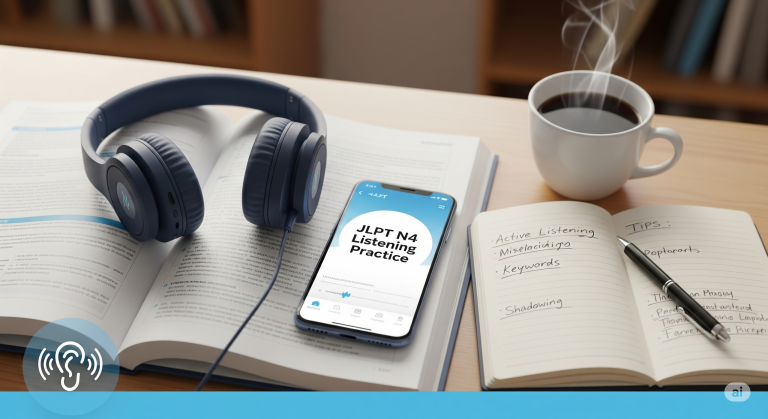
Listening Strategy: Don’t just listen passively. Actively listen. Try to shadow (repeat after the speaker). Write down what you hear.
Phase 3: Review, Application, and Mastery (Months 4-6)
You’ve learned the pieces. Now it’s time to put the puzzle together and practice for the specific format of the test.
Step 5: Take Official Practice Tests
This is the most crucial step in your final preparation. You must familiarize yourself with the format, timing, and question styles.
- The Official JLPT Website: Provides sample questions for every section. (Outbound Link to Official JLPT Sample Questions)
- Official Workbooks: You can purchase “JLPT Official Practice Workbooks” which are compiled from old tests.
- Simulate Test Conditions: Time yourself strictly. Take the entire test in one sitting without interruptions. This builds mental stamina.
Step 6: Identify and Attack Your Weaknesses
After taking a practice test, analyze your mistakes. Did you miss listening questions because of a specific vocabulary set (e.g., directions, times)? Did you get confused by a particular grammar pattern? Go back and review those areas intensely.
Step 7: Reading and Listening Speed Drills
The test is timed. You need to be efficient.
- Reading: Practice skimming simple paragraphs for key information. Who is the subject? What is the main action? Where does it take place?
- Listening: The listening audio only plays once. Practice listening to a short dialogue and immediately summarizing the main point out loud in English (or Japanese!).
Essential Resources for Your JLPT N5 Journey
- Primary Textbook: Genki I (3rd Edition)
- Grammar Reference: A Dictionary of Basic Japanese Grammar (It’s a reference book, not a textbook, but it’s incredible for deeper understanding).
- Kanji: Remembering the Kanji 1 (by Heisig) or the kanji lessons integrated into Genki.
- SRS App: Anki (for PC and mobile)
- Listening Practice: YouTube channels mentioned above, textbook audio.
- Practice Tests: Official JLPT website and workbooks.
For a deeper dive into the best tools available, explore our pillar post on The Ultimate JLPT N5 Complete Guide 2025: Syllabus, Study Plan, and How to Master the Test
The Day Before and The Day Of: Your Game Plan
- Don’t Cram: The day before the test, do a light review. Maybe flip through your flashcards. But do not try to learn new things. It will only increase anxiety.
- Know Your Test Center: Make sure you know how to get there and how long it takes.
- Bring What You Need: Your test voucher, ID, pencils, and an eraser. A watch (without an alarm) is also helpful to manage your time.
- Stay Calm and Trust Your Preparation: You’ve followed this roadmap. You are prepared. Take a deep breath. You’ve got this.
Final Words of Encouragement
The journey to JLPT N5 is your first beautiful step into the vast world of Japanese. It’s a marathon, not a sprint. There will be days you feel frustrated and days everything “clicks.” Embrace both.
Remember, the goal isn’t just a certificate. The goal is the ability to understand a little more of the anime you love, to order food confidently in a restaurant in Tokyo, or to make a Japanese friend smile by speaking their language.
You are capable of this. 頑張ってください!(Ganbatte kudasai! – Do your best!)
JLPT N5 Exam: A Breakdown of the Format and Structure You Need to Know
Decoding the JLPT N5: Your Ultimate Guide to Passing Marks & The Scoring System
Top JLPT N5 Preparation Tips to Boost Your Score