
Konnichiwa, future JLPT N5 champion!
So, you’ve decided to take the plunge and tackle the Japanese-Language Proficiency Test, starting at the N5 level. Congratulations! This is an incredibly exciting first step on your Japanese language journey. If you’re like most learners, one of the first things you’ll hear about is the infamous kanji – those beautiful, complex characters borrowed from Chinese. It’s easy to feel overwhelmed. A hundred characters? How will I ever learn them all?
Take a deep breath. I’m here to tell you not only that you can do it, but that it can also be an enjoyable and deeply rewarding process. As someone who has both studied and taught these characters for years, I can assure you that the N5 kanji are the most essential building blocks of the language. They are the ones you’ll see on street signs, menus, and in everyday conversations.
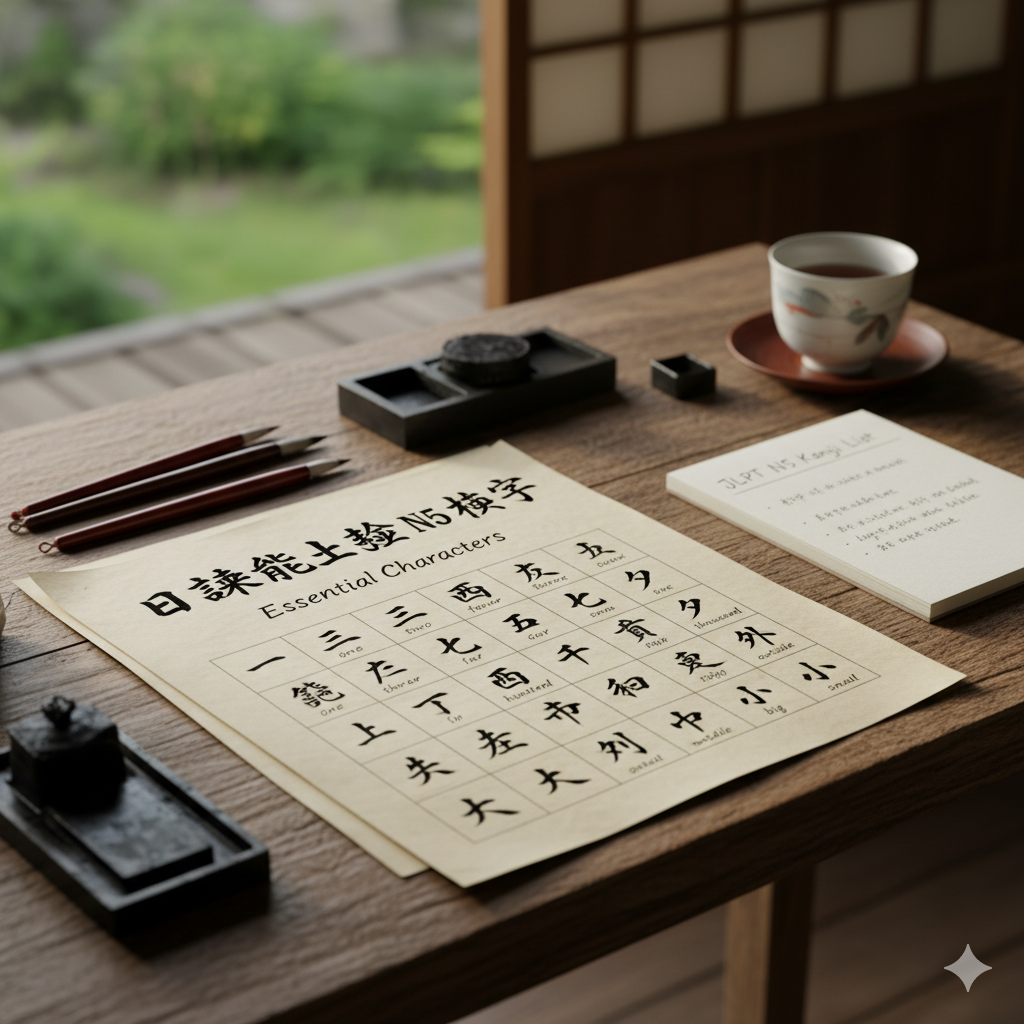
This blog post is your dedicated cluster guide, diving deep into the official list of JLPT N5 kanji. We won’t just throw a chart at you and wish you luck. We’re going to break these characters down into logical groups, explore their meanings, readings, and, most importantly, show you how they are used in real life. Consider this your sensei, your cheat sheet, and your motivational coach, all in one.
By the way, if you’re still getting familiar with the overall structure of the test, our JLPT N5 Kanji Master Guide: List, Meanings, Stroke Order & Practice is the perfect starting point. It covers everything from the test format to study strategies for grammar, vocabulary, and listening.
First, Let’s Demystify: What Exactly is the N5 Kanji List?
The JLPT N5 exam expects you to recognize and understand approximately 100 kanji characters. The keyword here is recognize. At this level, you are not required to produce them from memory (though it’s great practice!). You need to be able to:
- Know their core meaning(s).
- Recognize their most common readings (both onyomi – sound reading, and kunyomi – meaning reading).
- Understand them in the context of simple sentences.
These characters were chosen for a reason: they are the most frequently used kanji in the Japanese language. Mastering them will instantly boost your reading comprehension and make you feel more confident navigating life in Japan (or Japanese media).
A Quick Note on Readings: You’ll see terms like onyomi (音読み) and kunyomi (訓読み). Don’t get too bogged down in the terminology. Simply think of it this way:
- Onyomi: The “original” Chinese-derived reading. Often used when the kanji is part of a compound word with other kanji (e.g., 先生 sensei – teacher).
- Kunyomi: The native Japanese reading. Often used when the kanji is standing alone or with okurigana (hiragana attachments) (e.g., 大きい ookii – big).
Ready to meet your new 100 friends? Let’s group them into manageable categories.
The Organized Learner’s Guide to the 100 Essential N5 Kanji
Trying to learn kanji in a random order is like trying to build a house without a blueprint. Grouping them by theme or similarity makes the process logical and efficient. Here is our expert-recommended categorization of the list of JLPT N5 kanji.
Group 1: The World Around You – Numbers & Time
These are some of the most practical kanji you’ll learn. You’ll see them on clocks, calendars, prices, and schedules.
| Kanji | Meaning | Onyomi | Kunyomi | Example Word |
|---|---|---|---|---|
| 一 | One | ICHI, ITSU | hito(tsu) | 一人 (hitori) – one person |
| 二 | Two | NI | futa(tsu) | 二つ (futatsu) – two things |
| 三 | Three | SAN | mit(tsu) | 三日 (mikka) – third day/3 days |
| 四 | Four | SHI | yon, yot(tsu), yo | 四時 (yoji) – 4 o’clock |
| 五 | Five | GO | itsu(tsu) | 五つ (itsutsu) – five things |
| 六 | Six | ROKU | mut(tsu), mu | 六日 (muika) – sixth day/6 days |
| 七 | Seven | SHICHI | nana(tsu), nano | 七時 (shichiji) – 7 o’clock |
| 八 | Eight | HACHI | yat(tsu), ya | 八つ (yattsu) – eight things |
| 九 | Nine | KYŪ, KU | kokono(tsu) | 九人 (kyūnin) – nine people |
| 十 | Ten | JŪ | tō | 十日 (tōka) – tenth day/10 days |
| 百 | Hundred | HYAKU | – | 百円 (hyaku en) – 100 yen |
| 千 | Thousand | SEN | – | 千円 (sen en) – 1000 yen |
| 万 | Ten thousand | MAN, BAN | – | 一万円 (ichiman en) – 10,000 yen |
| 時 | Time | JI | toki | 時間 (jikan) – time |
| 間 | Interval, space | KAN, KEN | aida, ma | 時間 (jikan) – time |
| 分 | Minute, to understand | FUN, BUN | wa(karu) | 五分 (gofun) – five minutes |
| 半 | Half | HAN | naka(ba) | 半時間 (hanjikan) – half an hour |
| 日 | Day, sun | NICHI, JITSU | hi, -ka | 日曜日 (nichiyōbi) – Sunday |
| 月 | Month, moon | GETSU, GATSU | tsuki | 月曜日 (getsuyōbi) – Monday |
| 火 | Fire | KA | hi | 火曜日 (kayōbi) – Tuesday |
| 水 | Water | SUI | mizu | 水曜日 (suiyōbi) – Wednesday |
| 木 | Tree, wood | MOKU, BOKU | ki | 木曜日 (mokuyōbi) – Thursday |
| 金 | Gold, money | KIN, KON | kane | 金曜日 (kin’yōbi) – Friday |
| 土 | Soil, earth | DO | tsuchi | 土曜日 (doyōbi) – Saturday |
| 年 | Year | NEN | toshi | 今年 (kotoshi) – this year |
| 先 | Previous, ahead | SEN | saki | 先週 (senshū) – last week |
| 今 | Now | KON, KIN | ima | 今日 (kyō) – today |
| 毎 | Every | MAI | – | 毎日 (mainichi) – every day |
Insight & Practical Tip: Notice how the days of the week are made? 日曜日 (Sun-day), 月曜日 (Moon-day), etc. It’s a direct parallel to English! This is a fantastic mnemonic. Also, practice these numbers by reading prices on online Japanese stores like Rakuten or looking up train schedules on HyperDia.
Group 2: People & Society
These kanji describe people, relationships, and basic social concepts. They are the bedrock of forming sentences about yourself and others.
| Kanji | Meaning | Onyomi | Kunyomi | Example Word |
|---|---|---|---|---|
| 人 | Person | JIN, NIN | hito | 日本人 (nihonjin) – Japanese person |
| 男 | Man, male | DAN, NAN | otoko | 男の人 (otoko no hito) – man |
| 女 | Woman, female | JO, NYO | onna | 女の子 (onna no ko) – girl |
| 子 | Child | SHI | ko | 子供 (kodomo) – child |
| 父 | Father | FU | chichi | 父 (chichi) – my father |
| 母 | Mother | BO | haha | 母 (haha) – my mother |
| 友 | Friend | YŪ | tomo | 友達 (tomodachi) – friend |
| 口 | Mouth | KŌ, KU | kuchi | 口 (kuchi) – mouth |
| 目 | Eye | MOKU | me | 目 (me) – eye |
| 耳 | Ear | JI | mimi | 耳 (mimi) – ear |
| 手 | Hand | SHU | te | 手 (te) – hand |
| 足 | Foot, leg | SOKU | ashi, ta(riru) | 足 (ashi) – foot/leg |
| 力 | Power, strength | RYOKU, RIKI | chikara | 力 (chikara) – power |
| 名 | Name | MEI, MYŌ | na | 名前 (namae) – name |
| 生 | Life, to be born | SEI, SHŌ | i(kiru), u(mu) | 学生 (gakusei) – student |
| 学 | To study | GAKU | mana(bu) | 学校 (gakkō) – school |
| 校 | School | KŌ | – | 学校 (gakkō) – school |
| 先生 | Teacher | SENSEI | – | 先生 (sensei) – teacher |
| 社 | Company, shrine | SHA | yashiro | 会社 (kaisha) – company |
Insight & Practical Tip: The kanji for “mother” (母) and “father” (父) have two readings. You use haha and chichi when talking about your own parents to someone else, but you use okaasan and otoosan when addressing them directly or talking about someone else’s parents. It’s a subtle but important cultural nuance!
Group 3: Nature & Directions
These characters help you understand your place in the world, literally. They’re used for geography, weather, and giving/receiving directions.
| Kanji | Meaning | Onyomi | Kunyomi | Example Word |
|---|---|---|---|---|
| 山 | Mountain | SAN | yama | 山 (yama) – mountain |
| 川 | River | SEN | kawa | 川 (kawa) – river |
| 空 | Sky, empty | KŪ | sora, a(ku) | 空 (sora) – sky |
| 天 | Heaven, sky | TEN | ame, ama | 天気 (tenki) – weather |
| 気 | Spirit, energy | KI, KE | – | 天気 (tenki) – weather |
| 雨 | Rain | U | ame | 雨 (ame) – rain |
| 電 | Electricity | DEN | – | 電車 (densha) – train |
| 車 | Car, vehicle | SHA | kuruma | 電車 (densha) – train |
| 上 | Above, up | JŌ | ue, aga(ru) | 上 (ue) – above |
| 下 | Below, down | KA, GE | shita, sa(garu) | 下 (shita) – below |
| 中 | Inside, middle | CHŪ | naka | 中 (naka) – inside |
| 外 | Outside | GAI, GE | soto, hoka | 外 (soto) – outside |
| 左 | Left | SA | hidari | 左 (hidari) – left |
| 右 | Right | U, YŪ | migi | 右 (migi) – right |
| 東 | East | TŌ | higashi | 東京 (Tōkyō) – Tokyo |
| 西 | West | SEI, SAI | nishi | 西 (nishi) – west |
| 南 | South | NAN | minami | 南 (minami) – south |
| 北 | North | HOKU | kita | 北 (kita) – north |
Insight & Practical Tip: 電車 (densha – train) literally means “electric car.” 天気 (tenki – weather) literally means “heaven’s energy.” Understanding these compound words makes them much easier to remember. Try to find a map of Japan and identify the Kanto (東) region (east) and Kansai (関西) region (west of the barrier).
Group 4: Verbs & Adjectives (Action Words!)
Many kanji represent core verbs and adjectives. Learning these will supercharge your ability to form simple sentences.
| Kanji | Meaning | Onyomi | Kunyomi | Example Word |
|---|---|---|---|---|
| 見 | To see | KEN | mi(ru) | 見る (miru) – to see |
| 行 | To go | KŌ, GYŌ | i(ku), okona(u) | 行く (iku) – to go |
| 来 | To come | RAI | ku(ru) | 来る (kuru) – to come |
| 出 | To exit | SHUTSU | de(ru), da(su) | 出る (deru) – to exit |
| 入 | To enter | NYŪ | hai(ru), i(reru) | 入る (hairu) – to enter |
| 食 | To eat | SHOKU | ta(beru) | 食べる (taberu) – to eat |
| 飲 | To drink | IN | no(mu) | 飲む (nomu) – to drink |
| 言 | To say | GEN, GON | i(u) | 言う (iu) – to say |
| 話 | To speak, talk | WA | hanashi, hana(su) | 話す (hanasu) – to speak |
| 聞 | To hear, listen | BUN | ki(ku) | 聞く (kiku) – to listen |
| 読 | To read | DOKU | yo(mu) | 読む (yomu) – to read |
| 書 | To write | SHO | ka(ku) | 書く (kaku) – to write |
| 立 | To stand | RITSU | ta(tsu) | 立つ (tatsu) – to stand |
| 休 | To rest | KYŪ | yasu(mu) | 休む (yasumu) – to rest |
| 会 | To meet | KAI | a(u) | 会う (au) – to meet |
| 買 | To buy | BAI | ka(u) | 買う (kau) – to buy |
| 大 | Big | DAI, TAI | ō(kii) | 大きい (ōkii) – big |
| 小 | Small | SHŌ | chii(sai), ko | 小さい (chiisai) – small |
| 新 | New | SHIN | atara(shii) | 新しい (atarashii) – new |
| 古 | Old | KO | furu(i) | 古い (furui) – old |
| 安 | Cheap, safe | AN | yasu(i) | 安い (yasui) – cheap |
| 高 | Expensive, tall | KŌ | taka(i) | 高い (takai) – expensive/tall |
| 白 | White | HAKU, BYAKU | shiro, shiro(i) | 白い (shiroi) – white |
| 長 | Long | CHŌ | naga(i) | 長い (nagai) – long |
Insight & Practical Tip: Most action kanji have a kunyomi reading that ends with a verb in hiragana (e.g., 見る, 食べる). This is called okurigana. Focus on learning the kanji plus its accompanying hiragana as a single unit. It’s not just “見”, it’s “見る”.
Group 5: The Essentials & Miscellany
These are the crucial “glue” words that hold sentences together—pronouns, places, and important concepts.
| Kanji | Meaning | Onyomi | Kunyomi | Example Word |
|---|---|---|---|---|
| 私 | I, me | SHI | watakushi, watashi | 私 (watashi) – I, me |
| 本 | Book, origin | HON | moto | 本 (hon) – book |
| 何 | What | KA | nani, nan | 何 (nani) – what |
| 町 | Town | CHŌ | machi | 町 (machi) – town |
| 店 | Shop | TEN | mise | 本屋 (honya) – bookstore |
| 国 | Country | KOKU | kuni | 中国 (Chūgoku) – China |
| 方 | Direction, person | HŌ | kata | 方 (kata) – person (polite) |
| 円 | Yen, circle | EN | maru(i) | 百円 (hyaku en) – 100 yen |
| 語 | Language, word | GO | kata(ru) | 日本語 (nihongo) – Japanese language |
How to Actually Learn and Remember These Kanji: An Expert’s Study Plan
Knowing the list of JLPT N5 kanji is one thing; memorizing it is another. Here is a battle-tested strategy:
- Learn in Context, Not in Isolation: Never just stare at a single kanji. Always learn it as part of a word. Instead of memorizing 食 (eat), memorize 食べる (taberu – to eat) and 食事 (shokuji – a meal).
- Use Spaced Repetition Software (SRS): This is non-negotiable for efficiency. Tools like Anki or WaniKani use algorithms to show you flashcards just before you’re about to forget them. It’s incredibly powerful.
- Storytelling & Mnemonics: Our brains love stories. The kanji 休 (to rest) is a person (人) leaning against a tree (木). That’s a perfect mnemonic! Create little stories for each character.
- Write Them Out: Even though you don’t need to produce them for the test, the physical act of writing helps with muscle memory. Practice writing each kanji 5-10 times while saying its meaning and reading aloud.
- Read, Read, Read: Find super-basic reading material. Children’s books, NHK’s easy news site NHK Web Easy, or dedicated graded readers are perfect. You’ll be thrilled when you start recognizing kanji “in the wild.”
For a more detailed breakdown of these study techniques, check out our guide on Decoding the JLPT N5: Your Ultimate Guide to Passing Marks & The Scoring System
Putting It All Together: Practice Reading with N5 Kanji
Let’s test your knowledge! Here is a simple paragraph using only grammar and vocabulary (including kanji) that you would find at the N5 level. Can you read it?
日本語の勉強
私は学生です。毎日、学校に行きます。学校は九時から三時までです。午後、友達と日本語を勉強します。時々、町の店で買い物をします。小さい本や安い食べ物を買います。日曜日は休みです。父と母と食事をします。
(Translation: Japanese Language Study. I am a student. Every day, I go to school. School is from 9 to 3. In the afternoon, I study Japanese with a friend. Sometimes, I go shopping at town shops. I buy small books and cheap food. Sunday is a day of rest. I have a meal with my father and mother.)
Seeing them in action makes a huge difference, doesn’t it?
Beyond the List: Your Next Steps
Mastering this list of JLPT N5 kanji is a huge accomplishment. But remember, kanji are just one part of the language puzzle. To truly succeed on the JLPT N5, you need to integrate this knowledge with grammar and listening practice.
Final Words of Encouragement
Learning 100 kanji might seem like a mountain now, but you will climb it one character at a time. Celebrate small victories. Did you recognize a kanji on a restaurant menu? That’s a win! Did you remember how to write 食べ物 without looking? Huge win!
Be patient with yourself. Language learning is a marathon, not a sprint. You have all the tools you need right here. Grab your notebook, fire up your flashcards, and start your journey.
Ganbatte kudasai! (Do your best!)
あなたの成功を祈っています!(We wish you success!)


