The Confused Kitchen & Classroom: An Introduction
When I first started teaching Japanese to students from South Asia, I noticed a very common, almost comical moment of confusion. I’d be enthusiastically introducing the concept of $\text{Kanji}$—the majestic, ancient characters borrowed from Chinese—and a student would raise their hand and ask, “Sensei, why are we learning about rice flour or porridge?”
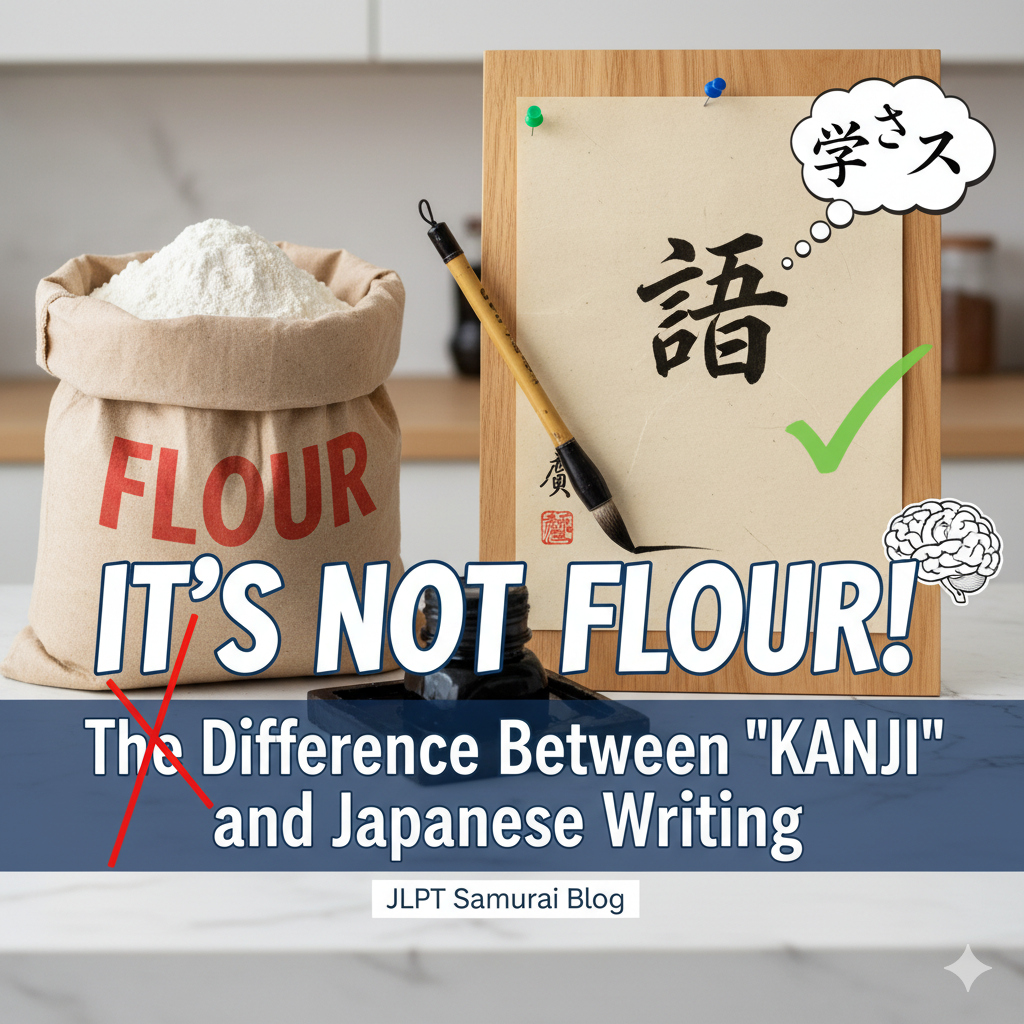
The room would erupt in laughter, but the question was completely valid!
This simple query highlights a fascinating linguistic overlap that causes a persistent headache for language learners and curious minds alike. The truth is, the two words—the foundational component of the Japanese writing system and the simple starch or porridge ingredient—are spelled the same way in the Roman alphabet (Romaji), but they are worlds apart in meaning, origin, and pronunciation.
If you’re studying Japanese, preparing for the JLPT (Japanese Language Proficiency Test), or just trying to understand the basics of this beautiful language, it is crucial to understand this distinction. It’s the difference between asking for a simple ingredient in a kitchen and writing a complex philosophical concept on paper.
In this deep-dive, we will unravel this linguistic mystery. We’ll explore the history of the $\text{Kanji}$ writing system, provide a clear pronunciation guide to avoid awkward mix-ups, and offer practical study tips, all while establishing once and for all: It’s Not Flour!
The Star of the Show: The Japanese Writing System
Let’s begin with the subject that brings most people to this article: the Japanese writing system.
What is $\text{Kanji}$ (漢字)?
The word $\text{Kanji}$ ($\text{漢字}$) translates literally as “Han characters.” $\text{Han}$ refers to the dominant ethnic group in China, and $\text{zi}$ ($\text{字}$) means character or letter. Therefore, $\text{Kanji}$ are simply Chinese characters used in the Japanese language.
Japan adopted these characters over a thousand years ago, primarily to aid in government, record-keeping, and the study of Chinese texts.
- Origin: Ancient China.
- Role in Japanese: It is one of the three primary components of the modern Japanese writing system, alongside $\text{Hiragana}$ (used for native Japanese words and grammatical particles) and $\text{Katakana}$ (used for foreign loan words, emphasis, and sound effects).
- Function: $\text{Kanji}$ is typically used to write the stems of nouns, verbs, and adjectives. They carry rich semantic meaning, making the text concise and less ambiguous.
The Complexity of $\text{Kanji}$ Readings: $\text{On’yomi}$ vs. $\text{Kun’yomi}$
This is where the true complexity—and beauty—lies. Because $\text{Kanji}$ were borrowed, they often have two primary types of readings:
- $\text{On’yomi}$ ($\text{音読み}$ – Sound Reading): This is the reading that approximates the original Chinese pronunciation at the time it was introduced to Japan. It is typically used when $\text{Kanji}$ are combined to form compounds (like $\text{大学}$ – $\text{daigaku}$ – university).
- $\text{Kun’yomi}$ ($\text{訓読み}$ – Meaning Reading): This is the native Japanese reading given to the $\text{Kanji}$ to match an existing Japanese word with the same meaning. It is typically used when a $\text{Kanji}$ stands alone or is followed by $\text{Hiragana}$ (like $\text{食}$べる – $\text{taberu}$ – to eat).
Expert Insight: For JLPT students, understanding the context is key. If you see two or more $\text{Kanji}$ together, you usually use the $\text{On’yomi}$. If a $\text{Kanji}$ is followed by $\text{okurigana}$ ($\text{送り仮名}$ – trailing $\text{Hiragana}$), you almost always use the $\text{Kun’yomi}$. This is a practical application of your knowledge!
How Many $\text{Kanji}$ Do I Need to Know? (The JLPT Perspective)
The sheer number of $\text{Kanji}$ can be overwhelming, but for practical purposes, the required number is manageable.
| JLPT Level | Approximate Kanji Required | Focus |
| N5 (Beginner) | ~100 | Basic nouns, numbers, and core verbs. |
| N4 (Upper Beginner) | ~300 | Everyday concepts, time, location, and simple phrases. |
| N3 (Intermediate) | ~650 | Abstract concepts, more complex verbs, and common news/text readings. |
| N2 (Upper Intermediate) | ~1000 | Ability to read most newspapers and general literature. |
| N1 (Advanced) | ~2000+ | All $\text{Jōyō}$ $\text{Kanji}$ ($\text{常用漢字}$ – the 2,136 officially designated characters for general use). |
The official list of $\text{Jōyō}$ $\text{Kanji}$ is 2,136 characters. Mastering these is the benchmark for high-level Japanese literacy.
The Confuser: ‘Kanji’ as a Common Noun in South Asia
Now, let’s turn our attention to the other ‘kanji’—the one that belongs in the kitchen, not in a textbook.
What is ‘Kanji’ (Rice Starch/Porridge)?
The word ‘kanji’ is a common term in several South Asian languages, particularly Hindi, Urdu, and Bengali, though it is sometimes referred to by other names. It refers to:
- Rice Starch Water: The thin, starchy liquid left over after boiling rice. This is often used for medicinal purposes (like treating stomach ailments) or even as a hair treatment.
- Porridge/Gruel: A thin, runny rice porridge.
- A Fermented Drink: In some contexts, particularly parts of North India, $\text{Kanji}$ is a traditional, sour, fermented beverage made with black carrots, mustard seeds, and water, often consumed during the festival of Holi.
The Linguistic Disconnect: Pronunciation is Key
This is the most critical piece of information for avoiding confusion. While the Romanized spelling is the same, the sounds in the native languages are fundamentally different.
| Term | Language | Romanization | Pronunciation | Tone/Stress | Meaning |
| $\text{漢字}$ | Japanese | Kanj-i | Kahn-jee | $\text{The stress is relatively even, and the ‘j’ is a sharp, clear ‘j’ sound.}$ | Chinese character/Writing System |
| कंजी | Hindi/Urdu | kanji | Kuh-njeee | $\text{Often a softer ‘j’ sound (closer to a ‘z’ or ‘zh’ sound in some dialects), and the vowel sounds are different.}$ | Rice Starch Water/Porridge |
Humanizing the Sound: Think of it this way:
- Japanese $\text{Kanji}$: Say “Can” (like a metal can) and then “Gee” (like the sound a clock makes). $\text{CAN-GEE}$
- Indian $\text{Kanji}$: Say the first part of “Cup” ($\text{Cuh}$) and then “Njeee” (with a drawn-out ‘e’ sound). $\text{CUH-NJEEE}$
While these are approximations, the difference in the vowel quality and the position of the tongue for the ‘j’ sound is enough for a native speaker of either language to instantly know which one you mean. The similarity is purely an accident of the Romanization system.
SEO and Language Learner Insights: Practical Application
Why does this matter for your Japanese journey and the JLPT? Because $\text{Kanji}$ is the cornerstone of advanced Japanese, and mastering it requires structured study.
Unique Insight: The Secret of Recognition Over Memorization
Many students fail at $\text{Kanji}$ because they treat the 2,000+ characters as 2,000+ individual drawings to be memorized. This is a mistake.
The secret to conquering $\text{Kanji}$ is to see them not as pictures, but as logical compounds of semantic and phonetic components.
- Radicals ($\text{部首}$ – $\text{bushu}$): Every $\text{Kanji}$ has a primary $\text{radical}$ that often hints at its meaning. For example, any $\text{Kanji}$ with the $\text{radical}$ $\text{水}$ ($\text{water}$) on the left will likely be related to water, liquid, or a state of being wet:
- $\text{泳}$ ($\text{oyogu}$ – to swim)
- $\text{流}$ ($\text{nagasu}$ – to flow)
- $\text{湖}$ ($\text{mizuumi}$ – lake)
- Practical Application: When studying a new $\text{Kanji}$, first identify its $\text{radical}$. This gives you a category of meaning, making it easier to file away in your memory.
- Phonetic Components: In many complex $\text{Kanji}$, one part of the character is present only to indicate its sound ($\text{On’yomi}$).
- The $\text{Kanji}$ $\text{青}$ ($\text{ao}$ – blue/$\text{sei}$) contributes its $\text{on’yomi}$ ($\text{sei}$) to other characters like $\text{清}$ ($\text{kiyoi}$ – pure/$\text{sei}$) and $\text{晴}$ ($\text{hareru}$ – clear weather/$\text{sei}$).
- Practical Application: If you know $\text{Kanji}$ A has an $\text{On’yomi}$ of “sei,” and you see it as a component in $\text{Kanji}$ B, there’s a good chance $\text{Kanji}$ B will also have an $\text{On’yomi}$ of “sei,” “shō,” or “jō.” This drastically cuts down on rote memorization.
This method transforms $\text{Kanji}$ learning from a monotonous drawing exercise into a logical puzzle, which is far more engaging and effective, especially for the demanding vocabulary sections of the JLPT.
Humanizing the Learning Process: A Teacher’s Advice
Learning $\text{Kanji}$ is not a sprint; it’s a marathon that lasts your entire Japanese-speaking life. Don’t be too hard on yourself.
- The Power of Context: Stop studying $\text{Kanji}$ in isolation! The best way to humanize the process is to learn $\text{Kanji}$ in the context of real words and sentences. When you learn the character for $\text{食}$ ($\text{to eat}$), don’t just learn $\text{shoku}$; learn the word $\text{食堂}$ ($\text{shokudō}$ – dining hall) or $\text{食べる}$ ($\text{taberu}$ – to eat). This immediately gives you the most common $\text{On’yomi}$ and $\text{Kun’yomi}$ and a practical application.
- Spaced Repetition Systems (SRS): Tools like Anki are your best friends. They use an algorithm to show you cards (Kanji, vocabulary, grammar) at increasing intervals, ensuring you review the information just before you forget it. This is the single most effective study hack for the JLPT.
- Read! Read! Read! The most organic way to master the Kanji writing system is through exposure. Start with simple $\text{Hiragana}$ texts and slowly transition to material that uses more and more $\text{Kanji}$. This is how a native speaker builds literacy. Reading manga with $\text{furigana}$ (the small $\text{Hiragana}$ above the $\text{Kanji}$) is a fantastic, human-friendly entry point.
The $\text{Kanji}$ Conclusion: From Starch to Symbol
The next time someone mentions the word “kanji,” you’ll know exactly how to handle the confusion. You can confidently explain the difference between the starchy water from boiled rice and the sophisticated writing system that underpins a global language.
The $\text{Kanji}$ writing system is a challenge, but it is also the key to unlocking the true richness, history, and depth of Japanese culture and literature. It’s what differentiates a beginner from a fluent speaker, and what will allow you to pass the highest levels of the JLPT.
Embrace the complexity of the $\text{Kanji}$ script, and leave the rice starch where it belongs—in the kitchen!
Further Learning & Resources
To continue your journey mastering the Kanji writing system for the JLPT and beyond, check out these excellent external resources:
- For learning all the official $\text{Kanji}$ meanings and stroke orders: The Japan Times provides fantastic, reliable information on the standard characters used in modern Japanese. Jōyō Kanji List – The Japan Times
- For practical, level-specific JLPT vocabulary and grammar practice: Focusing your study on the official requirements is essential for test success. JLPT Official Practice Workbooks – Japan Educational Exchanges and Services
- For a detailed linguistic overview of the Japanese writing systems (Kanji, Hiragana, Katakana): Understanding the historical and linguistic context will deepen your appreciation and retention. An Overview of the Japanese Writing System – Oxford University Press
Diving Deeper: The History and Evolution of $\text{Kanji}$
To truly appreciate the $\text{Kanji}$ writing system, we must travel back in time. It wasn’t a sudden adoption; it was a slow, complex cultural transfer that shaped the language forever.
The Great Arrival: Kofun and Asuka Periods
$\text{Kanji}$ began arriving in Japan around the 5th century CE, primarily through contact with Chinese scholars, Buddhist monks, and Korean emissaries. Initially, there was no native Japanese writing system. $\text{Kanji}$ were first used simply to write Chinese.
The challenge was immense: How do you use a language’s writing system (Chinese) to write a grammatically distinct language (Japanese)?
Chinese is an isolating language, meaning its word order is strict (Subject-Verb-Object), and it relies heavily on characters that represent a single syllable or morpheme. Japanese, on the other hand, is an agglutinative language, meaning it relies on particles and suffixes to change meaning and is Subject-Object-Verb.
The Birth of $\text{Kana}$: A Necessary Simplification
The solution was brilliant: simplify the complex $\text{Kanji}$ to create a phonetic alphabet. This process gave birth to $\text{Hiragana}$ and $\text{Katakana}$ (collectively known as $\text{Kana}$).
- $\text{Man’yōgana}$ ($\text{万葉仮名}$): This was the first step. $\text{Kanji}$ were used purely for their sound to represent Japanese syllables, completely ignoring their original meaning. For example, the $\text{Kanji}$ $\text{安}$ ($\text{yasui}$ – cheap/peaceful) might be used just for the sound ‘a’.
- $\text{Hiragana}$ ($\text{ひらがな}$): Evolved from the cursive form of $\text{Man’yōgana}$, $\text{Hiragana}$ (“plain $\text{kana}$”) was initially used by women in the Heian court for poetry and diaries, hence its beautiful, flowing script. It became the primary script for writing native Japanese words, grammatical elements (particles like $\text{は}$, $\text{を}$, $\text{に}$), and verb/adjective endings ($\text{okurigana}$).
- $\text{Katakana}$ ($\text{カタカナ}$): Evolved from a fragment of a $\text{Man’yōgana}$ character, $\text{Katakana}$ (“fragmentary $\text{kana}$”) was used by Buddhist monks as a shorthand tool for reading and annotating Chinese texts. Today, it is primarily used for foreign loan words (e.g., $\text{コンピューター}$ – $\text{konpyūtā}$ – computer), technical terms, and for emphasis.
Expert Insight for JLPT N5-N4: The simple presence of three scripts—$\text{Kanji}$, $\text{Hiragana}$, and $\text{Katakana}$—is not a random aesthetic choice. It is a highly efficient system. $\text{Kanji}$ carries the meaning, $\text{Hiragana}$ handles the grammar, and $\text{Katakana}$ updates the lexicon with new global terms. This makes Japanese highly efficient and easy to parse visually, despite its initial perceived complexity.
The Post-War Standard: The $\text{Jōyō}$ List
After World War II, the Japanese government undertook a significant reform to simplify and standardize the writing system to promote universal literacy. This effort resulted in the $\text{Tōyō}$ $\text{Kanji}$ ($\text{当用漢字}$ – $\text{Kanji}$ for general use) list, which was later revised and expanded to the current $\text{Jōyō}$ $\text{Kanji}$ ($\text{常用漢字}$ – $\text{Kanji}$ for daily use) list of 2,136 characters.
The $\text{Jōyō}$ list dictates the characters used in media, education, and government documents. All JLPT exams, from N5 to N1, are based on this core set of characters. Mastering these is the definition of Japanese literacy.
Advanced $\text{Kanji}$ Insights for the JLPT N2/N1 Student
If you’ve cleared the N3 and are tackling the upper levels, you need more than just rote memorization. You need to understand the nuance of $\text{Kanji}$ compounds.
Insight 1: Verb Pairs and Transitivity
A fascinating application of $\text{Kanji}$ is in Japanese verb pairs. Many verbs come in a transitive/intransitive set, meaning:
- Transitive: Requires a direct object (e.g., I open the door.).
- Intransitive: Does not require a direct object (e.g., The door opens.).
Often, these pairs share the same core $\text{Kanji}$, but the $\text{okurigana}$ ($\text{Hiragana}$ ending) differs:
| Kanji | Transitive (with object) | Intransitive (no object) | Meaning |
| 開 | $\text{開ける}$ ($\text{akeru}$) | $\text{開く}$ ($\text{aku}$) | To open |
| 閉 | $\text{閉める}$ ($\text{shimeru}$) | $\text{閉まる}$ ($\text{shimaru}$) | To close |
| 始 | $\text{始める}$ ($\text{hajimeru}$) | $\text{始まる}$ ($\text{hajimaru}$) | To begin |
Practical Application: Learning these pairs together under the same $\text{Kanji}$ dramatically increases your vocabulary efficiency for the JLPT and helps you master the crucial $\text{が}$ (subject marker) vs. $\text{を}$ (object marker) particle distinction.
Insight 2: The Logic of $\text{On’yomi}$ Compounds
The $\text{On’yomi}$ ($\text{sound reading}$) is not random. It is categorized into different historical Chinese import periods, such as $\text{Go-on}$ ($\text{呉音}$ – arrived earliest, often used in Buddhist terms) and $\text{Kan-on}$ ($\text{漢音}$ – arrived later, most common).
A simple $\text{Kanji}$ might have both a $\text{Go-on}$ and a $\text{Kan-on}$. For example, the $\text{Kanji}$ $\text{行}$ (to go) has readings:
- $\text{Go-on}$: $\text{gyō}$ (e.g., $\text{旅行}$ – $\text{ryokō}$ – travel)
- $\text{Kan-on}$: $\text{kō}$ (e.g., $\text{行為}$ – $\text{kōi}$ – act/behavior)
Practical Application: When you encounter a compound word ($\text{Kanji}$ + $\text{Kanji}$), observe the entire block. If it is a common, older term (like those related to religion, time, or traditional concepts), the reading might default to $\text{Go-on}$. If it’s a newer, more formal or technical term, the reading is often $\text{Kan-on}$. Recognizing this pattern helps you make educated guesses on N2 and N1 reading questions.
The Human Touch: Overcoming $\text{Kanji}$ Frustration
Let’s be honest. There will be days where you look at a $\text{Kanji}$ like $\text{憂鬱}$ ($\text{yūutsu}$ – melancholy/depression) and feel overwhelmed. It happens to every single learner.
The key to a humanized learning process is to acknowledge the frustration and develop a sustainable, enjoyable habit:
- The $\text{Kanji}$ Story: Stop trying to write the character 100 times. Instead, make a bizarre, memorable story that connects the radicals.
- Example: For the $\text{Kanji}$ $\text{休}$ ($\text{yasumu}$ – to rest), which is composed of $\text{人}$ ($\text{person}$) and $\text{木}$ ($\text{tree}$), your story is: “A person takes a rest under a tree.” The simpler and sillier the story, the better you will remember it.
- The “One a Day” Rule: Consistency beats intensity. It is far more effective to learn one new $\text{Kanji}$ with its most common word, two readings, and a story every day than to cram 50 on a Saturday and forget them by Monday.
- Appreciate the Art: Look at the $\text{Kanji}$ not just as a symbol, but as an art form. The stroke order is not a suggestion; it’s a necessity that makes the character beautiful and balanced. Slow down, appreciate the balance of the radicals, and you’ll find the process becomes meditative, not maddening.
🔗 For More Resources You Might Find Helpful
Kanji Spotlight: Why is Money (お金 – Okane) Written with the Gold Radical 金 – JLPT Samurai
The Ultimate Guide to Namae Kanji: How to Write and Read Japanese Names Correctly – JLPT Samurai
Hanzi vs. Kanji: Understanding the Key Differences for Chinese and Japanese Learners – JLPT Samurai
JLPT Preparation: How to Learn 15 Kanji Per Day with Component Study – JLPT Samurai
Beyond the Battlefield: Essential Japanese Vocabulary for Gaming and Anime Fans – JLPT Samurai