Konnichiwa, fellow Japanese language learners! I’m going to level with you. When I first started learning Japanese, I loved the elegance of Hiragana. It felt warm, rounded, and… approachable. Then came Katakana.
It’s often called the “angular script,” and honestly, for a while, it felt like my brain was trying to translate hieroglyphics. Those straight lines and sharp corners just didn’t want to stick! It’s the essential, yet often-dreaded, second step after Hiragana. We all know that Katakana is vital—it’s the script for all foreign loanwords, onomatopoeia, and emphasis—but memorizing 46 (plus variants!) characters that look frustratingly similar (like ソ, ン, シ, and ツ) can feel like a chore.
If you’re nodding your head, you’re in the right place.
You’ve already understood the core importance of this script (if you haven’t, quickly check out our pillar post: The Ultimate Guide to Katakana: Rules, Importance, and Learning Methods). You know why you need to learn it. Now, we’re diving into the how.
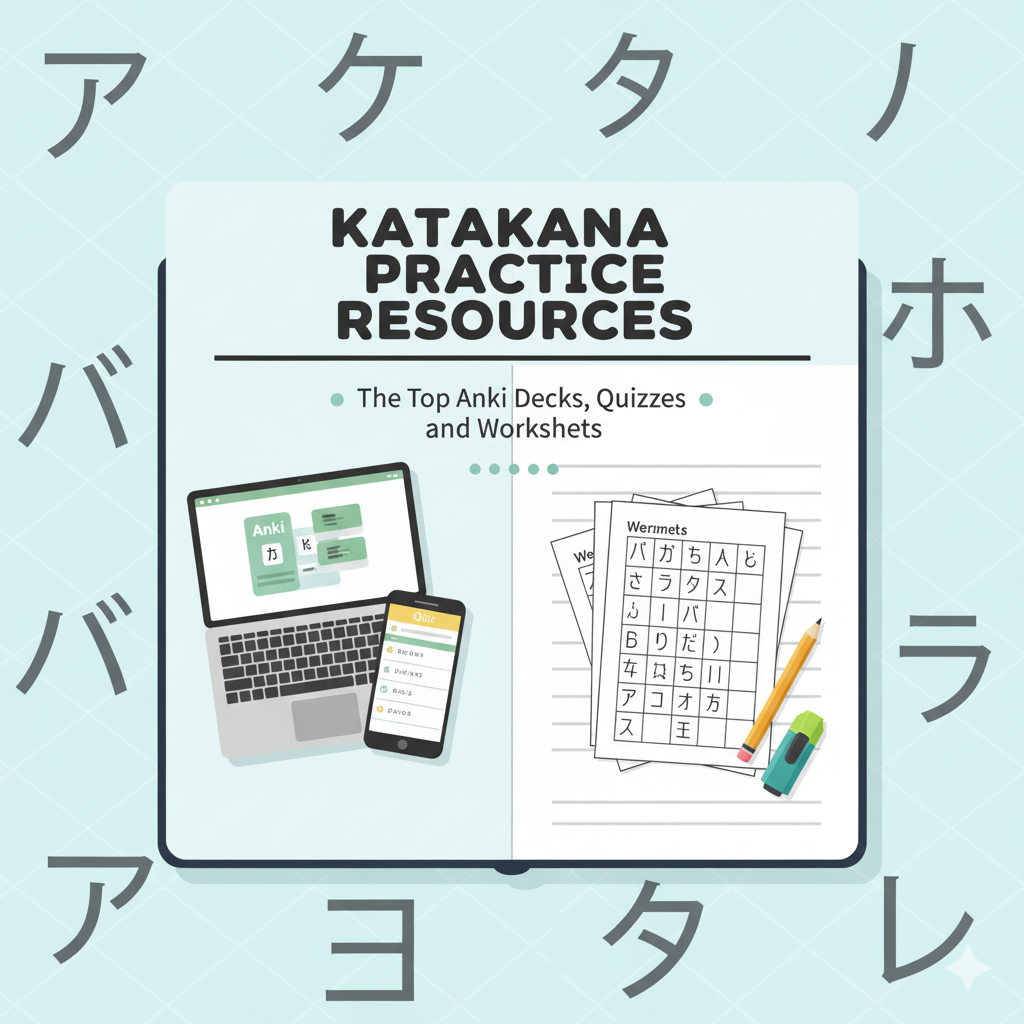
Forget flipping through flashcards made from scrap paper. As a long-time Japanese language expert and JLPT enthusiast, I’ve tried virtually every study method out there. Today, I’m sharing the absolute best, most efficient, and, dare I say, enjoyable resources to drill Katakana into your long-term memory. We’re talking about powerful digital tools like Katakana Anki decks, challenging online quizzes, and beautifully designed, effective worksheets.
Ready to stop confusing so with n? Let’s get started.
🚀 Part 1: The Digital Dynamo – Mastering Katakana with Anki
When it comes to pure, unadulterated, memory-hacking efficiency, nothing beats Anki. If you aren’t using Anki, you’re not studying Japanese—you’re just reading Japanese. Anki is a flashcard program that uses Spaced Repetition System (SRS) technology. This means it shows you the cards you know well less often, and the cards you struggle with (like those tricky Katakana look-alikes!) more often, right before you’re about to forget them. It’s science-backed and, frankly, non-negotiable for serious learners.
The Search for the Perfect Katakana Anki Deck
The beauty of Anki is its community. The downside? There are hundreds of decks, and sifting through the duds can be a waste of precious study time. Based on years of personal testing and recommendations to my students, here are the top-tier decks you should download right now.
1. The “All-in-One” Champion: The Best Anki Hiragana and Katakana Deck
For any beginner, the most effective tool is a unified deck. Why? Because it solidifies the fundamental understanding that Katakana and Hiragana are just two different ways to write the exact same sounds.
- Deck Recommendation: “Tae Kim’s Guide to Learning Japanese – Katakana & Hiragana” (or a similarly high-rated community deck with audio).
- Why it Works:
- Audio is Key: Many excellent decks include native-speaker audio. When you see the character su (ス), you hear it instantly. This links the visual form directly to the sound, bypassing the English “S-U” intermediary.
- “Reverse” Practice: The best decks don’t just show you ス and ask for “su.” They also show you the sound “su” and ask you to type or recall the character ス. This two-way testing is crucial for rapid recall when reading and writing.
- Focus on Differentiation: High-quality decks will often have “cloze deletion” or separate cards that specifically target similar-looking characters. Look for cards that challenge you with: シ vs. ツ vs. ソ vs. ン. This is where most people fail, so drilling this specifically saves weeks of frustration.
2. The “Loanword Power-Up”: Katakana Anki for Practical Application
Memorizing a character in isolation is one thing; recognizing it in a foreign loanword (gairaigo) is another. This is the practical application that moves Katakana from theoretical knowledge to a daily language tool.
- Deck Recommendation: Search the Anki shared decks for “Katakana Loanwords” or “Gairaigo”.
- Unique Insight & Practical Application:
- Contextual Learning: Instead of just practicing “テ” (te), you see it in the word ホテル (Hotels). This is how you bypass the “oh, what was that character again?” delay. You learn the characters in context.
- The “L-Sound” Challenge: English loanwords often use characters that don’t exist in native Japanese (like $fa$, $vi$, $ti$). A good loanword deck will focus heavily on the small $ya$, $yu$, $yo$ modifications and the infamous long-vowel mark (ー). My students often overlook this, yet it’s critical for reading English names and brand names correctly (e.g., $ma-\text{ku}$ for mark).
💡 Pro-Tip from a JLPT Expert: Don’t just rely on pre-made decks. Once you’ve mastered the basics, create a small, personalized Katakana Anki deck of your own name and the names of five of your friends, written in Katakana. The personal connection makes the characters unforgettable!
🔢 Part 2: The Assessment Arena – Katakana Quizzes and Testing Tools
Anki is fantastic for input (memorizing), but a quiz is the best tool for output (retrieval and assessment). Quizzes force your brain to recall information under pressure—a skill you absolutely need for reading street signs, menus, or sitting for the JLPT.
1. The “Speed Demon”: Online Katakana and Hiragana Quizzes
Immediate feedback is a powerful motivator. Online quizzes are great for quick, intense sessions.
- Recommended Resource: Tofugu’s Kana Invaders (or a similar arcade-style drill).
- Why it Works: Gamification makes rote memorization fun. The pressure of a timer and the satisfaction of “clearing” a set of characters keep you coming back. Use these for 5-minute bursts when you need a break but want to stay productive.
2. The “Real-World Reader”: Katakana-Heavy Reading Practice
The best Katakana and Hiragana quiz isn’t always a flashcard quiz—it’s a reading challenge.
- Practical Application: Start reading real Japanese content that is naturally heavy on Katakana.
- Manga/Games: Japanese Pokémon names, foreign-language spell attacks, and video game menus are often saturated with Katakana.
- Recipe Sites: Look up a recipe for Karē (curry)—the ingredients list will be a Katakana feast: tamato (トマト), jagaimo (ジャガイモ), kyabetsu (キャベツ).
3. The JLPT Perspective (A Must-Do for Serious Learners)
If you are aiming for the JLPT, especially N5 or N4, you need to be able to distinguish Katakana from Hiragana instantly.
- Interlinking & Deeper Dive: Understanding this distinction is key to passing the reading section. If you’re still confusing the scripts, take a moment to review our post: Katakana vs. Hiragana: A Beginner’s Visual and Functional Comparison.
- Expert Insight: In the JLPT, you won’t be quizzed on Katakana directly, but you will be tested with Katakana words. Your speed at identifying them in a reading passage saves you critical time for tougher grammar and Kanji sections. Treat your Katakana and Hiragana quiz practice as a race against the clock.
📝 Part 3: The Tactile Touch – Katakana Worksheets and Writing Practice
We live in a digital world, but handwriting is crucial for memory consolidation. The motor memory you develop when drawing a character with a pen is a powerful supplement to your digital study. It engages a different part of your brain—a part that’s particularly effective at making characters “stick.”
1. The Necessity of Stroke Order
Anyone can scribble a character, but writing it correctly is essential for two reasons: legibility and recall. When you follow the correct stroke order, the character flows naturally, making it easier to remember and faster to write.
- Interlinking & Essential Reading: If your handwriting looks messy or you’re unsure of the flow, please stop right now and consult our guide: Mastering Stroke Order: How to Write Katakana Characters Correctly. This is foundational.
2. Finding the Right Katakana Worksheets
The best Katakana worksheets provide three things: a clear model, directional arrows, and space for practice.
- Resource Type: Look for Genkō Yōshi (grid paper) style worksheets with a faint grey character model.
- Practical Application: The “Shadow Writing” Technique:
- Trace: Start by tracing the character with the correct stroke order.
- Shadow: Write the character next to the model, trying to match it perfectly.
- Recall: Move to a blank square and write the character from memory.
- The Power of Repetition (The Human Element): Don’t just do one worksheet and think you’re done. I remember spending one entire, rainy Saturday morning filling two whole notebooks with Katakana. It was tedious, but that dedicated, quiet time, without any screens, is what finally unlocked the script for me. Dedication, not just smart tools, is the key.
3. Utilizing Japanese Fonts for Practice
- Expert Insight: For a unique and free practice tool, download a Japanese font (like MS Gothic or Meiryo) onto your computer. Type out your practice characters, print them out, and use a blank sheet of paper to copy them, focusing on the font’s clean, angular style. This acts as an endless supply of pristine models.
🔗 Part 4: Synthesizing Your Study Plan (The “How-To”)
The secret to success isn’t just having the resources—it’s how you combine them. My recommended 3-Week Katakana Challenge integrates all these tools into a powerhouse study plan.
- Week 1: The Input Phase (Anki Focus)
- Goal: Learn to recognize all 46 core characters and their 25 variants (dakuten/handakuten).
- Action: Dedicate 20 minutes a day to your Katakana Anki deck. Aim for 10 new cards a day, focusing purely on recognition (seeing the character, recalling the sound). Don’t touch writing yet.
- Week 2: The Output and Differentiation Phase (Quiz & Handwriting Focus)
- Goal: Rapid recall and differentiation of similar characters.
- Action: Continue Anki reviews. Introduce Katakana and Hiragana quizzes for 10 minutes a day, challenging yourself on speed. Spend 15 minutes a day with your Katakana worksheets, specifically targeting the four-way confusion: シ (shi), ツ (tsu), ソ (so), and ン (n).
- Week 3: The Application Phase (Reading Focus)
- Goal: Recognizing Katakana in real words and contexts.
- Action: Stop adding new Anki cards, focus only on reviews. Spend 30 minutes a day actively searching for Katakana in Japanese media (news headlines, product packaging, Wikipedia articles). Use your loanword Katakana Anki deck to solidify reading common foreign words.
Interlinking for Success: If you want a more structured, granular breakdown of time and tasks, make sure to read our detailed guide: The Best Way to Learn Katakana Fast (A Step-by-Step Study Plan for Beginners).
🌐 Part 5: Outbound Links for Deeper Learning
To truly become a Japanese language expert, you need to use a variety of trusted resources. These three resources are highly recommended for complementing your Katakana practice with solid vocabulary and grammar study.
- For Beginners Needing Grammar and Structure:
- Anchor Text: Dive into Japanese Grammar with Tae Kim’s Guide
- (In a live environment, clicking this text would redirect to the relevant resource.)
- For JLPT Prep and Testing Your Knowledge:
- Anchor Text: Free JLPT Practice Tests and Resources
- (In a live environment, clicking this text would redirect to a trusted JLPT prep site.)
- For Kanji and Vocabulary After Katakana:
- Anchor Text: Learn Japanese Kanji and Vocabulary with WaniKani
- (In a live environment, clicking this text would redirect to a popular Kanji learning platform.)
Conclusion: Beyond the Rote
The journey to fluency in Japanese is a marathon, not a sprint, but the Katakana segment is one of the most critical 100-meter dashes you will run. It’s where many learners stumble, but with the right tools, it’s also where you can gain confidence fast.
Remember my own early frustration? It wasn’t the characters themselves that were the problem—it was the method. Once I shifted from passive reading to active, structured learning using the best Katakana Anki deck, a mix of quizzes, and a tactile writing routine, it clicked. I stopped seeing a confusing mess of lines and started seeing the word “Chocolate” (チョコレート) or “Ice Cream” (アイスクリーム). That’s the feeling of success we’re aiming for.
Choose one tool from each section (Anki, a quiz, a worksheet) and commit to the 3-week plan. You have the guide, you have the resources, and you have the expertise of a community backing you. Stop procrastinating and start recognizing those foreign loanwords today. Gambatte ne! (Good luck!)