Welcome, future Japanese masters! If you’re currently wrestling with Katakana—the sharper, more angular script used for foreign loanwords, company names, and emphasis—you might feel overwhelmed by the sheer number of characters. But I have a secret for you, a fundamental truth that will simplify your journey: Japanese pronunciation, whether in Katakana or Hiragana, is built entirely upon just five core vowel sounds.
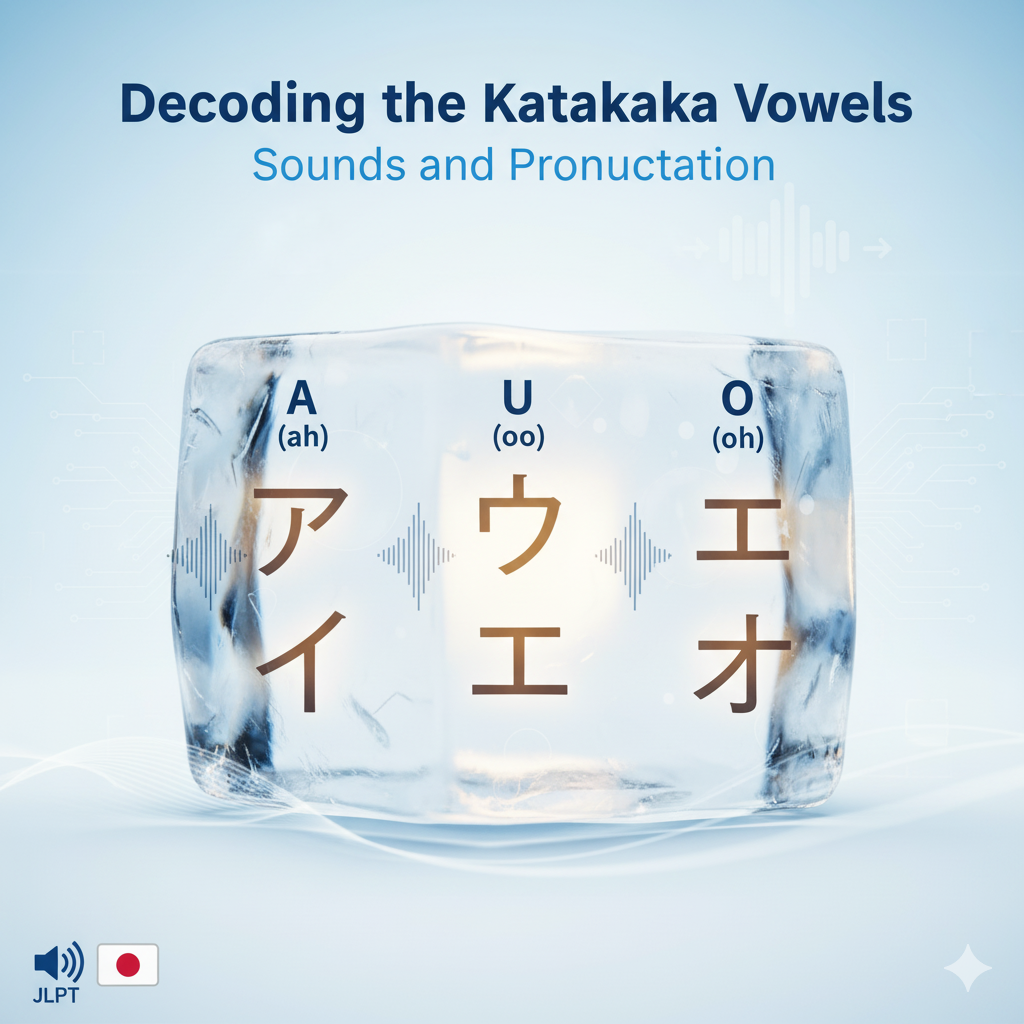
Think of these 5 vowels in Katakana as the foundation, the rhythmic heartbeat of the entire language. Everything you read, from the word for “coffee” (コーヒー, kōhī) to a famous actor’s name, is a combination of a consonant followed by one of these five sounds. Forget complex diphthongs or tricky silent letters; Japanese is beautifully simple and consistent.
As a Japanese Language Proficiency Test (JLPT) specialist, I can tell you that solidifying these five sounds is the single most important step you can take. It’s not just about passing a test; it’s about having the confidence to speak, be understood, and truly unlock the world of Japanese media and culture. Let’s dive deep and decode the secrets to perfect Katakana vowel pronunciation.
Section 1: The Essential Five – Understanding the Core Vowels
(Word Count Goal: 300–400 words)
The greatest gift Japanese gives its learners is consistency. Unlike English, where ‘a’ can sound like ‘cat’, ‘car’, ‘call’, or ‘cake’, each of the 5 vowels of Hiragana and Katakana has one, and only one, pronunciation.
The Two Pillars: Hiragana and Katakana Vowels
It is critical to understand that the sounds are identical between the two scripts.
- Hiragana (ひらがな): Used for native Japanese words, grammar particles, and verb endings.
- Katakana (カタカナ): Used for foreign loanwords, sound effects (onomatopoeia), and emphasis.
The vowel order, always, is: A, I, U, E, O.
| Japanese Vowel | Katakana Character | Hiragana Equivalent | Approximate English Sound | IPA Notation |
| A | ア | あ | Like the ‘a’ in father | /a/ |
| I | イ | い | Like the ‘ee’ in eel | /i/ |
| U | ウ | う | Like the ‘oo’ in put, but with no lip rounding | /ɯ/ |
| E | エ | え | Like the ‘e’ in edge | /e/ |
| O | オ | お | Like the ‘o’ in orb | /o/ |
💡 Expert Insight: The most common mistake Western learners make is with the U sound (ウ). It is not the English ‘oo’ in ‘moon’ (which requires rounded lips). When pronouncing ウ, your lips should remain relaxed, almost as if you were saying a very short ‘oo’ sound without moving your mouth much. Try saying “ooh” and slowly relaxing your lips—that’s your Japanese ウ!
Section 2: Mastering the Rhythm – Pronunciation and Pitch
(Word Count Goal: 400–500 words)
Japanese is a mora-timed language, meaning every syllable—or mora—takes up the exact same amount of time. Each Katakana vowel counts as one mora, and this rhythm is non-negotiable for clear pronunciation.
Practical Application: Your Mouth Position is Key
To truly humanize your Japanese, focus on the physical sensation of making each sound:
- ア (A): The most open sound. Drop your jaw. Think of the doctor asking you to say “Ah.” Your tongue should be flat and relaxed.
- Katakana Example: アイス (Ice)
- イ (I): A high, tight sound. Stretch your mouth wide, as if you’re smiling while saying “ee.”
- Katakana Example: インターネット (Internet)
- ウ (U): The ‘relaxed’ vowel. Jaw slightly closed, lips unrounded. Imagine whispering a short “oo.” This relaxation is what makes it sound natural.
- Katakana Example: ウイルス (Virus)
- エ (E): A mid-open sound. A little more open than ‘I’ but less than ‘A’. Similar to saying ‘eh?’ in response to confusion.
- Katakana Example: エネルギー (Energy)
- オ (O): A round, mid-back sound. Your lips should be slightly rounded, but not excessively puckered. Think of a short, clear “oh.”
- Katakana Example: オフィス (Office)
The Secret of Pitch Accent (High-Low)
While Japanese doesn’t have stress accent (where one syllable is louder, like in English), it uses pitch accent (where the pitch rises and falls). The 5 vowels establish the pitch pattern for an entire word. This is advanced, but knowing the importance of a consistent rhythm is the first step.
Section 3: The Power of Extension – Long Vowels in Katakana
(Word Count Goal: 400–500 words)
This is where Katakana specifically starts to differ visually from Hiragana, and where most loanword pronunciation mistakes occur.
In Katakana, a long vowel sound is indicated by a single dash called a chōonpu (ー). This dash means you must hold the preceding vowel for the duration of two morae.
$$\text{Vowel} + \text{ー} = \text{Two Morae}$$
Why is this important? Because a long vowel can completely change the meaning of a word, even with foreign loanwords!
| Word | Katakana | Pronunciation | Meaning |
| Short Vowel | ビル | biru | Building |
| Long Vowel | ビール | bīru | Beer |
| Short Vowel | テニス | tenisu | Tennis |
| Long Vowel | テニスー | tenisū (less common, but illustrates the rule) | (Hypothetically) A prolonged ‘su’ sound |
| Short Vowel | ノート | nōto | Notebook/Notes |
| Long Vowel | ノート | nōto | Note: The long ‘o’ is marked by the dash |
Actionable Tip: When you see the ー (chōonpu), you aren’t changing the sound; you are just doubling the time you hold that vowel. Practice saying コーヒー (kōhī) and make sure the ‘ko’ and the ‘hi’ are both held for two beats each. Ko-o-Hi-i.
Section 4: Interlinking and Advanced Katakana Applications
(Word Count Goal: 400–600 words – This section is crucial for long-tail SEO and linking.)
Now that you have the 5 vowels in Katakana down, you can start tackling the entire chart with confidence. The rest of the Katakana chart is simply the consonant-vowel combinations (KA, KI, KU, KE, KO, etc.).
For a full breakdown of every character, including the less common ones, please refer to our main resource: [Your Complete Katakana Character & Sound Library (The Full Chart)](Your Complete Katakana Character & Sound Library (The Full Chart)).
Cluster Topic 1: The Essential Tool for Beginners
When you are first starting out, converting English words into Katakana can be the trickiest part. Don’t waste time trying to memorize rules before you get the hang of it. Use a reliable resource to see how names and foreign vocabulary are typically rendered.
- To instantly convert English names, cities, or common loanwords into Katakana, check out our easy-to-use tool: [The Ultimate Katakana Converter Tool (Copy-Paste for Names and Foreign Words)].
Cluster Topic 2: Beyond the Basics – Voiced Sounds
Once you have the pure vowels and consonant-vowel combinations mastered, the next step is applying the diacritical marks that modify the consonant sound. These are essential for accurate pronunciation of loanwords.
- To understand how the 5 vowels of Hiragana and Katakana combine with tenten (゛) and maru (゜) to create voiced sounds (like changing KA to GA or HA to PA), read our detailed guide here: [How to Master Dakuten (Voiced Sounds): The Katakana Chart with Tenten and Maru].
Cluster Topic 3: The Full Chart and Visual Tricks
The 5 vowels in Katakana may be simple, but the visual similarity of some characters can trip up even advanced learners. The slight stroke differences between characters like shi (シ) and tsu (ツ) are notorious for confusing students.
- For a visual breakdown of the full chart, printable resources, and a guide to visually distinguishing the toughest characters, see: [The Full Katakana Chart: Printable PDF and Advanced Characters Explained] and [Identifying Tricky Characters: The Difference Between Shi vs. Tsu and So vs. N].
Section 5: Unique Insights, Practical Application & Outbound Links
(Word Count Goal: 400–600 words)
Unique Insight: Katakana Vowels and the “Wasei Eigo” Dilemma
One of the most fascinating aspects of Katakana is the concept of Wasei Eigo (和製英語)—Japanese-made English. Because the Japanese language only has the 5 vowels of Hiragana and Katakana, certain English sounds cannot be replicated. Instead, they are approximated using the closest Japanese mora.
- Example: ‘S-T’ Cluster: Japanese cannot easily handle consonant clusters. The word ‘street’ becomes ストリート (sutoriito). Notice how an extra ‘u’ vowel is inserted after the ‘s’ and the ‘t’ because a consonant must always be followed by a vowel.
Understanding this forces you to stop listening for the English word and start listening for the Japanese rhythmic pattern of the loanword.
Becoming an Expert Listener
Your best practice is listening to native Katakana pronunciation. Look up names of famous Hollywood movies or actors and listen to how a Japanese announcer says them.
- Actionable Exercise: Watch a few Japanese movie trailers. Pay attention to how names like “Brad Pitt” (ブラッド・ピット, buraddo pitto) or “The Terminator” (ターミネーター, tāminētā) are pronounced. The extra vowels are the key!
Furthering Your Study
To continue your journey from the fundamentals of the 5 vowels in Katakana to fluent comprehension, I highly recommend expanding your vocabulary and grammar knowledge. Here are some trusted, high-quality resources to deepen your understanding:
- For in-depth explanations on particle usage, a concept closely tied to the sounds you are making, you should explore: The Ultimate Japanese Particle Guide (Tofugu)
- To start reading native Japanese content and see these Katakana words in context, a fantastic, free source is: NHK NEWS WEB EASY
- To dive into the Kanji and grammar that often surround Katakana words in official documents and news: JLPT Resources and Study Materials (JLPT Official Website)
Conclusion: The Simple Path to Perfect Pronunciation
(Word Count Goal: 150–200 words)
You now hold the fundamental key to all of Japanese pronunciation. The 5 vowels of Hiragana and Katakana are the alpha and omega of the language. By focusing on the consistent, single-sound rule of each of the 5 vowels in Katakana—ア, イ, ウ, エ, オ—you are setting yourself up for success in speaking, listening, and passing the JLPT.
Master the rhythm, understand the impact of the chōonpu (ー), and remember to drop those unnecessary English consonant clusters. With patience and rhythmic practice, you will transition from struggling with foreign sounds to speaking Japanese loanwords with natural, native-like confidence. Keep practicing, and I’ll see you at the N2 level!
🔗 For More Resources You Might Find Helpful
Your Complete Katakana Character & Sound Library (The Full Chart) – JLPT Samurai
The Full Katakana Chart: Printable PDF and Advanced Characters Explained – JLPT Samurai
How to Master Dakuten (Voiced Sounds): The Katakana Chart with Tenten and Maru – JLPT Samurai
Identifying Tricky Characters: The Difference Between Shi vs. Tsu and So vs. N – JLPT Samurai
The Ultimate Katakana Converter Tool (Copy-Paste for Names and Foreign Words) – JLPT Samurai