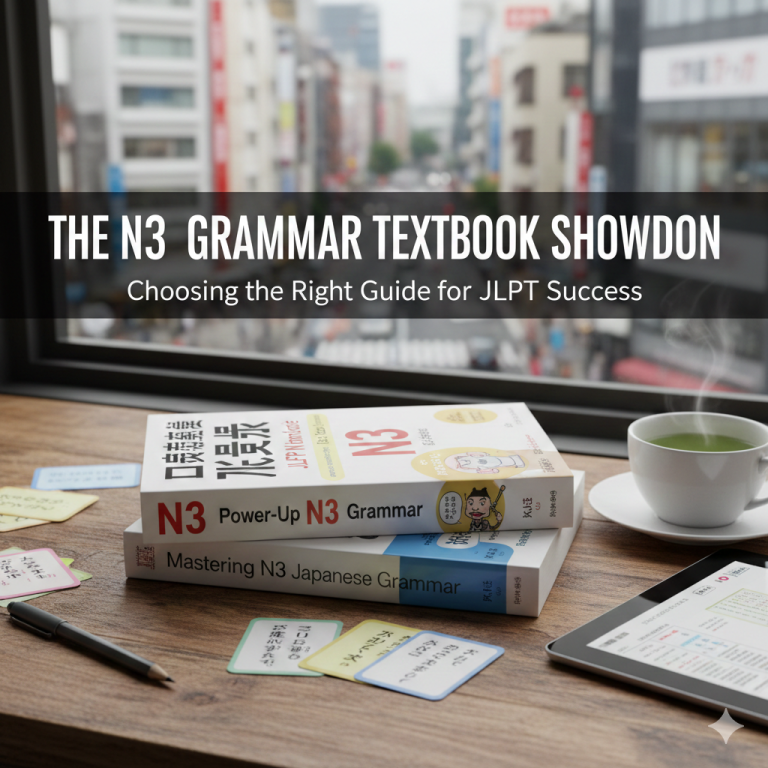
🇯🇵 The Unspoken Truth About Your N3 Study Journey
Hello, fellow Japanese learners! If you’re like most people aiming for the JLPT N3, your study area is probably already home to a beloved, perhaps slightly dog-eared, core n3 textbook. Maybe it’s a Shinkanzen Master, a Try!, or a Sou Matome. You highlight, you take notes, you listen to the CDs, and you feel that satisfying aha! moment when a grammar point finally clicks.
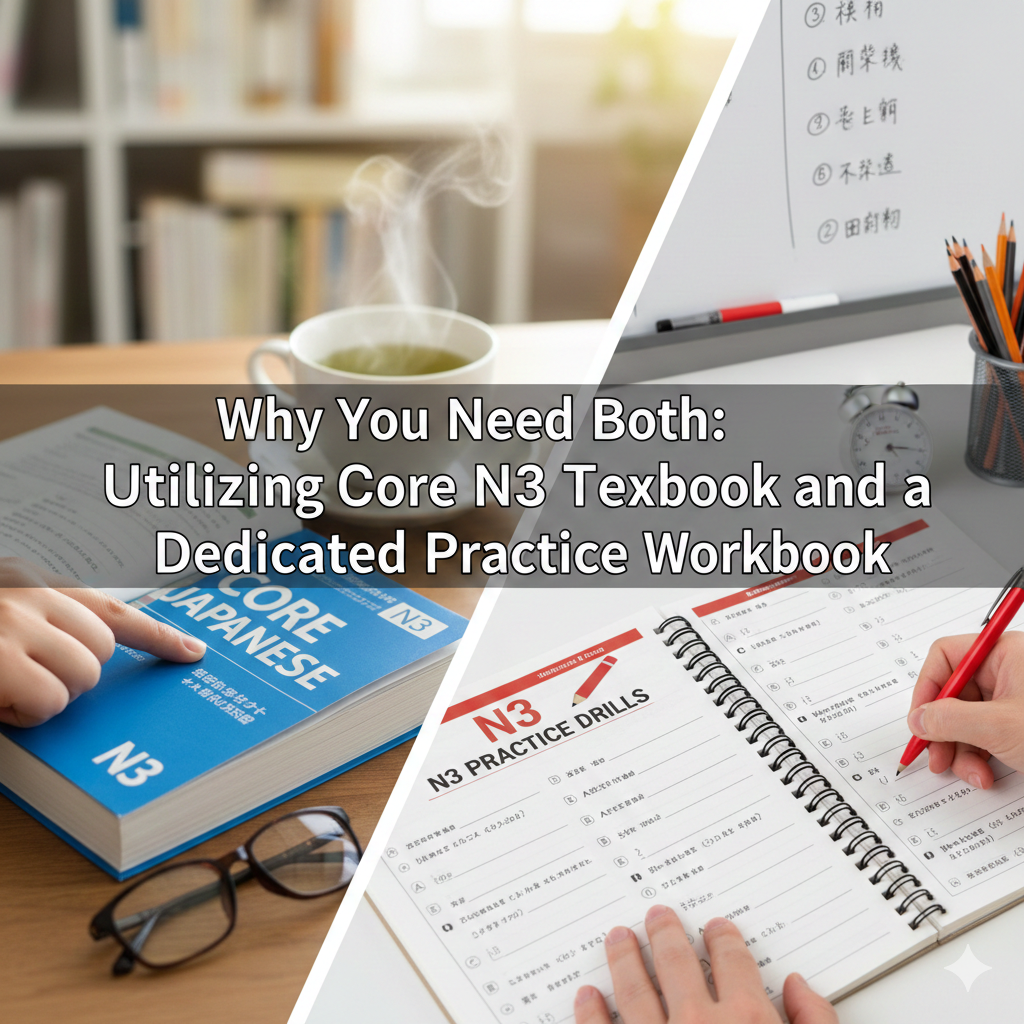
That feeling is great. That feeling, however, is not enough to pass the JLPT N3.
I’ve been in the world of Japanese language education and JLPT prep for years, and I’ve seen countless students—brilliant, dedicated students—fall into the same trap: mistaking comprehension for application.
They treat their primary jlpt n3 textbook like a novel, absorbing the information but failing to activate it under pressure. And this is where the dedicated practice workbook—often overlooked or bought as an afterthought—becomes the absolute, non-negotiable hero of your study plan.
The N3 is a significant jump. It’s where Japanese stops being about rote memorization (like much of N5 and N4) and starts being about nuance, context, speed, and real-world application. It’s a test of whether you can use the language, not just know it.
To conquer this level, you need a two-pronged attack. You need the Structure of a core jlpt n3 book and the Drill of a specialized practice workbook. Let’s dive deep into why this synergy is vital, how to pick your perfect pair, and the exact study methods that will turn your theoretical knowledge into a passing score.
🧐 Part I: Understanding the Core N3 Textbook (The Architect)
What Your Primary Textbook Does Best
Your primary n3 textbook is the architect of your knowledge. Its main job is to introduce new concepts in a structured, logical progression.
1. The Power of Sequential Learning
A good jlpt n3 textbook (like the ones we compare in [JLPT N3 Grammar Textbook Review: Shinkanzen Master vs. Speedmaster vs. Yuka’s Guide] is meticulously designed.
- It contextualizes: It doesn’t just list grammar points; it shows them in short dialogues, sample sentences, or reading passages. You learn what a phrase means and when to use it.
- It builds complexity: It introduces foundation concepts first (e.g., potential forms) and then layers more complex, similar-sounding structures on top (e.g., grammar points expressing possibility like $\text{~かもしれない}$ or $\text{~はずだ}$). This reduces confusion.
- It integrates skills: Most comprehensive jlpt n3 book options include sections for grammar, vocabulary, kanji, reading, and listening, aiming for holistic skill development.
2. The Trap: The Illusion of Mastery
This thoroughness is also the textbook’s biggest weakness when used alone.
- Immediate Context Reliance: When you answer a practice question right after reading the explanation in the same chapter, your brain isn’t retrieving the information from long-term memory. It’s simply matching the sentence structure you just saw. You pass the chapter quiz, but that knowledge hasn’t been tested against a backlog of other N3 grammar points.
- Lack of Timing Pressure: Textbooks are leisurely. You can spend 20 minutes decoding a complex reading passage. The JLPT, however, requires you to read, comprehend, and answer several challenging passages in the same amount of time.
- Superficial Review: Flipping back through a marked-up textbook feels like studying, but it’s passive. You are recognizing information, not actively recalling and applying it.
⚙️ Part II: Understanding the Dedicated Workbook (The Drillmaster)
What Your Practice Workbook Does Best
If the textbook is the architect, the workbook is the military drill sergeant. Its purpose is brutal, repetitive, and essential: to forge your raw knowledge into functional skill.
A dedicated practice workbook—and I stress dedicated, meaning one focused entirely on grammar, or vocabulary, or reading comprehension, separate from your main textbook—achieves three things your core book cannot.
1. The Shuffle and Stress Test (Mixing It Up)
This is the most critical function. Workbooks are rarely organized by the same chapter structure as your n3 textbook.
- They present a question that could test a grammar point from Chapter 2, followed by one from Chapter 15, and then one from Chapter 7.
- The Benefit: You are forced to stop relying on contextual clues. You have to independently identify the structure, recall its meaning and usage, and apply it correctly—all without the safety net of knowing which chapter it’s from. This simulates the actual exam environment, where all N3 concepts are fair game on every question.
2. Pattern Recognition and Speed Development
The N3 has a high volume of tricky, similar-sounding grammar points (e.g., $\text{~としたら}$ vs. $\text{~とすれば}$). The workbook, through sheer repetition, forces you to notice the subtle differences.
- Example: A grammar workbook might have 50 practice questions specifically on connecting particles. After the first 20, you stop reading slowly and start recognizing the common patterns and traps instantly. You develop the speed needed to move through the Language Knowledge section swiftly, saving crucial time for the challenging Reading section.
3. Targeted Weakness Isolation
The textbook shows you what you should know. The workbook shows you what you don’t know well enough.
When you consistently miss questions about relative clauses or conditional expressions in a mixed-practice section of a workbook, you have concrete, testable evidence of your weak points. You can then go back to your jlpt n3 textbook not to read the whole chapter, but to re-study specific, targeted grammar notes.
🤝 Part III: The Essential Synergy: Textbook & Workbook in Harmony
The true power comes from using these two resources in a continuous, reinforcing loop. This is the Active Study Cycle.
Phase 1: Knowledge Acquisition (Textbook Focus)
- Read and Understand: Go through one chapter (or one section of grammar/kanji/vocab) in your n3 textbook. Take notes. Focus on understanding the meaning and the context.
- Initial Practice: Complete the short practice questions within that textbook chapter.
- Self-Correction: Check your answers immediately. If you get something wrong, re-read the explanation right then and there.
Phase 2: Application and Recall (Workbook Focus)
- The Delay: Wait at least 24 hours, or ideally, until you’ve completed 3-5 textbook chapters. Do not immediately jump to the workbook.
- Mixed Practice: Complete a set of practice questions in your dedicated workbook that covers the material you’ve just learned, but mixed with older material. This forces recall.
- The Red Pen Moment: Mark all incorrect answers. Do not look at the workbook explanation yet.
Phase 3: Targeted Reinforcement (Back to the Textbook)
- Isolate the Weakness: For every missed question in the workbook, note the specific grammar point, kanji, or vocabulary word it tested.
- Targeted Review: Go back to your core jlpt n3 book and re-read only the specific section related to the missed item. This is crucial: you are fixing a problem, not aimlessly reviewing.
- Re-Test: After reviewing, complete a similar, small set of questions in the workbook to confirm the weakness has been addressed.
This cycle turns your study from passive reading into active problem-solving. It’s what distinguishes an N3 student who is “almost there” from one who confidently passes.
💡 Part IV: Unique Insights & Practical Application
Humanizing Your Study: The “Contextual Gap”
When you study from a jlpt n3 book, the examples are usually grammatically perfect and highly formal or academic. But real-world Japanese is messy, fast, and full of abbreviations. The “Contextual Gap” is the distance between the pristine textbook language and the spoken/written reality.
A good workbook (especially one focused on reading or listening comprehension) helps bridge this gap by offering:
- Longer Passages: Moving beyond the short, single-idea sentences of the textbook to multi-paragraph articles and advertisements.
- “Gist” Questions: Not just asking for the definition of a word, but asking you to summarize the author’s intent or compare two characters’ opinions. This is a core feature of the N3 Reading section.
- Realistic Audio: Often, practice workbooks have audio tracks that include background noise, mumbling, or fast conversational speech, which is far more realistic than the perfectly enunciated sentences in your core n3 textbook.
Pro-Tip: The “Error Log” Method
This is a method I strongly recommend for any serious JLPT student, and it depends entirely on the separation between your two study materials.
- Keep a dedicated digital or physical notebook (your “Error Log”).
- Whenever you miss a question in your practice workbook, write down three things:
- The Item: The full, incorrect sentence/question.
- The Rule: A brief, simple explanation of the rule you missed (written in your own words, after reviewing your jlpt n3 textbook).
- The Trap: Why you think you got it wrong (e.g., “I confused $\text{~としたら}$ with $\text{~とすれば}$ because I forgot the nuance of ‘imagining’ vs. ‘assuming'”).
- Review your Error Log once a week. This log becomes the most important jlpt n3 book you own, because it is personalized to your specific weaknesses.
🎯 Part V: Choosing Your Perfect Pair (The Practical Guide)
Selecting the right combination of core textbook and workbook is an art. Your personality and learning style matter.
1. The Comprehensive Core Textbook (The Foundation)
Most students fall into one of three categories for their main n3 textbook:
- The Detailed Analyst (e.g., Shinkanzen Master): These books offer incredibly detailed, often translation-heavy explanations and are great for students who need to know the why behind every rule. [Interlink: The N3 Grammar Textbook Showdown: Choosing the Right Guide for JLPT Success]
- The Practical Synthesizer (e.g., Try!): These focus heavily on context and sentence patterns, often better for visual learners or those who want to see the grammar used in dialogues first.
- The Fast-Paced Marathoner (e.g., Sou Matome): These are broken down into daily study schedules and focus on quick, high-volume exposure—ideal for students who thrive on structured routine.
Before committing, remember to check out resources like [Free N3 Grammar Book PDF: A Legal Guide to Finding Downloadable Study Materials] to explore samples and see which style truly resonates with your brain.
2. The Focused Practice Workbook (The Blade)
Once you choose your n3 textbook, you need a workbook that fills its specific gap.
| If your core textbook is… | Choose a practice workbook that is… | Why? |
| Shinkanzen Master (Detail-Heavy) | Speed-focused and high-volume (e.g., Jitsuryoku Up or drills) | Shinkanzen gives you the knowledge; you need the drills to build speed and overcome the tendency to overthink every question. |
| Sou Matome (Fast-Paced) | Explanation-rich and contextual (e.g., a dedicated reading/listening volume) | Sou Matome focuses on volume. You need a workbook that slows down to show you the complex usage in longer-form text. |
| Try! (Context-Focused) | Purely test-format question banks (e.g., mock exams/Taisaku drills) | Try! shows usage but might lack true exam-style question repetition. You need the workbook to train your brain for the specific multiple-choice layout and timing. |
📢 Part VI: The Exam-Day Mindset
Ultimately, the N3 is not just about language; it’s about endurance, time management, and confidence.
When you walk into that exam room, the questions are randomized. You might see a difficult reading passage followed by a simple vocabulary question, then a challenging grammar point. This randomness is the reality your core textbook can’t prepare you for, but your practice workbook must.
The ultimate goal of this two-book strategy is “automaticity.” This means reaching the point where, when you see a grammar point like $\text{~にかわって}$, you don’t have to pause and translate it in your head. You instantly know its meaning (“in place of/instead of”) and, critically, you instantly know the type of noun that typically precedes it and the kind of verb that typically follows it. This speed is the result of repeated, mixed, workbook-style practice, informed by the solid foundation from your jlpt n3 textbook.
Don’t let your comprehensive jlpt n3 book collect dust while you only read it. Pair it with a drill-oriented workbook, commit to the Active Study Cycle, and watch your confidence—and your score—soar.
🔗 Recommended Resources & Next Steps
Ready to take the next step in perfecting your N3 study plan? Here are a few essential resources for every serious learner:
- Understanding the Verb Forms: The N3 level heavily relies on knowing your verb conjugations inside and out. For a comprehensive, yet easily digestible breakdown of all the basic and conditional verb forms you’ll need, check out a great resource on How to Conjugate Japanese Verbs: A Comprehensive Guide. (Outbound Link 1)
- Mastering the Kanji: While this post focuses on the grammar and structure from your n3 textbook and workbook, remember that a strong foundation in kanji is critical for N3 reading speed. For tips on effective kanji memorization techniques beyond rote lists, an excellent article detailing various methods is available here: The Best Way to Learn Japanese Kanji: 8 Methods Explained. (Outbound Link 2)
- Reading Practice is Key: To truly test the comprehension you gain from your jlpt n3 book, you need consistent reading practice. Check out this site for advice on finding level-appropriate Japanese reading material that goes beyond textbook examples: Japanese Reading Practice for Intermediates (JLPT N3 Level). (Outbound Link 3)