We’ve all been there. You’re sitting at your desk, surrounded by a mountain of Shin Kanzen Master and Sou Matome textbooks, feeling like you’re drowning in kanji. The Japanese Language Proficiency Test (JLPT) is a beast, and as someone who has navigated the climb from N5 all the way to N1, I know that the hardest part isn’t just the Japanese—it’s the discipline and the format.
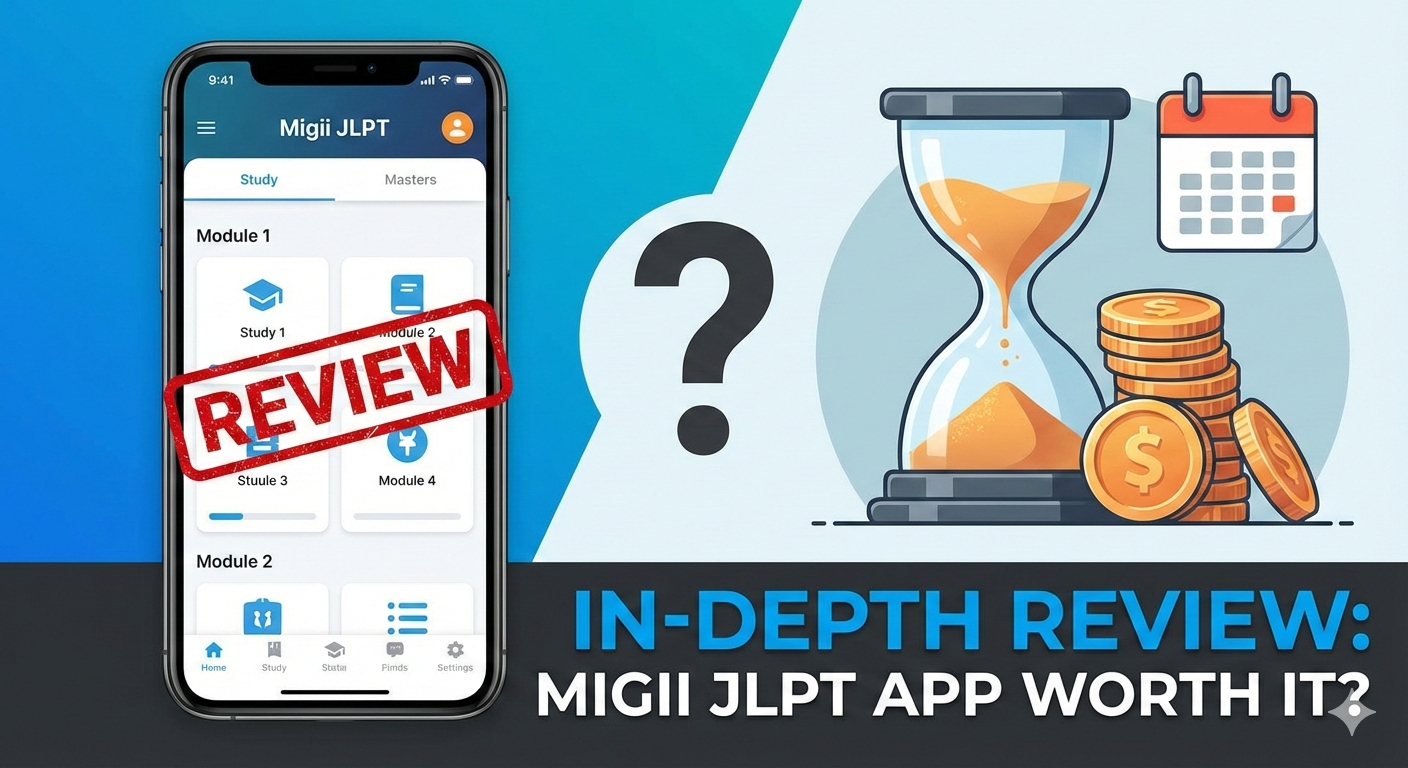
In recent years, the shift from heavy paper books to mobile learning has exploded. Enter Migii JLPT. If you’ve spent any time searching for “how to pass the JLPT,” you’ve likely seen this app pop up. But is it just another flashy interface, or is it a genuine game-changer for your 2025 study plan?
In this comprehensive migii jlpt app review, I’m going to strip away the marketing fluff and tell you exactly what it’s like to use this app as a serious student. We will also see how it stacks up against alternatives like my jlpt app, jlpt quest app, and jlpt sensei app.
What Exactly is Migii JLPT?
Migii JLPT is an all-in-one preparation platform designed specifically for the five levels of the Japanese Language Proficiency Test (N5, N4, N3, N2, and N1). Unlike apps that just teach “general Japanese,” Migii is laser-focused on the exam’s specific sections: Vocabulary (Kotoba), Grammar (Bunpou), Reading (Dokkai), and Listening (Choukai).
What sets it apart from a standard dictionary or a simple flashcard app is its “Roadmap” feature. It’s designed to take you from your current level to “exam-ready” in a set number of days—usually 30, 60, or 90.
Before we dive deeper, if you are still trying to figure out which app fits your specific level, check out our guide on JLPT N5 to N1: The Best Study Apps for Every Japanese Proficiency Level.
Key Features: A Deep Dive into the “Roadmap”
The biggest selling point of Migii is its personalized roadmap. When you first sign up, you take an entry test. Based on your score, the AI calculates your weak points.
1. The Daily Study Plan
Instead of guessing what to study, the app gives you a daily checklist. For an N2 student, this might look like:
- 10 new Kanji (e.g., 網, 綱, 縛).
- 5 Grammar points (e.g., ~を抜きにして or ~にあって).
- One short reading passage.
- 5 minutes of listening practice.
This structure is a godsend for students who struggle with “decision paralysis.”
2. The Mock Test Engine
This is where Migii really shines. They claim to have a bank of over 200+ practice tests. In my experience, these tests are remarkably close to the actual exam format. The timer mirrors the real pressure of the testing center, which is something you just can’t get from a textbook alone.
If you’re curious about how these compare to other high-level prep tools, you might want to see how it fares in our analysis of Mastering Vocabulary and Grammar: Top JLPT Apps for Kotoba and Bunpou.
Comparison: Migii vs. The Field
When choosing a study tool, it’s rarely a “one-app-wins-all” scenario. Let’s look at how Migii compares to its main rivals in 2025.
My JLPT App (JLPT My Test)
Many users often confuse Migii with my jlpt app (sometimes listed as JLPT My Test in the Google Play store). While “my jlpt app” offers a solid, free alternative for basic drills, Migii’s interface is much more modern and the explanations are significantly more detailed. If you are on a razor-thin budget, the free version of “my jlpt app” is decent, but for the N2 and N1 levels, the depth of Migii’s reading section is superior.
JLPT Quest App
The jlpt quest app takes a completely different approach. It’s gamified—think of it as an RPG where you level up your character by answering Japanese questions. It’s fantastic for keeping you motivated if you find traditional studying boring. However, for “crunch time” (the last 30 days before the exam), Migii’s clinical, exam-focused environment is more effective for building the mental stamina needed for the actual test.
JLPT Sensei App
While jlpt sensei app and the accompanying website are goldmines for grammar lists and PDFs, they lack the interactive “mock test” feel of Migii. I personally recommend using JLPT Sensei as a reference library and Migii as your “training ground.”
For a head-to-head breakdown of these options, don’t miss our article: My JLPT App vs. The Competition: Which Japanese Test Prep App Wins?.
The Reality Check: Is It All Sunshine and Sakura?
No app is perfect, and as an expert, I have to be honest about Migii’s shortcomings.
1. The “Translation” Problem: Because Migii is developed by a team that handles multiple languages (including Vietnamese and Chinese), the English translations for grammar points can sometimes feel a bit “clunky.” It’s never so bad that you won’t understand, but it lacks the nuance you’d find in a professional publication like The Japan Times.
2. Accuracy Issues: Some users have pointed out that at the N1 and N2 levels, there are occasional “overlaps” where an N2 grammar point shows up in an N3 practice set. In the real JLPT, boundaries are indeed blurry, so this might actually be “accidental realism,” but it can be frustrating for a student following a strict curriculum.
3. Buggy Audio: Occasionally, the listening audio can take a second to load or may sound slightly compressed. When you’re trying to distinguish between su and tsu in a fast sentence, every bit of clarity counts.
If you’re worried about these technical hurdles, you can compare device performance in our review of Android vs. iPhone: Finding the Best JLPT App for Your Device (PC Options Included).
Practical Insights: How to Use Migii to Pass
If you decide to invest in Migii, don’t just “click through” the answers. Here is the strategy I teach my private students:
- The “Double Review” Method: After finishing a mock test, don’t just look at the score. Go to the “Incorrect Answers” section. Migii allows you to save these to a personal notebook. Re-take just those incorrect questions 24 hours later.
- Shadow the Listening: Don’t just listen and answer. Use the transcript feature in Migii to “shadow” (repeat out loud) the audio. This builds your “inner Japanese ear.”
- Integrate with Mazii: Migii integrates seamlessly with the Mazii dictionary. If you see a word you don’t know in a reading passage, tap it. Don’t just read the definition—add it to your SRS (Spaced Repetition System) flashcards within the app.
For more on these skills, check out JLPT Reading and Listening: The Best Apps for Comprehensive Practice.
The Big Question: Free vs. Premium?
Migii does have a free version, but it is heavily ad-supported and locks many of the full-length mock tests.
In 2025, the premium pricing generally falls into three tiers:
- 3-Month Pass: Best for the “final sprint” before the July or December exam.
- 1-Year Pass: The best value for someone starting a new level (e.g., moving from N4 to N3).
- Lifetime Pass: Only recommended if you are at N5/N4 and plan to go all the way to N1.
Is it worth it? If you consider that a single JLPT textbook costs about $25-$30, and the 1-year pass is often in that same price range, Migii offers much more “content per dollar.” However, if you are strictly looking for no-cost options, you should read our guide: Free vs. Paid: Are Free JLPT Apps Good Enough to Pass the Exam?.
Don’t Forget the Logistics!
Even the best app won’t help if you miss the registration deadline! As you prepare with Migii, make sure you are keeping an eye on the official requirements. You can find everything you need in our 2025 JLPT Application Guide: Deadlines, Fees, and How to Apply Online.
For more official information on test centers and global schedules, visit the Official JLPT Website.
Final Verdict: The Expert’s Score
Migii JLPT App Rating: 4.5/5
Who it’s for: Serious students who need structure, mock exam practice, and a clear path to follow. It is particularly strong for N3, N2, and N1 candidates who need to focus on reading stamina.
Who it’s NOT for: People who want to learn Japanese “casually” for travel or those who are easily annoyed by slightly clunky English translations.
The JLPT is more than just a Japanese test; it’s a test of how well you can take the JLPT. Migii trains you for the format better than almost any other app on the market.
If you want to see how Migii fits into a larger ecosystem of tools, check out our pillar post: The Ultimate Guide: 15 Best JLPT Apps to Pass Your Japanese Language Proficiency Test.
What do you think? Have you used Migii to pass your last exam, or did you find jlpt quest app more helpful? Drop a comment below and let’s discuss our 2025 study strategies!