In the world of Japanese business, a letter or an email is never just a message. It is a reflection of your professional character, your respect for hierarchy, and your mastery of Keigo (honorific language). As someone who has spent years navigating the nuances of the JLPT (Japanese Language Proficiency Test) and working within Japanese corporate structures, I can tell you: the “how” is often more important than the “what.”
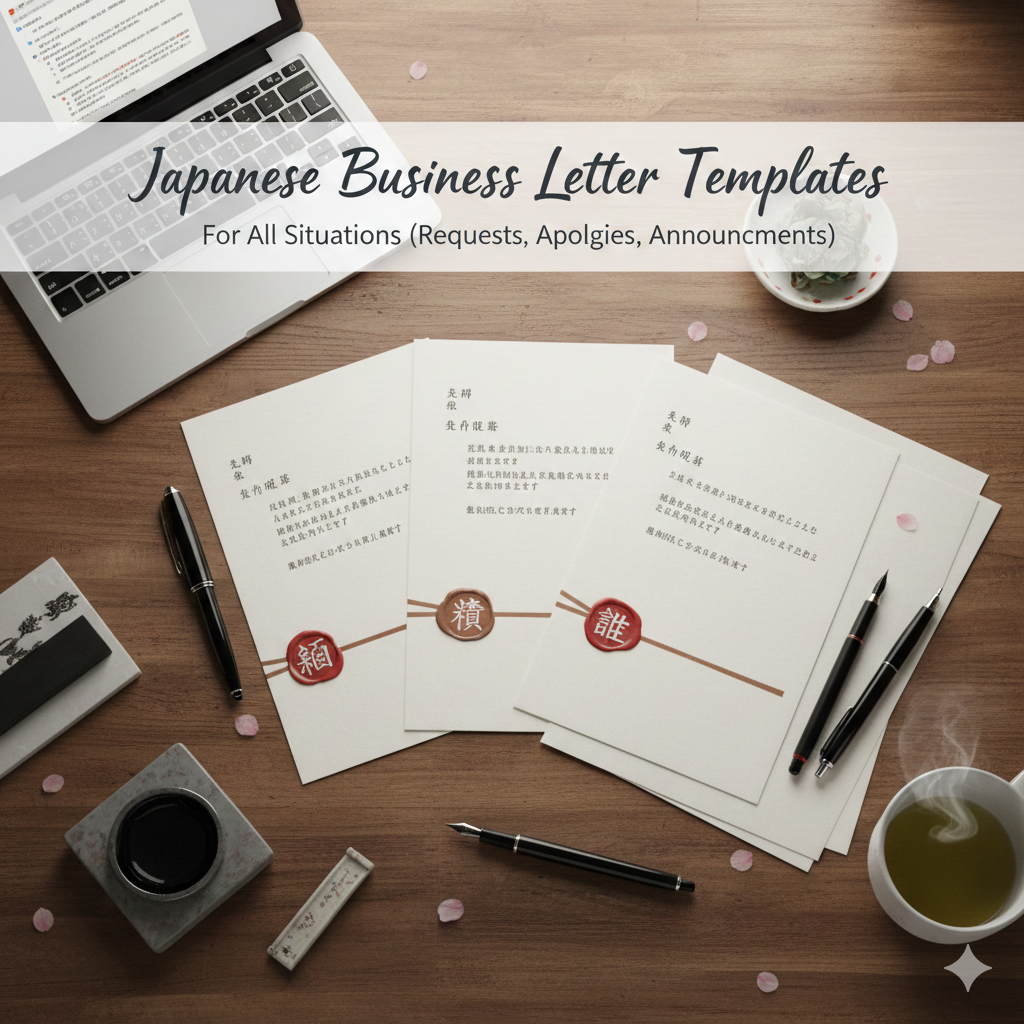
Whether you are reaching out to a new client, apologizing for a delay, or announcing a personnel change, using the correct Japanese Business Letter Templates for All Situations ensures you maintain Wa (harmony) and professionalism.
In this guide, we will break down the essential components of Japanese business writing, provide ready-to-use templates, and offer insights that go beyond simple translation.
1. The Anatomy of a Japanese Business Letter
Before we dive into specific templates, you must understand the rigid structure that governs Japanese formal writing. Deviating from this structure can make your correspondence seem rushed or disrespectful.
The Standard Layout:
- Zekku (Salutation): Usually starts with Haikei (Dear…).
- Kigo (Seasonal Greeting): A brief mention of the current weather or season.
- Gisatsu (Standard Well-wishes): Thanking the recipient for their continued patronage.
- Shubun (Main Body): The actual purpose of your letter.
- Musubi (Closing Greeting): Wishing the recipient health or success.
- Kigo (Closing): Usually Keigu (Sincerely yours), pairing with Haikei.
Pro Tip: In modern business emails, we often skip the seasonal greetings to save time, but for formal paper letters, they are mandatory.
2. Template: Requesting a Meeting (Irai)
Making a request in Japan requires a delicate balance. You must be clear about what you want while appearing humble and mindful of the recipient’s busy schedule.
Key Phrases:
- O-isogashii tokoro osoreirimasu ga… (I am sorry to bother you while you are busy, but…)
- Go-kento itadakereba saiwai desu. (I would be grateful if you could consider this.)
The Template:
Subject: [Meeting Request] Regarding the New Project Collaboration
Body:
ABC Corporation
Mr./Ms. [Name]
Always grateful for your exceptional support. This is [Your Name] from [Your Company].
I am writing to request a brief meeting to discuss [Topic]. We believe this collaboration could offer significant value to both parties.
If your schedule permits, could we meet for 30 minutes next week?
…
For more hands-on practice, check out these Example Japanese Business Letters You Can Use at Work Today to see how these requests look in a live environment.
3. Template: The Art of the Business Apology (Oshazai)
In Japan, an apology isn’t just about admitting a mistake; it’s about taking full responsibility and restoring trust. A common mistake is being too defensive.
Key Insights:
Avoid using “I think” or “Perhaps.” Use definitive, humble language. Instead of sumimasen, use Moushiwake gozaimasen.
The Template:
Subject: Sincere Apology Regarding [Issue]
Body:
…I am writing to express my deepest apologies for the [Error/Delay]. This was due to an oversight on our part, and we are currently taking [Action] to ensure this does not happen again.
We value your trust immensely and hope to make amends…
4. Template: Formal Announcements (Tsuchi)
Whether it’s an office relocation or a change in person-in-charge, announcements must be concise.
Structure:
- The “What” (The Change)
- The “When” (Effective Date)
- The “Why” (Briefly)
If you find yourself struggling with the right level of politeness for these announcements, you might need a refresher on How to Use Keigo in Japanese Business Letters (With Real Examples) to ensure you aren’t over-using or under-using honorifics.
5. Navigating Keigo: The Silent Language
Mastering Japanese Business Letter Templates for All Situations is impossible without a grasp of Sonkeigo (Respectful), Kenjougo (Humble), and Teineigo (Polite) Japanese.
| Type | Usage | Example |
| Sonkeigo | To elevate the listener/client | O-kaki ni naru (You write) |
| Kenjougo | To lower yourself/your company | Haishaku suru (I borrow) |
| Teineigo | Standard polite ending | Desu / Masu |
Misusing these is one of the most Common Mistakes in Japanese Business Letters and How to Avoid Them. For instance, never use Sonkeigo for your own actions!
6. Practical Tips for Non-Native Professionals
- Kanji Accuracy: Always double-check the recipient’s name kanji. A mistake here is seen as a sign of extreme negligence.
- Punctuation: Business Japanese uses fewer exclamation points. Stick to the traditional Japanese period (。) and comma (、).
- Response Time: In Japan, a “fast” response is usually within 24 hours. If you need more time, send a “receipt” email using Informational Email Templates in Japanese for Work Communication to acknowledge you’ve seen the message.
7. The Digital Shift: Email vs. Traditional Letters
While traditional letters (on Washi paper) are still used for extreme apologies or high-level greetings, most daily business is conducted via email. However, the formality remains.
Even in an email, you should start with a clear subject line. A vague subject line like “Hello” or “Question” will often be ignored or viewed as unprofessional. Use brackets to categorize your mail:
- 【依頼】 (Request)
- 【報告】 (Report)
- 【重要】 (Important)
Conclusion
Writing a business letter in Japanese is like a choreographed dance. It requires patience, practice, and a deep respect for the recipient. By utilizing these Japanese Business Letter Templates for All Situations, you aren’t just sending information—you are building a bridge of trust between cultures.
If you are preparing for the JLPT or simply looking to refine your professional skills, remember that language is a living thing. Keep practicing, and don’t be afraid to ask a native colleague to proofread your first few drafts.