If you’ve ever sat staring at a blank email draft in a Japanese office, feeling the cold sweat of “Keigo anxiety,” you aren’t alone. Even for those of us who have cleared the JLPT N2 or N1, the transition from textbook grammar to a professional business letter feels like moving from a calm pond into the open ocean.
In Japanese business culture, a letter or email isn’t just a carrier of information; it is a reflection of your respect, your social standing, and your professionalism. Using Keigo correctly is the “secret handshake” that signals you understand Japanese corporate etiquette.
In this guide, we’re going to deconstruct Keigo specifically for written correspondence. No more “dictionary-speak”—just practical, human-centered advice.
1. The Three Pillars of Keigo: A Quick Refresher
Before we dive into the templates, let’s ground ourselves. Written Keigo is slightly more formal than spoken Keigo. While you might get away with a slip-up in a meeting, a written error is “permanent evidence.”
- Sonkeigo (Honorific): Used to elevate the reader (the client or your boss). You describe their actions.
- Kenjougo (Humble): Used to lower yourself or your company. You describe your actions.
- Teineigo (Polite): The standard Desu/Masu form that keeps the tone professional.
Expert Insight: In business letters, we often use Sonzogo (polite vocabulary) like using Sashou instead of Sukoshi (a little), or Honjitsu instead of Kyou (today).
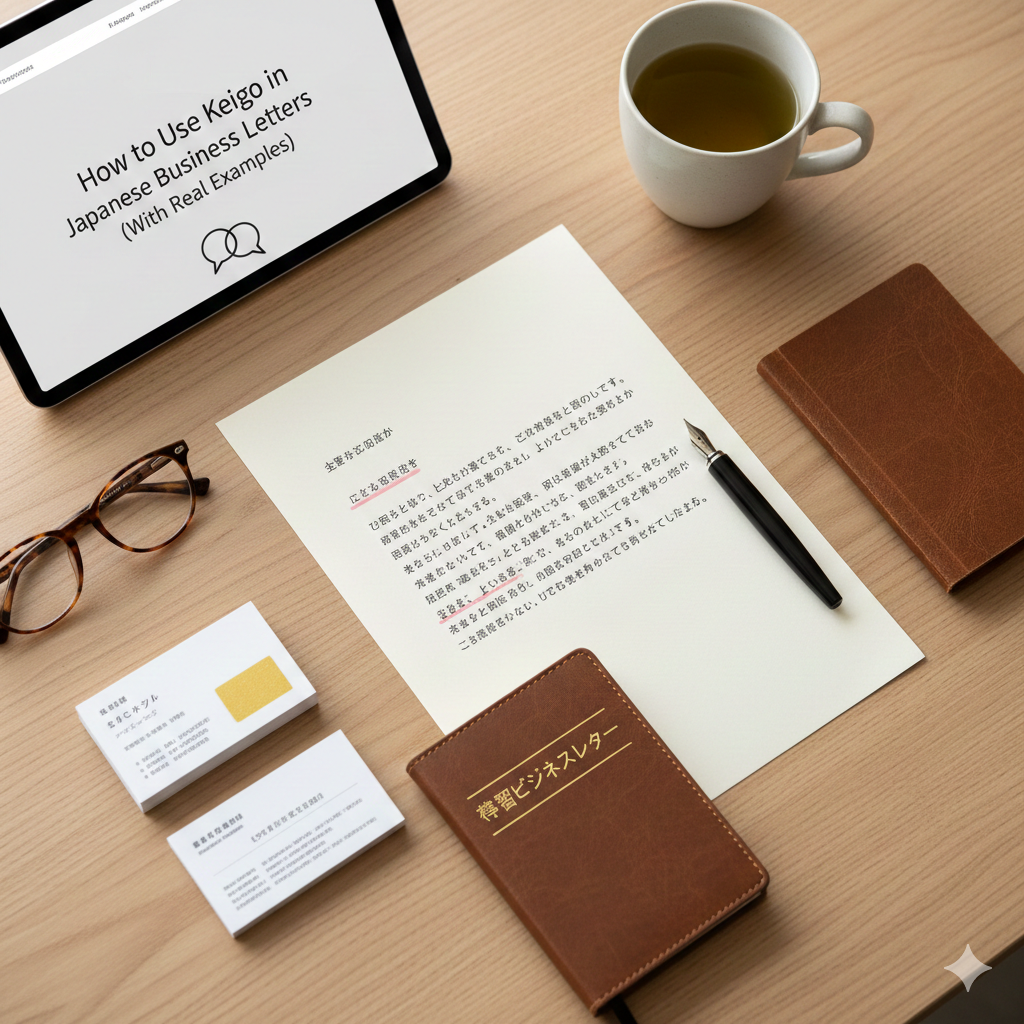
2. Setting the Stage: The Structure of a Business Letter
A Japanese business letter follows a very specific “ritual.” If you jump straight to the point, you might come across as rude or “too Western.”
- Toiawase (Heading): Company name, Department, and Title.
- Kashiragaki (Opening Word): Usually Haikei (Dear…).
- Gaisatsu (Seasonal Greeting): Acknowledging the season or the reader’s prosperity.
- Shubun (Main Body): This is where your Keigo skills shine.
- 結びの挨拶 (Closing Greeting): Wishing the reader well.
- 結語 (Closing Word): Usually Keigu (Sincerely).
3. Real-World Examples: Keigo in Action
Scenario A: Inquiring About a Product (The Humble Approach)
When you are asking for something, you must use Kenjougo for yourself and Sonkeigo for the recipient.
Subject: 製品詳細に関するお問い合わせ (Inquiry regarding product details)
Main Body Snippet:
「貴社の新製品について、詳細な資料をご送付いただけますでしょうか。お忙しいところ恐縮ですが、ご検討いただければ幸いです。」
- Analysis: * Kisha (Your company) is the standard written honorific for a business partner.
- Go-soufu itadakemasu deshou ka is a beautiful way to ask “Could you please send?” rather than the blunter okutte kudasai.
Scenario B: Following Up After a Meeting (The Gratitude Approach)
Gratitude is the bedrock of Japanese business relationships.
Main Body Snippet:
「本日はご多忙の折、貴重なお時間を割いていただき、誠にありがとうございました。心より感謝申し上げます。」
- Analysis: * Saite-itadaki acknowledges that their time is precious.
- Kansha moushiagemasu is the humble way to say “I am offering my thanks.”
4. Key Keigo Verbs for Your “Cheat Sheet”
In business writing, certain verbs are replaced entirely. If you use the “dictionary” form, your letter will look amateur.
| Meaning | Standard Verb | Sonkeigo (They do) | Kenjougo (I do) |
| To do | Suru | Nasaru / Saremasu | Itasu |
| To go | Iku | Irassharu | Mairu / Ukagau |
| To see | Miru | Goran ni naru | Haiken suru |
| To know | Shiru | Gozonji da | Shouchi suru / Zonjiageru |
| To say | Iu | Ossharu | Moushiageru |
5. Avoiding the “Double Keigo” Trap
One of the most common mistakes I see (even among native speakers!) is Nijuu Keigo (Double Keigo). This happens when you apply two honorific rules to one verb.
- Wrong: O-yomi ni nararemasu (Adding both O…ni naru and the passive …reru).
- Right: O-yomi ni narimasu.
Keep it clean. Over-politeness can actually feel sarcastic or confusing. For more on what to avoid, check out Common Mistakes in Japanese Business Letters and How to Avoid Them.
6. Practical Application: Tips for Success
- Use Fixed Phrases: Don’t reinvent the wheel. Phrases like Osewa ni natte orimasu (I am in your debt/Thank you for your support) are non-negotiable starters.
- Check Your Kanji: In business, using the correct Kanji for Keigo is vital. For example, use 致す instead of いたす in formal documents, though the hiragana is often preferred in softer emails.
- Read it Aloud: If it sounds like a robot wrote it, simplify. Even Keigo should have a human flow.
For those looking to save time, I highly recommend looking at Japanese Business Letter Templates for All Situations (Requests, Apologies, Announcements) to see how these verbs fit into a full page.
7. Deepening Your Learning
Mastering Keigo takes time. If you are preparing for the JLPT or just want to sound more natural, I recommend checking out these external resources:
- For a deep dive into grammar structures, the JLPT Sensei Grammar Master Gallery is an incredible tool for visual learners.
- To see how real Japanese companies handle formal communication, the JET Programme Professionalism Guide offers great insights into workplace culture.
Conclusion
Keigo is not a barrier; it is a tool for building trust. By mastering the humble and honorific forms in your writing, you show your Japanese counterparts that you value the relationship as much as the business deal.
Related Reading for Your Career:
- Complete Guide to Japanese Business Letters: Formats, Templates & Etiquette
- Example Japanese Business Letters You Can Use at Work Today
- Informational Email Templates in Japanese for Work Communication