Introduction
Learning Japanese grammar can feel like navigating a maze—complex rules, countless particles, and subtle nuances that textbooks alone can’t always explain. But what if you had a tool that adapts to your learning pace, reinforces memory, and makes grammar stick? Enter Anki, the spaced repetition flashcard app that’s a game-changer for language learners.
In this guide, we’ll explore the best Anki decks for Japanese grammar, how to use them effectively, and practical tips to avoid burnout. Whether you’re prepping for the JLPT or just want to speak naturally, these decks will supercharge your studies.
(Looking for general Japanese learning tips? Check out our Beginner’s Guide to Learning Japanese for a structured approach.)

Why Use Anki for Japanese Grammar?
Anki’s spaced repetition system (SRS) ensures you review material just before you forget it, making retention effortless. Unlike traditional flashcards, Anki schedules reviews based on your performance—harder cards appear more often, while easier ones fade into the background.
Key Benefits:
✅ Efficient Memorization – No more cramming; Anki reinforces grammar naturally.
✅ Customizable Decks – Modify cards to fit your learning style (add audio, images, or mnemonics).
✅ Pre-Made Resources – Save time with high-quality shared decks.
✅ Cross-Platform Sync – Study on your phone, laptop, or tablet.
Best Anki Decks for Japanese Grammar (2025 Edition)
Here are the top-rated Anki decks for mastering Japanese grammar, from beginner to advanced levels.
1. Ultimate Grammar Anki Deck (850+ Grammar Points)
This massive deck covers 850+ grammar points with 6,500+ example sentences, sourced from JLPT Sensei. Each card includes:
- The grammar structure
- English meaning
- Example sentences (with translations)
- Usage notes (e.g., combining with nouns/adjectives)
Why It’s Great:
✔ Covers JLPT N5-N1 (filter by difficulty).
✔ Ideal for lookup and active recall practice.
✔ Updated with similar-structure tags (e.g., volitional form, ~こと).
“I use this deck daily—flip the card, guess the meaning, then check the example sentence. If I’m wrong, I hit ‘Again.’ Simple but powerful!” — WaniKani User 2.
2. Intermediate Japanese Grammar Flashcards
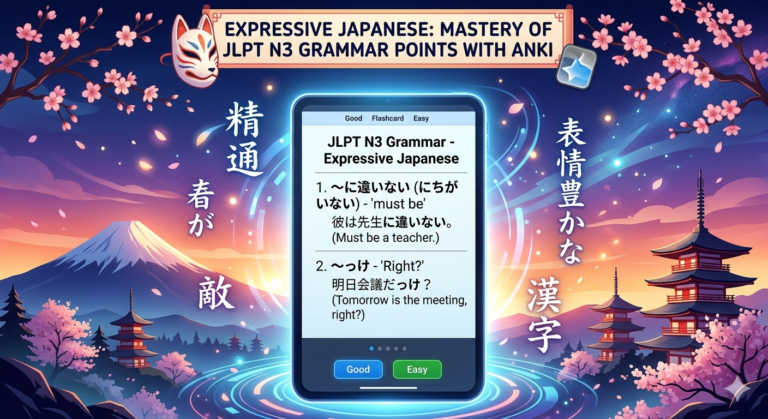
Designed for learners who’ve finished Genki or Tae Kim, this deck focuses on JLPT N3-N2 grammar. It uses the Instantaneous Composition Method:
- Front: English prompt (e.g., “Despite…”)
- Back: Japanese sentence (e.g., “…にもかかわらず”)
Key Features:
✔ Teaches reflexive sentence formation.
✔ Includes furigana and usage notes.
✔ Best paired with a grammar reference book (e.g., Dictionary of Intermediate Japanese Grammar).
Pro Tip: “Don’t rush—spend 1 hour per 2 grammar points for deep understanding” 6.
3. JLPT Grammar Deck (N5-N1)
A structured deck organized by JLPT level, with:
- Clear explanations (e.g., ~たら vs. ~なら).
- Multiple examples per point.
- Audio pronunciations (via AwesomeTTS add-on).
Best For:
✔ Test-takers needing targeted practice.
✔ Quick reviews (use the “suspend” feature to hide mastered cards).
4. Tango N5-N1 Vocabulary & Grammar
While primarily a vocab deck, Tango includes grammar in context—perfect for seeing how structures work in real sentences.
Highlights:
✔ Sentence-based learning (e.g., “この本は読みやすい” for ~やすい).
✔ Natural progression from N5 to N1.
5. Customizable Grammar Deck (Self-Made)
Pre-made decks are great, but creating your own ensures relevance. Here’s how:
- Pull sentences from textbooks (e.g., Genki, Shin Kanzen Master).
- Add notes (e.g., “~わけだ = ‘No wonder…’”).
- Tag cards by difficulty or JLPT level.
“I made a deck from my mistakes in conversation—now I never forget them!” — Reddit User 10.
How to Study Japanese Grammar with Anki
1. Use the “Basic & Reversed Card” Format
- Front: “How to say ‘even though’?”
- Back: “~のに” + example.
This two-way recall strengthens memory 12.
2. Add Context
- Attach images (e.g., a sad face for ~ながら “although”).
- Record audio (use AwesomeTTS for native pronunciation).
3. Limit New Cards to 10-15/Day
Avoid burnout by capping new cards—consistency beats cramming 4.
4. Supplement with Immersion
- Watch anime/dramas and note grammar in use.
- Try Satori Reader for annotated texts 10.
Common Mistakes to Avoid
❌ Overloading on Decks – Stick to 1-2 primary decks + a custom one.
❌ Skipping Reviews – Anki works best with daily practice.
❌ Ignoring Output – Practice writing/speaking to reinforce grammar.
Final Thoughts
Anki is a powerful tool for Japanese grammar, but it’s not magic—active use is key. Start with the Ultimate Grammar Deck, supplement with immersion, and tweak settings to fit your pace.
Need vocab help? Explore our
- The Best Dictionaries for Learning Japanese Grammar Effectively
- Top 10 Free Apps to Ace JLPT 2025: My Personal Journey from N5 to N1
- How to Pass the JLPT N5 on Your First Attempt