Introduction
If you’re preparing for the Japanese Language Proficiency Test (JLPT) N1, you already know it’s one of the most challenging levels. But beyond mastering vocabulary, grammar, and listening skills, understanding the JLPT N1 answer sheet is crucial. Many test-takers lose points not because of lack of knowledge but due to avoidable mistakes in filling out the answer sheet.
In this guide, we’ll break down the JLPT N1 answer sheet format, share pro tips for filling it out correctly, and highlight common mistakes that could cost you precious points. Whether you’re a first-time test-taker or looking to refine your strategy, this post will help you navigate the answer sheet with confidence.
Understanding the JLPT N1 Answer Sheet Format
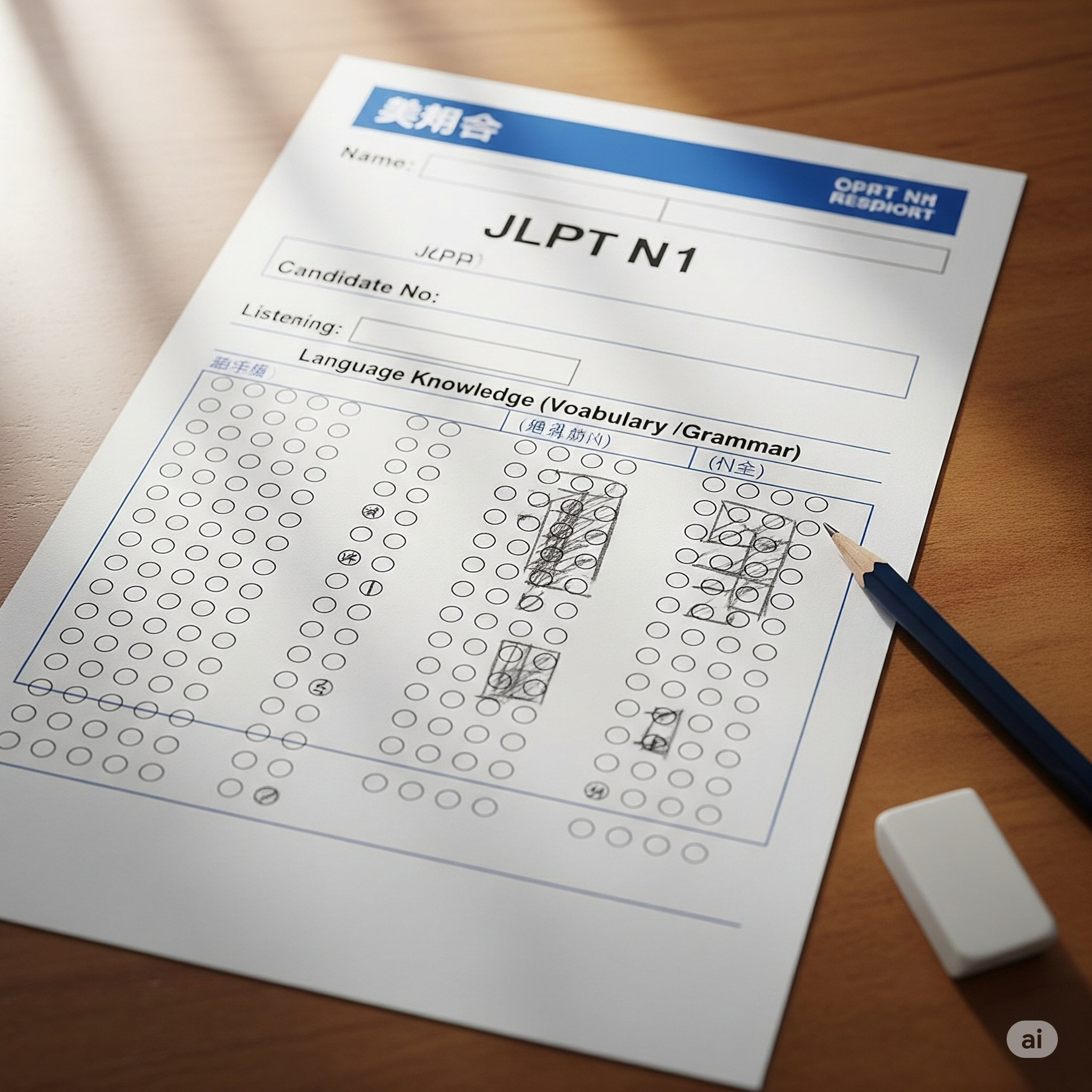
The JLPT N1 answer sheet follows a standardized format, but it can be tricky if you’re not familiar with it. Here’s what you need to know:
1. Personal Information Section
Before the test begins, you’ll be asked to fill in:
- Your name (in capital letters, as per your registration)
- Exam date & level (already printed, but verify it’s N1)
- Registration number (provided on your test voucher)
🔹 Pro Tip: Double-check your details. A mismatch here could invalidate your results.
2. Answer Bubbles (Maru or Filling Completely)
Unlike some multiple-choice tests, the JLPT uses fully filled circles (●) rather than checkmarks (✓). You must darken the bubble completely with an HB pencil.
🔹 Common Mistake: Light shading or incomplete filling may not be scanned correctly.
3. Section-Wise Breakdown
The JLPT N1 is divided into three sections:
- Language Knowledge (Vocabulary & Grammar) + Reading
- Listening
Each section has its own set of answer bubbles.
a. Vocabulary/Grammar & Reading Section
- Question numbers are sequential.
- Some questions (like text comprehension) have multiple parts but one answer bubble per question.
🔹 Pro Tip: Skip difficult questions but ensure you mark the right bubble later. Misalignment (marking Q15’s answer in Q16’s bubble) is a frequent error.
b. Listening Section
- Answers are marked in real-time—you won’t get extra time to transfer them.
- The audio plays only once, so focus!
🔹 Common Mistake: Waiting too long to bubble in answers and missing the next question.
Top Tips for Filling the JLPT N1 Answer Sheet Correctly
1. Use an HB Pencil & Eraser
- HB pencils are required—mechanical pencils or pens are not allowed.
- Bring a good eraser to correct mistakes cleanly.
2. Practice with Mock Tests
- Use official JLPT practice sheets (like those from The Japan Foundation) to get comfortable.
- Simulate test conditions to improve speed and accuracy.
🔹 Pro Tip: Check out our JLPT N1 Study Plan for structured preparation.
3. Answer in Batches (For Reading Section)
- Instead of marking answers one by one, circle them in the booklet first, then transfer 5-10 answers at a time to avoid misalignment.
4. Double-Check Listening Answers
- Since the audio moves quickly, mark your best guess if unsure—better than leaving it blank.
Common Mistakes to Avoid
1. Misaligned Answers
- The biggest blunder is shifting answers (e.g., marking Q12’s answer in Q13’s bubble).
- Solution: Place a finger on the current question to track progress.
2. Incomplete Bubbles
- Lightly filled circles may not be detected by the scanner.
- Solution: Fill bubbles fully and darkly.
3. Ignoring Instructions
- Some questions (like reading comprehension) have multiple steps but one answer.
- Solution: Read instructions carefully—don’t assume format is the same as practice books.
4. Last-Minute Guesswork
- Random guessing can backfire due to negative marking rumors (though JLPT doesn’t penalize wrong answers).
- Solution: Educated guesses > blind ones.
Final Thoughts
Mastering the JLPT N1 answer sheet is as important as mastering the language itself. By understanding its format, practicing with real sheets, and avoiding common mistakes, you’ll maximize your chances of success.
🔹 Need More Help? Check out our JLPT N1 Grammar Guide and Best Books for JLPT N1 for deeper preparation.
Good luck (頑張って!), and may your answer sheet be perfectly filled!