Introduction
Passing the JLPT N1 is a major milestone for Japanese learners. It requires mastery of advanced grammar, 10,000+ vocabulary words, and kanji recognition—all while maintaining reading and listening fluency.
One of the most powerful tools for this challenge? Anki, a spaced repetition system (SRS) that helps you retain information long-term. But simply downloading a deck and reviewing cards won’t cut it—you need a smart, structured approach.
In this guide, you’ll learn:
✅ Best Anki decks for JLPT N1 (free & paid)
✅ Proven strategies to maximize retention
✅ Study hacks to save time and avoid burnout
✅ Common mistakes and how to fix them
Let’s dive in!
Why Anki is a Game-Changer for JLPT N1
Before we get into the how, let’s talk about the why.
1. Spaced Repetition = Long-Term Retention
Anki uses spaced repetition, a learning technique that schedules reviews at optimal intervals. Instead of cramming, you retain information longer with less effort.
2. Active Recall > Passive Learning
Reading textbooks is helpful, but actively recalling words and grammar points strengthens memory. Anki forces you to retrieve information, making it stick.
3. Customizable & Efficient
Unlike generic flashcards, Anki lets you:
- Add images, audio, and example sentences
- Adjust difficulty per card
- Focus on weak areas
Now, let’s get into the best decks for N1 prep.
Best Anki Decks for JLPT N1 (Free & Paid)
Not all Anki decks are created equal. Here are the top-rated decks for N1:
1. JLPT N1 Vocabulary Deck (Free)
- Covers 3,000+ N1 words
- Includes pitch accent markings
- Example sentences for context
🔹 Best for: Learners who want a comprehensive vocab base
2. Nayr’s Core 5k/10k (Free)
- 5,000+ words (includes N1-level terms)
- Native audio for pronunciation
- Frequency-based (learn most useful words first)
🔹 Best for: Building a strong vocabulary foundation
3. JLPT N1 Kanji Deck (Free)
- 1,200+ kanji with readings & compounds
- Stroke order diagrams
- Mnemonics for tricky characters
🔹 Best for: Mastering kanji recognition & recall
4. Migaku Japanese Add-On (Paid, but worth it)
- Sentence mining from Netflix, YouTube, etc.
- Furigana & pitch accent support
- One-click card creation
🔹 Best for: Advanced learners who want real-world immersion
💡 Pro Tip: Combine multiple decks for balanced learning (e.g., vocab + kanji + grammar).
How to Study JLPT N1 with Anki: Smart Strategies
Now that you have your decks, how should you use them effectively?
1. Set a Realistic Daily Review Limit
- New cards: 15-30/day (adjust based on time)
- Reviews: 100-200/day (prevents backlog)
⚠️ Avoid burnout: Don’t add too many new cards at once.
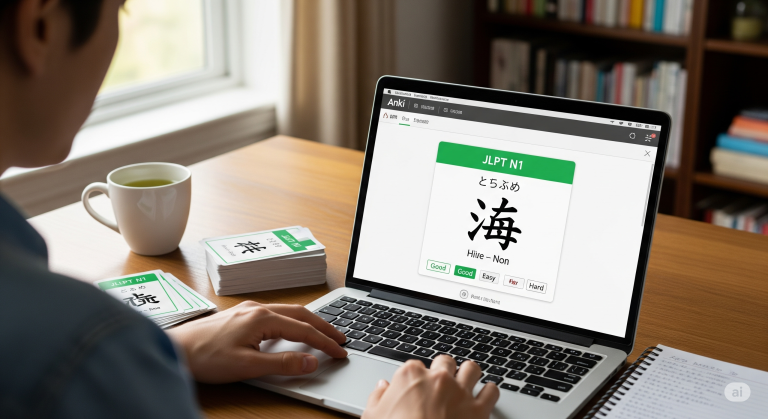
2. Use the “Hard, Good, Easy” System Wisely
- Hard: If you struggled, see it again soon.
- Good: If you recalled it correctly.
- Easy: If it was instant, delay the next review.
💡 Insight: Be honest with yourself—don’t mark cards “Easy” just to skip them.
3. Add Context to Your Cards
- Example sentences (from novels, news, or dramas)
- Audio clips (for pitch accent & listening practice)
- Images (help with visual memory)
📌 Example:
- Front: 彼は______を拒否した。 (He refused the ______.)
- Back: 要求 (きゅうよう) – demand
4. Practice Active Recall Before Seeing the Answer
- Don’t just flip the card immediately.
- Try to recall the meaning/reading first.
5. Combine Anki with Immersion
- Watch Japanese news (NHK) → Add new words to Anki.
- Read novels (村上春樹, 東野圭吾) → Mine sentences.
📖 Recommended: How to Use Netflix to Learn Japanese

Study Hacks to Save Time & Boost Retention
1. Batch-Create Cards
Instead of making cards one by one:
- Export lists from dictionaries.
- Use Yomichan (browser add-on) to auto-generate cards.
2. Focus on High-Frequency Words First
- Tango N1 Deck sorts words by frequency.
- Skip rare words until you’ve mastered common ones.
3. Use Anki’s “Custom Study” Feature
- Before mock tests, review weak areas.
- Cram specific tags (e.g., “grammar,” “kanji”).
4. Listen to Audio Decks While Commuting
- Convert cards to MP3 with AwesomeTTS.
- Passive listening reinforces memory.
Common Mistakes & How to Fix Them
❌ Mistake 1: Only Using Pre-Made Decks
✅ Fix: Add your own cards from mistakes in practice tests.
❌ Mistake 2: Skipping Reviews
✅ Fix: Set a daily reminder (Anki mobile app helps).
❌ Mistake 3: Not Testing Production (Japanese → English)
✅ Fix: Make reverse cards (e.g., “要求 → demand”).
❌ Mistake 4: Ignoring Grammar & Listening
✅ Fix: Use sentence cards with audio (e.g., Bunpro Deck).
Final Tips for JLPT N1 Success
- Consistency > Cramming – 30 mins/day > 5 hours/weekend.
- Mix Anki with Real Practice – Read news, watch dramas.
- Take Mock Tests – JLPT Official Practice Workbook
- Adjust as Needed – If a deck isn’t working, modify it.
🚀 Want more JLPT tips? Check out our Ultimate JLPT N1 Study Guide.
Conclusion
Anki is one of the most powerful tools for JLPT N1 prep—if used correctly. By choosing the right decks, applying smart strategies, and avoiding common pitfalls, you can retain more in less time.
Now it’s your turn!
- Which Anki deck will you try first?
- Have a study hack to share? Comment below!
📌 Save this guide and start optimizing your Anki routine today. Good luck on the JLPT N1! 🎌