Introduction
If you’re preparing for the Japanese Language Proficiency Test (JLPT) N4, you know how overwhelming it can be to juggle grammar rules, kanji, and vocabulary. The N4 level bridges the gap between basic and intermediate Japanese, testing your ability to understand everyday conversations and simple written materials.
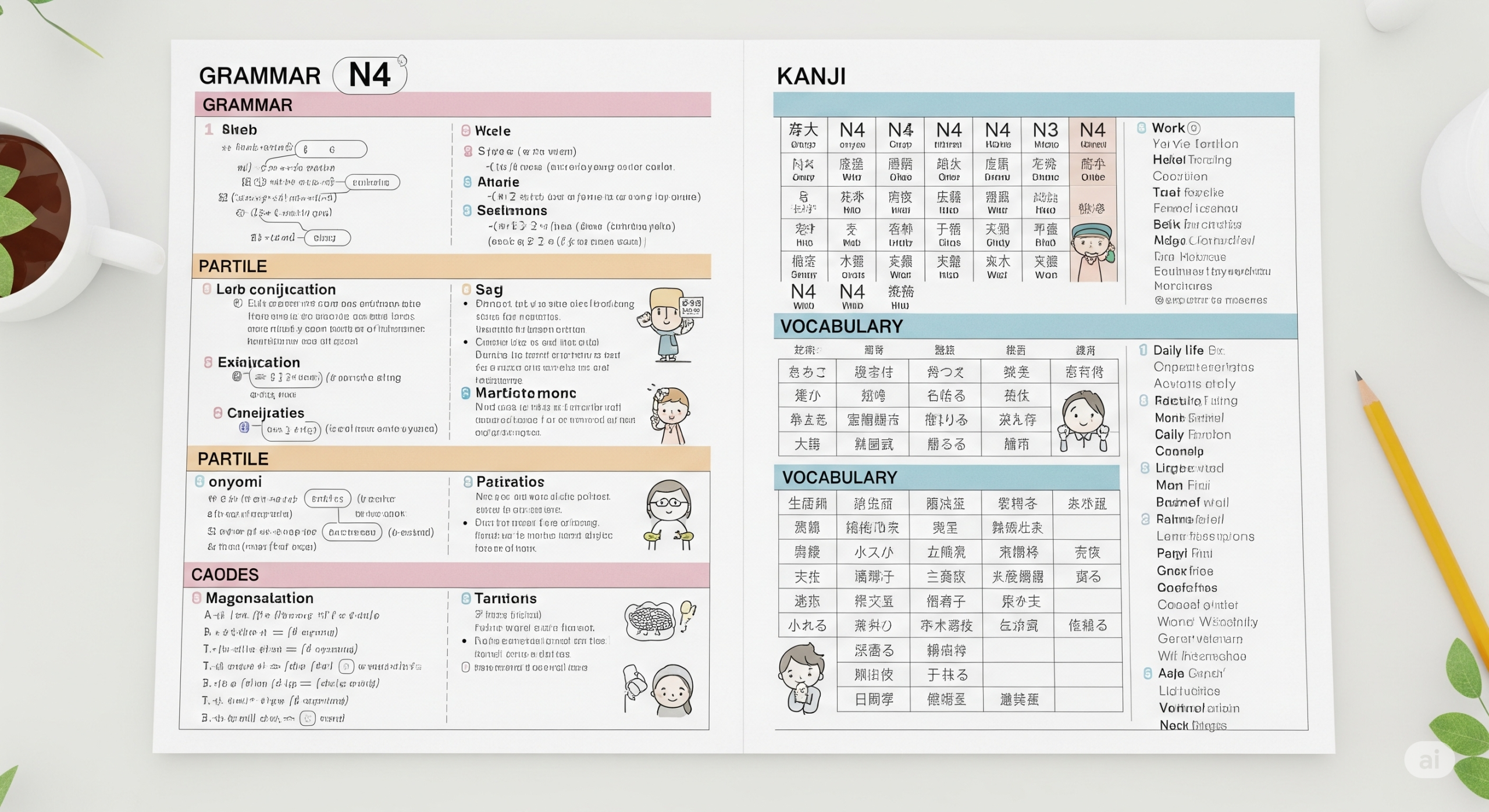
To make your study sessions smoother, we’ve created the ultimate JLPT N4 cheat sheet—a quick-reference guide covering the most essential elements you’ll need to pass the exam. Whether you’re cramming last-minute or reinforcing your knowledge, this guide will help you focus on what truly matters.
(Looking for N5 basics? Check out our JLPT N5 Study Guide first!)
Why the JLPT N4 Matters
The JLPT N4 is a crucial step for learners who want to:
✔ Understand daily conversations
✔ Read simple articles and signs
✔ Build a foundation for intermediate Japanese (N3 and beyond)
Many Japanese language schools and employers recognize N4 as proof of basic communication skills, making it a valuable certification for students and professionals alike.
JLPT N4 Cheat Sheet: Key Study Areas
To pass the JLPT N4, you need a solid grasp of:
- Grammar (文法 – Bunpou)
- Kanji (漢字)
- Vocabulary (語彙 – Goi)
Let’s break them down with must-know examples and practical applications.
1. Essential JLPT N4 Grammar Points
Grammar is the backbone of Japanese sentence structure. Here are some high-frequency N4 grammar patterns you’ll encounter:
A. Verb Conjugations
- 〜たい (Want to do…)
- Example: 食べたい (tabetai) = “I want to eat.”
- Usage: Attach to the stem of verbs (食べる → 食べ + たい).
- 〜てみる (Try doing…)
- Example: やってみる (yatte miru) = “I’ll try doing it.”
B. Conditional Forms
- 〜たら (If… / When…)
- Example: 雨が降ったら、家にいます (Ame ga futtara, ie ni imasu) = “If it rains, I’ll stay home.”
- 〜なら (If it’s about…)
- Example: 日本語なら、わかります (Nihongo nara, wakarimasu) = “If it’s about Japanese, I understand.”
C. Passive & Causative Forms
- Passive (〜られる / 〜れる)
- Example: 本を読まれた (Hon o yomareta) = “The book was read (by someone).”
- Causative (〜させる / 〜せる)
- Example: 母は私に野菜を食べさせた (Haha wa watashi ni yasai o tabesaseta) = “My mom made me eat vegetables.”
(For a deeper dive into grammar, see our JLPT N4 Grammar Masterlist post!)
2. Must-Know JLPT N4 Kanji
The N4 test requires knowledge of around 300 kanji (on top of N5’s 100). Here are some high-yield kanji with common readings:
| Kanji | On’yomi (Chinese) | Kun’yomi (Japanese) | Meaning |
|---|---|---|---|
| 話 | ワ (wa) | はな.す (hanasu) | Speak / Story |
| 聞 | ブン (bun) | き.く (kiku) | Listen / Ask |
| 新 | シン (shin) | あたら.しい (atarashii) | New |
| 駅 | エキ (eki) | – | Station |
| 医 | イ (i) | – | Doctor / Medicine |
Pro Tip: Learn kanji in context—pair them with vocabulary (e.g., 話す = to speak, 新聞 = newspaper).
(Need kanji practice? Try WaniKani or Anki flashcards for spaced repetition!)
3. Key JLPT N4 Vocabulary
Vocabulary makes up a huge part of the exam. Here are essential N4 words categorized for easy memorization:
A. Common Verbs
- 覚える (oboeru) = To remember
- 消す (kesu) = To erase / Turn off
- 探す (sagasu) = To search
B. Useful Adjectives
- 危ない (abunai) = Dangerous
- 寂しい (sabishii) = Lonely
- 複雑 (fukuzatsu) = Complicated
C. Everyday Nouns
- 切符 (kippu) = Ticket
- 事故 (jiko) = Accident
- 規則 (kisoku) = Rule
Memory Hack: Group words by theme (e.g., travel, emotions, work) for better recall.
How to Use This Cheat Sheet Effectively
- Daily Review – Spend 10-15 minutes daily on grammar, kanji, or vocab.
- Practice with Mock Tests – Simulate exam conditions using JLPT Official Practice Workbooks.
- Apply in Real Life – Try writing sentences or speaking with native speakers on HelloTalk.
Final Tips for JLPT N4 Success
✅ Focus on Weak Areas – Struggling with kanji? Dedicate extra time to writing practice.
✅ Listen to Japanese Daily – Podcasts like Nihongo Con Teppei help with listening comprehension.
✅ Stay Consistent – Even 20 minutes a day adds up over weeks!
Conclusion
This JLPT N4 cheat sheet condenses the most critical elements into one easy-to-use resource. By mastering these grammar points, kanji, and vocabulary, you’ll be well-prepared for the exam.
Need more help? Check out our JLPT N4 Full Study Guide for a detailed roadmap!
Good luck with your studies—頑張ってください (Ganbatte kudasai)!