Introduction: What is “である (de a ru)”?
If you’ve been studying Japanese, you’re probably familiar with the polite “です/ます” endings. But have you encountered the more formal and literary “である (de aru)”?
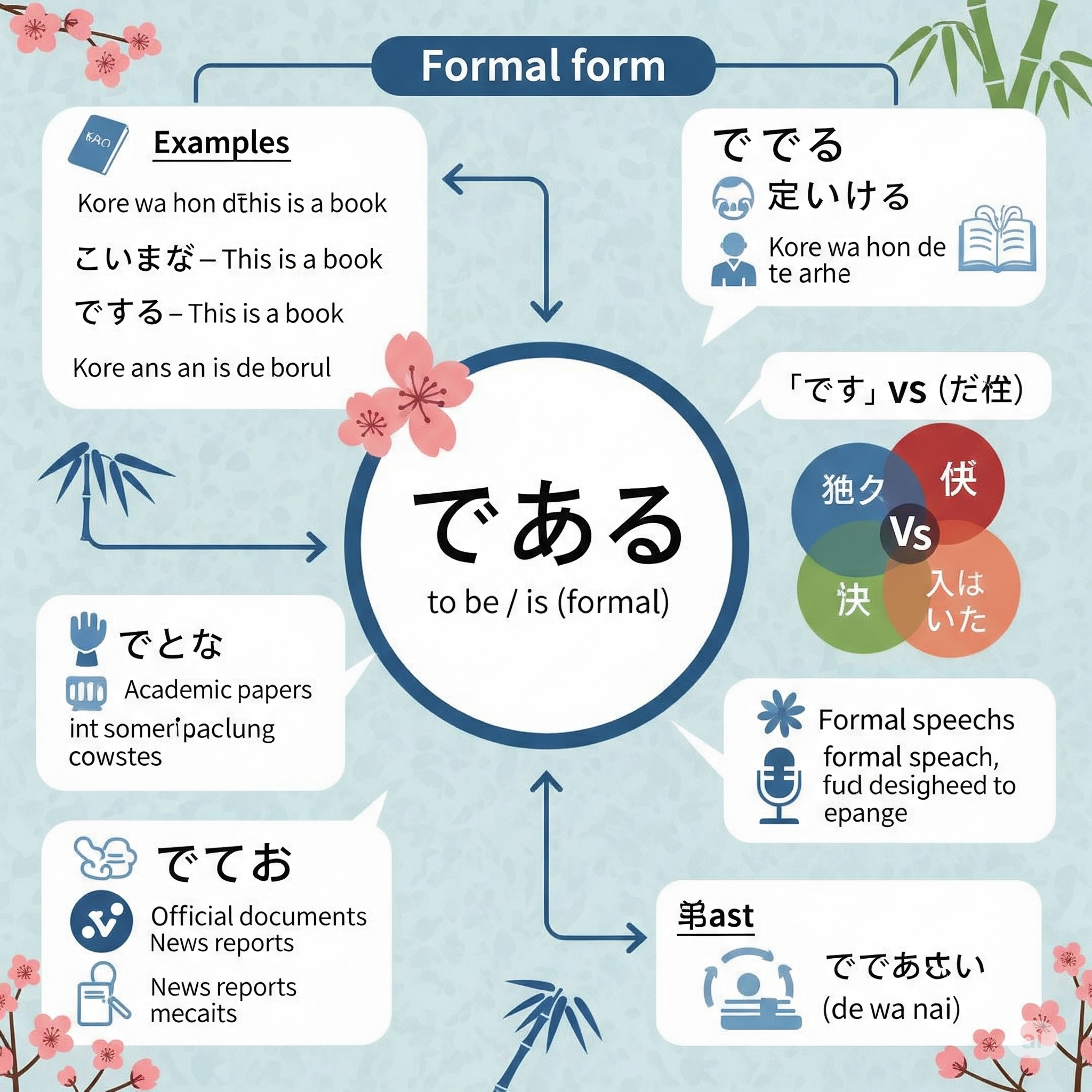
This structure is essential for formal writing, academic papers, news articles, and legal documents. Unlike “です”, which sounds conversational, “である” conveys authority and objectivity.
In this post, we’ll explore:
✔ What “である” means and how it functions
✔ Key differences between “である,” “だ,” and “です”
✔ When and where to use “である” correctly
✔ Practical examples and common mistakes to avoid
Let’s dive in!
1. Understanding “である” – The Formal Assertive Form
What Does “である” Mean?
“である” is a formal, written form of “to be” in Japanese. It’s equivalent to “だ” (plain form) and “です” (polite form) but carries a stronger, more authoritative tone.
- Plain: 彼は学生だ。 (Kare wa gakusei da.) – He is a student.
- Polite: 彼は学生です。 (Kare wa gakusei desu.) – He is a student.
- Formal/Written: 彼は学生である。 (Kare wa gakusei de aru.) – He is a student.
Grammatical Structure
“である” follows the same rules as “だ” but is more rigid in structure:
- Noun + である → 事実である (jijitsu de aru – “It is a fact”)
- Na-adjective + である → 重要である (juuyou de aru – “It is important”)
Unlike “です”, it cannot be used with i-adjectives directly.
2. When to Use “である” – Appropriate Contexts
1. Academic & Formal Writing
Since “である” sounds authoritative, it’s common in:
- Research papers
- Legal documents
- Official reports
Example:
この現象は科学的に証明されている。
(Kono genshou wa kagakuteki ni shoumei sarete iru.)
“This phenomenon has been scientifically proven.”
2. News Articles & Journalism
Japanese newspapers often use “である” for neutrality and formality.
Example:
首相は明日会議に出席するである。 (Incorrect – “するである” is wrong!)
✅ Correct: 首相は明日会議に出席するものである。
(Shushou wa ashita kaigi ni shusseki suru mono de aru.)
“The prime minister will attend the meeting tomorrow.”
3. Literary & Historical Contexts
Novels, especially historical or philosophical texts, use “である” for a classical tone.
Example:
彼こそ真の勇者である。
(Kare koso shin no yuusha de aru.)
“He is the true hero.”
3. Key Differences: “である” vs. “だ” vs. “です”
| Feature | である | だ (Plain) | です (Polite) |
|---|---|---|---|
| Formality | Very formal | Casual | Polite |
| Usage | Writing, news | Spoken, informal | Daily conversation |
| Tone | Authoritative | Direct | Respectful |
| Example | 事実である | 事実だ | 事実です |
Can You Use “である” in Speech?
Rarely. It sounds overly stiff in conversation unless you’re giving a formal speech.
4. Common Mistakes & How to Avoid Them
❌ Mistake 1: Using “である” with i-Adjectives
Incorrect: この本は面白いである。 (Kono hon wa omoshiroi de aru.)
✅ Correct: この本は面白い。 (Kono hon wa omoshiroi.)
Fix: Only use “である” with nouns & na-adjectives.
❌ Mistake 2: Mixing “である” with Casual Speech
Incorrect (unless in a novel):
「今日は暑いである…」 (“Kyou wa atsui de aru…”) → Sounds unnatural.
✅ Better: 「今日は暑いね。」 (“Kyou wa atsui ne.”)
❌ Mistake 3: Overusing “である” in Emails
Unless writing a formal report, stick to “です/ます” in emails.
5. Practical Applications & Exercises
Exercise 1: Convert Sentences to “である” Form
- 彼は先生です。 → 彼は先生である。
- これは簡単だ。 → これは簡単である。
- 彼女は有名な歌手だ。 → 彼女は有名な歌手である。
Exercise 2: Identify Correct Usage
Which sentence is correct?
A) この問題は難しいである。
B) この問題は難しい。
Answer: B (i-adjectives don’t take “である”)
6. Advanced Insight: “である” in Classical Japanese
Historically, “である” evolved from “にてあり” (nite ari) in classical Japanese. You’ll still see remnants in samurai dramas or historical texts.
Example:
「我こそは王者にてある!」
(Ware koso wa ouja nite aru!)
“I am the king!”
Conclusion: Mastering “である” for Formal Japanese
“である” is a powerful tool for formal writing, offering a tone of authority and objectivity. While you won’t use it in daily chats, mastering it will help you:
✔ Read newspapers & academic papers
✔ Write professional reports
✔ Understand classical Japanese literature
Want to deepen your understanding? Check out our guide on Japanese Polite Form (です/ます) or explore NHK News Easy (outbound link) for real-world examples.
Now it’s your turn! Try writing a formal sentence using “である” in the comments.
Further Reading:
By mastering “である”, you’ll unlock a new level of Japanese proficiency. Keep practicing, and soon it’ll feel natural! 🚀