Introduction
So, you’ve decided to learn Japanese—fantastic choice! Whether you’re drawn by anime, manga, travel, or career opportunities, mastering Japanese opens doors to a rich culture and exciting experiences.
But where do you begin? With three writing systems, complex grammar, and different levels of politeness, Japanese can feel overwhelming. Don’t worry—this step-by-step guide will break it down into manageable chunks, making your learning journey smooth and enjoyable.
Let’s dive in!
Step 1: Set Clear Goals
Before jumping into textbooks, ask yourself:
- Why do I want to learn Japanese? (Travel, work, hobbies?)
- What level do I aim for? (JLPT N5, conversational fluency?)
- How much time can I commit daily? (15 mins? 1 hour?)
Having clear goals keeps you motivated. For example:
- “I want to understand anime without subtitles in 1 year.”
- “I need to pass JLPT N4 for my job in 18 months.”
Pro Tip: Use the SMART goal framework—Specific, Measurable, Achievable, Relevant, Time-bound.
Step 2: Learn Hiragana and Katakana (The Japanese Alphabets)
Japanese uses three scripts:
- Hiragana (ひらがな) – For native words and grammar.
- Katakana (カタカナ) – For foreign words and emphasis.
- Kanji (漢字) – Borrowed Chinese characters.
How to Master Hiragana & Katakana Fast:
- Use flashcards (Try Tofugu’s Mnemonics Guide)
- Write them daily – Muscle memory helps!
- Practice with apps like Duolingo or Memrise.
Fun Fact: You can read basic Japanese with just hiragana and katakana!
Step 3: Start with Basic Grammar & Common Phrases
Japanese grammar is different from English, but logical once you get the hang of it.
Essential Grammar Rules for Beginners:
- Sentence structure: Subject-Object-Verb (SOV)
- “I sushi eat” → “Watashi wa sushi o tabemasu.” (私は寿司を食べます。)
- Particles (like wa, ga, *o*) define word roles.
- No plurals or gendered nouns – A relief for English speakers!
Must-Know Phrases:
| Japanese | Romaji | English |
|---|---|---|
| こんにちは | Konnichiwa | Hello |
| ありがとう | Arigatou | Thank you |
| すみません | Sumimasen | Excuse me / Sorry |
| 大丈夫ですか? | Daijoubu desu ka? | Are you okay? |
Pro Tip: Practice speaking from Day 1—even if it feels awkward!
Step 4: Build Your Vocabulary
Words are the building blocks of fluency. Start with:
- Everyday words (food, family, numbers)
- Verbs (eat, go, see, speak)
- Adjectives (big, small, fun)
Best Ways to Learn Vocabulary:
✅ Flashcards (Anki is a lifesaver!)
✅ Label objects at home with sticky notes.
✅ Watch Japanese YouTube (Try Japanese Ammo with Misa)
Fun Exercise: Keep a Japanese journal—write 3 sentences daily!
Step 5: Tackle Kanji (The Beast of Japanese Writing)
Kanji scares many learners, but you don’t need to memorize all 2,000+ at once!
Smart Kanji Learning Strategy:
- Start with JLPT N5 Kanji (~100 characters).
- Learn radicals first (components that make up kanji).
- Use mnemonics – Turn kanji into stories.
- Example: 木 (ki) means “tree.” It looks like a tree!
Best Resources:
- WaniKani (Gamified kanji learning)
- Kanji Study App
Step 6: Immerse Yourself in Japanese
The fastest way to learn? Surround yourself with Japanese!
Easy Immersion Techniques:
🎧 Listen:
- Japanese podcasts (NHK News Easy)
- Music (J-pop, anime OSTs)
📺 Watch:
- Anime & dramas (with Japanese subtitles)
- YouTube channels like Comprehensible Japanese
📖 Read:
- Graded readers
- Manga (Start with Yotsuba&!)
Pro Tip: Shadowing (repeating after native speakers) improves pronunciation!
Step 7: Practice Speaking (Don’t Be Shy!)
Many learners understand Japanese but freeze when speaking. Here’s how to overcome that:
Ways to Practice Speaking:
🗣 Language Exchange:
🎤 Record Yourself:
- Compare your speech to natives.
Encouragement: “Mistakes are proof you’re learning!”
Step 8: Take the JLPT (If You Want Certification)
The Japanese Language Proficiency Test (JLPT) has five levels (N5 to N1).
Should You Take the JLPT?
✅ If you need proof of fluency for jobs/school.
✅ If you want structured goals.
Study Tips:
- Use JLPT prep books (Try Shin Kanzen Master series).
- Take mock tests to gauge progress.
Step 9: Stay Motivated (The Key to Success!)
Learning Japanese is a marathon, not a sprint. Here’s how to stay on track:
🔥 Motivation Boosters:
- Join a Japanese learning community (Reddit’s r/LearnJapanese).
- Reward yourself for milestones.
- Remind yourself why you started.
Quote to Keep You Going:
“The expert in anything was once a beginner.”
Final Thoughts
Learning Japanese is challenging but incredibly rewarding. Follow these steps, stay consistent, and you’ll see progress faster than you think!
Recap:
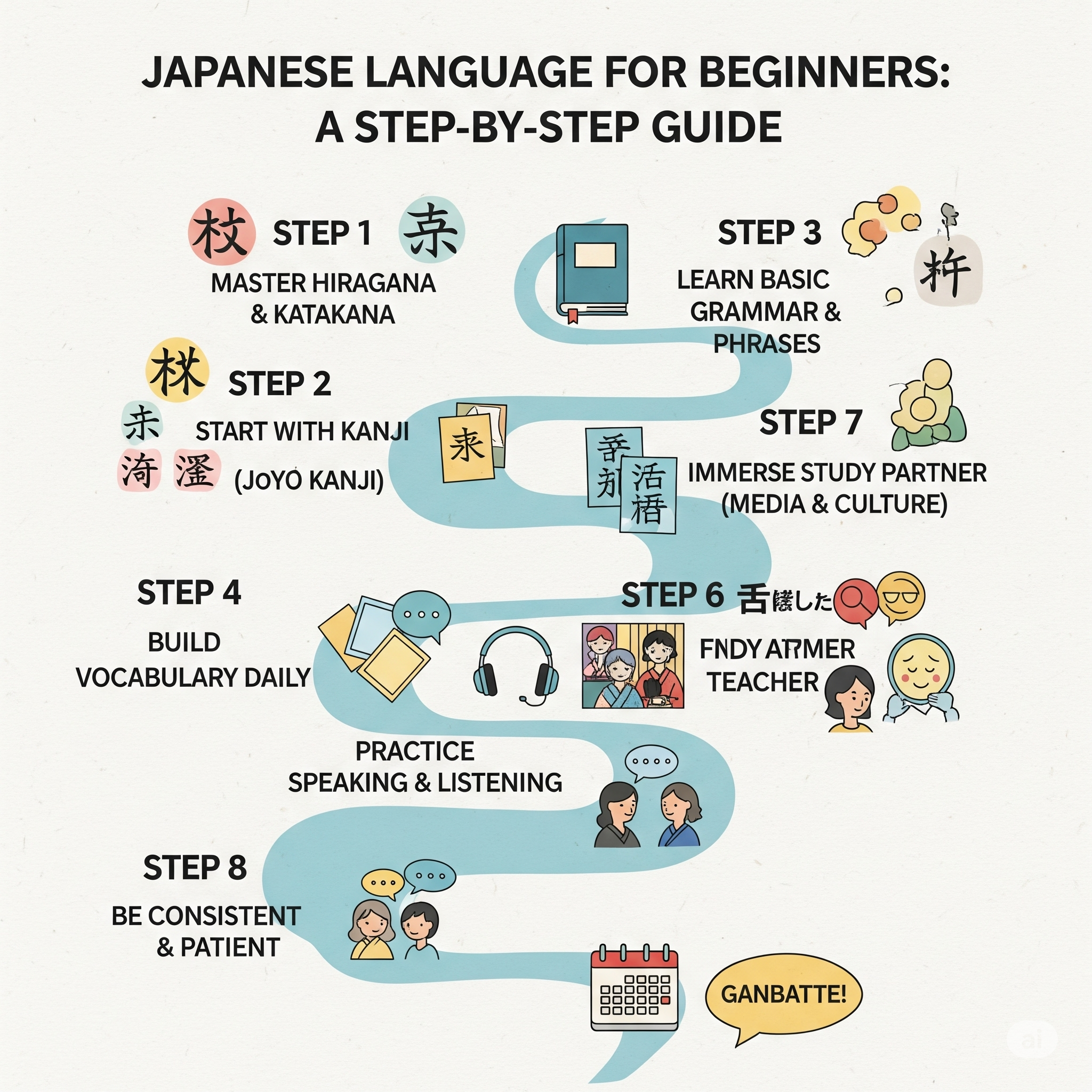
- Set clear goals.
- Master hiragana & katakana.
- Learn basic grammar & phrases.
- Expand vocabulary.
- Study kanji systematically.
- Immerse yourself in Japanese media.
- Practice speaking regularly.
- Consider JLPT certification.
- Stay motivated!
Ready to start? Grab your notebook, pick a resource, and take the first step today!
Further Reading:
External Resources:
What’s your biggest challenge in learning Japanese? Let me know in the comments! 🎌