
The Samurai’s Path: Why Ebooks are Your Secret Weapon for JLPT N2
Before we examine the specific tools, let’s understand the why. Stacks of physical books have their charm, but for the modern learner, ebooks offer unparalleled advantages:
- Portability: Your entire N2 library—grammar, vocabulary, kanji, reading practice—on one device. Study on your commute, on your lunch break, or while waiting in line. No excuses!
- Integrated Learning: Many ebooks aren’t just PDFs. They link to audio files, have built-in dictionaries, flashcards, and interactive quizzes. They create a seamless, multi-sensory learning experience.
- Searchability: Can’t remember that specific grammar point? Instead of flipping through an index, use the search function. Find exactly what you need in seconds.
- Cost-Effectiveness: Digital versions are often cheaper than their physical counterparts, and many excellent resources are even free.
The N2 exam tests your integrated Japanese ability. You can’t just know grammar; you need to understand it in context, hear it in conversations, and read it in complex passages. Ebooks and digital resources are uniquely positioned to help you do just that.
Forging Your Digital Toolkit: Category-by-Category Breakdown
A samurai doesn’t go into battle with just one weapon. You need a full arsenal. Here’s how to build yours.
1. The Grammar Grimoire: Mastering 文法 (Bunpou)
N2 grammar is where things get spicy. It’s less about simple rules and more about nuance, tone, and formal expressions.
- The Champion: “A Dictionary of Japanese Grammar” Series (Digital Editions)
- What it is: This is the holy grail for serious learners. The Intermediate and Advanced digital versions are worth their weight in gold. It’s not a textbook you read cover-to-cover but a reference guide you consult.
- Why it’s great for N2: It explains subtle differences between similar patterns (e.g., 〜に沿って vs 〜に応じて) with incredible clarity and example sentences. The search function in a PDF or ebook reader makes it an incredibly powerful tool. When you encounter a new grammar point in a practice test or novel, look it up here first.
- Practical Application: Keep this PDF open on your computer or tablet while you do reading practice. Every time you see an unfamiliar grammar structure, search for it. Read the explanation and all the examples. This active lookup cements understanding far better than passive reading.
- The Workhorse: “Shin Kanzen Master N2 Grammar” (Ebook)
- What it is: A more traditional, structured study guide. It’s methodical, comprehensive, and designed specifically for the JLPT.
- Why it’s great: It holds your hand through all the grammar points you need to know, grouped by similarity, with practice exercises. The digital format is perfect for doing exercises on your tablet and quickly checking answers.
- Practical Application: Dedicate one study session a week to working through a chapter. Do all the exercises. Use the SRS method (more on that later) to create flashcards for the example sentences that trip you up.
2. The Kanji Katana: Sharpening Your 漢字 (Kanji) Skills
N2 requires knowledge of around 1,000 kanji and several thousand vocabulary words. Rote memorization is a path to madness. You need a system.
- The Game-Changer: WaniKani
- What it is: A radical-based, SRS (Spaced Repetition System) web and app platform for learning kanji and vocabulary. It’s not a traditional ebook, but it’s the most effective digital resource for this task, bar none.
- Why it’s great for N2: It teaches you kanji through radicals (the building blocks), then vocabulary using those kanji. It uses mnemonics and SRS to ensure you remember them. By the time you finish its levels (which go well beyond N2), you will have a rock-solid foundation. It completely removes the stress of “how to study kanji.”
- Practical Application: This is a daily practice. 20-30 minutes a day is enough. Consistency is key. Trust the system. (Check out my full review of WaniKani here).
- The Supplement: “Kanji Look and Learn” (Ebook Version)
- What it is: A fantastic book from The Japan Times that uses illustrations and stories to teach 512 kanji (and 3,500+ vocabulary). The N2 level will require going beyond this, but it builds a phenomenal foundation for the intermediate level.
- Why it’s great: The visual mnemonics are incredibly sticky. The ebook is great for a quick review session.
- Practical Application: If you’re struggling with a specific kanji in WaniKani or elsewhere, look it up in this book. Its unique explanation might be the one that makes it click forever.
3. The Reading Scroll: Deciphering 読解 (Dokkai)
N2 reading comprehension is long, complex, and time-pressured. You need to practice with authentic, lengthy texts.
- The Immersion Powerhouse: Satori Reader
- What it is: A curated collection of engaging, well-written stories and articles designed for learners. Every story has line-by-line breakdowns, audio narration by native speakers, and explanations of grammar and usage.
- Why it’s perfect for N2: This is the best tool to bridge the gap from textbook Japanese to real Japanese. The articles are exactly the kind of length and complexity you’ll see on the N2 exam. The audio helps you connect the written word to spoken flow, aiding comprehension.
- Practical Application: Read one article a day. First, read it through without help. Then, activate the hints and read it again, paying attention to the explanations. Finally, listen to the audio while reading along. This three-step process attacks reading from every angle.
- The Exam Specialist: “So-Matome N2 Reading” or “Shin Kanzen Master N2 Reading” (Ebook)
- What it is: These books provide targeted practice for the specific question types found on the JLPT reading section (e.g., finding the main idea, understanding author’s intent, information retrieval).
- Why it’s great: They teach you the strategy for the test. Time management is critical in the reading section, and these books drill you on how to quickly find answers without getting bogged down.
- Practical Application: Use these books in the 2-3 months leading up to the exam. Do timed practice sessions. Practice skimming for main ideas and scanning for specific details.
4. The Listening Ear: Honing 聴解 (Choukai)
N2 listening is fast and features natural, everyday conversations with elisions and filler words.
- The Gold Standard: “Shin Kanzen Master N2 Listening” (with Audio Files)
- What it is: The best listening practice book, hands down. It comes with downloadable MP3s.
- Why it’s great: It doesn’t just throw practice questions at you; it breaks down why you might have missed an answer. Was it a similar-sounding word? Was the key information hidden in a casual remark? It builds your listening strategy.
- Practical Application: Load the audio files onto your phone. Don’t just listen once. If you get a question wrong, listen to that segment again and again until you can clearly hear the correct information. Read the script simultaneously.
- The Real-World Simulator: YouTube & Podcasts
- YouTube Channels: 三本塾 (Sanbonjuku) and 日本語の森 (Nihongo no Mori) are incredible free resources with specific N2-focused lessons on grammar and listening practice.
- Podcasts: Nihongo Con Teppei (for intermediates) is fantastic for getting used to natural speed. For more advanced, unscripted content, ゆる言語学ラジオ (Yuru Gengo-gaku Radio) is a challenge but excellent practice.
- Practical Application: Integrate this into your passive learning. Listen to a podcast during your workout or commute. Don’t worry about understanding every word; focus on catching the gist and getting your brain accustomed to the rhythm of natural speech.
Forging Your Study Plan: The Samurai’s Schedule
A weapon is useless without a strategy. Here’s how to combine these resources into a winning weekly plan.
- Daily (15-30 mins): WaniKani for Kanji/Vocab. Non-negotiable.
- Daily (15 mins): Listening practice. Use Shin Kanzen Master drills or a podcast.
- Alternate Days:
- Day 1 (Grammar): Work through one unit of your Shin Kanzen Master Grammar ebook.
- Day 2 (Reading): Read one article on Satori Reader or a passage from a reading workbook.
- Weekly (1 hour): Full practice test section. One week, do a full reading section timed. Another week, do a full listening section. This builds stamina.
- Ongoing: Use the Dictionary of Japanese Grammar as your constant reference companion.
The Final Showdown: Full-Length Practice Tests
In the final month before your exam, your focus must shift. You need to simulate the actual test environment.
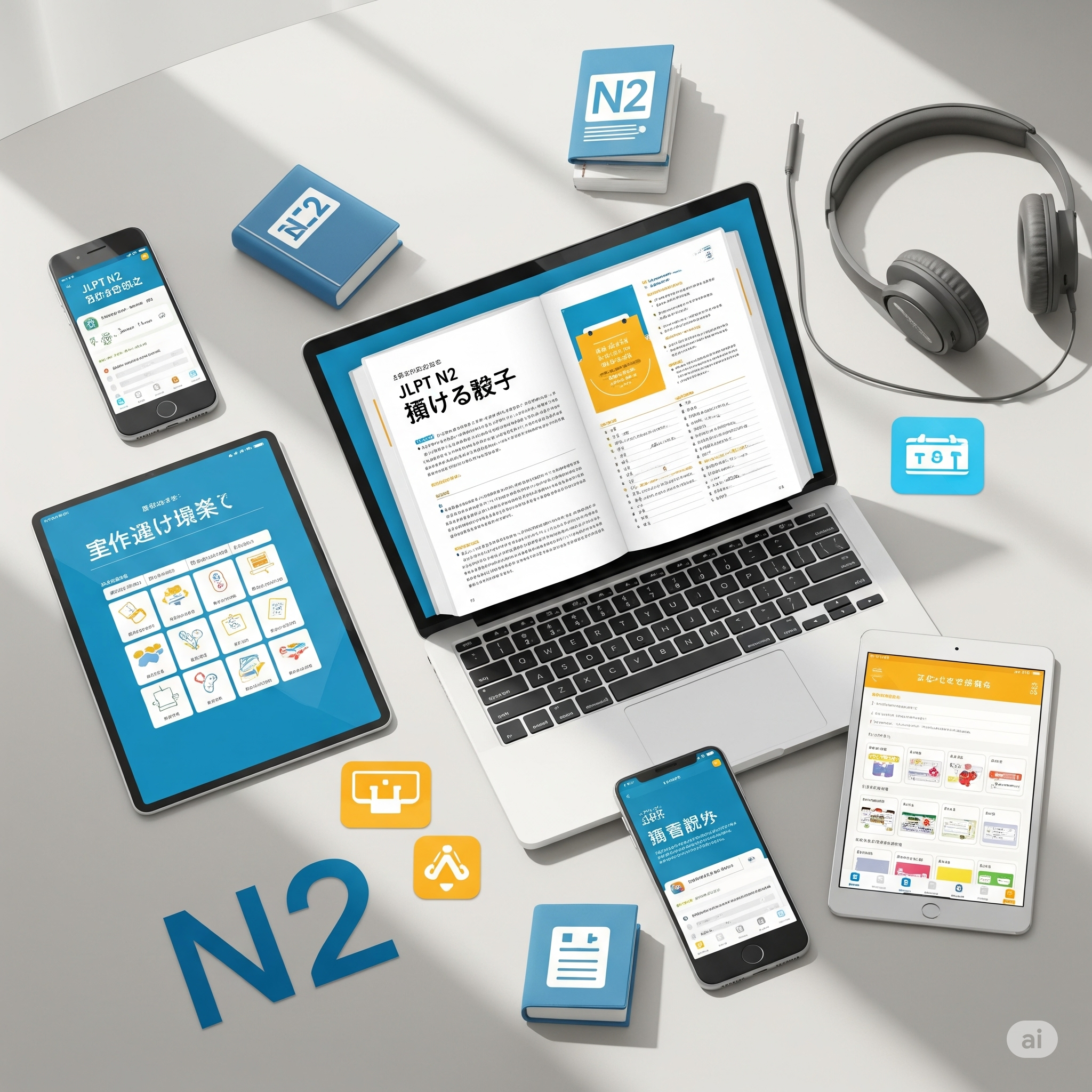
Your Journey Awaits
The path to JLPT N2 is demanding, but with the right digital toolkit—your ebook JLPT N2 grimoires, your SRS apps, your immersive readers—it is absolutely achievable. Remember, consistency is more important than intensity. Study a little every day, trust in your resources, and gradually, you will see your skills sharpen.
You have the spirit of a samurai. Now, you have the tools.
がんばってください! (Ganbatte kudasai!) Go for it!


