Hey there, fellow learner! So, you’ve mastered your basic greetings, you can navigate a conversation about your favorite anime, and you’re feeling pretty good about those ~なければならない grammar patterns. You’ve set your sights on the JLPT N4, the perfect milestone to prove your foundational prowess in Japanese.
You’ve heard the classic advice: “Use past papers!” You download a few, print them out, and then… what? Do you just take one, check your score, and hope for the best? If that’s your strategy, you’re leaving precious points on the table, my friend.
Think of past papers not as a simple practice test, but as a battle plan left behind by previous test-takers. They are a treasure trove of insights into the mind of the exam creators. Your mission is to decode them. Let’s break down exactly how to do that.
For more details, please visit Free JLPT N4 Practice Test Downloads for Smart Study – Your Path to Success
Why Past Papers Are Your Secret Weapon
Before we get into the “how,” let’s solidify the “why.” Cracking open an old exam is about so much more than just checking if you know the answers.
- Familiarity Breeds Confidence, Not Contempt: The JLPT is a timed, high-pressure environment. The format, the question styles, the answer sheet—everything can feel alien. By using past papers, you transform the unknown into the familiar. When exam day comes, you won’t be nervous about the format; you can focus all your mental energy on the language.
- Identify Your Personal Weaknesses (Your “Kyoui” 脅威): You might think you’re bad at kanji, but a past paper might reveal that your real “kyoui” (threat) is actually specific grammar patterns or the speed of your reading comprehension. Past papers give you a brutally honest diagnosis, allowing you to target your study time with surgical precision.
- Understand the “Exam Language”: The JLPT has its own way of phrasing questions. You’ll see patterns like 「~の意味が一番近いものはどれですか。」(“Which is the closest in meaning to ~?”) or 「~について、正しいものはどれですか。」(“Regarding ~, which is correct?”). Getting used to this “exam language” is a skill in itself.
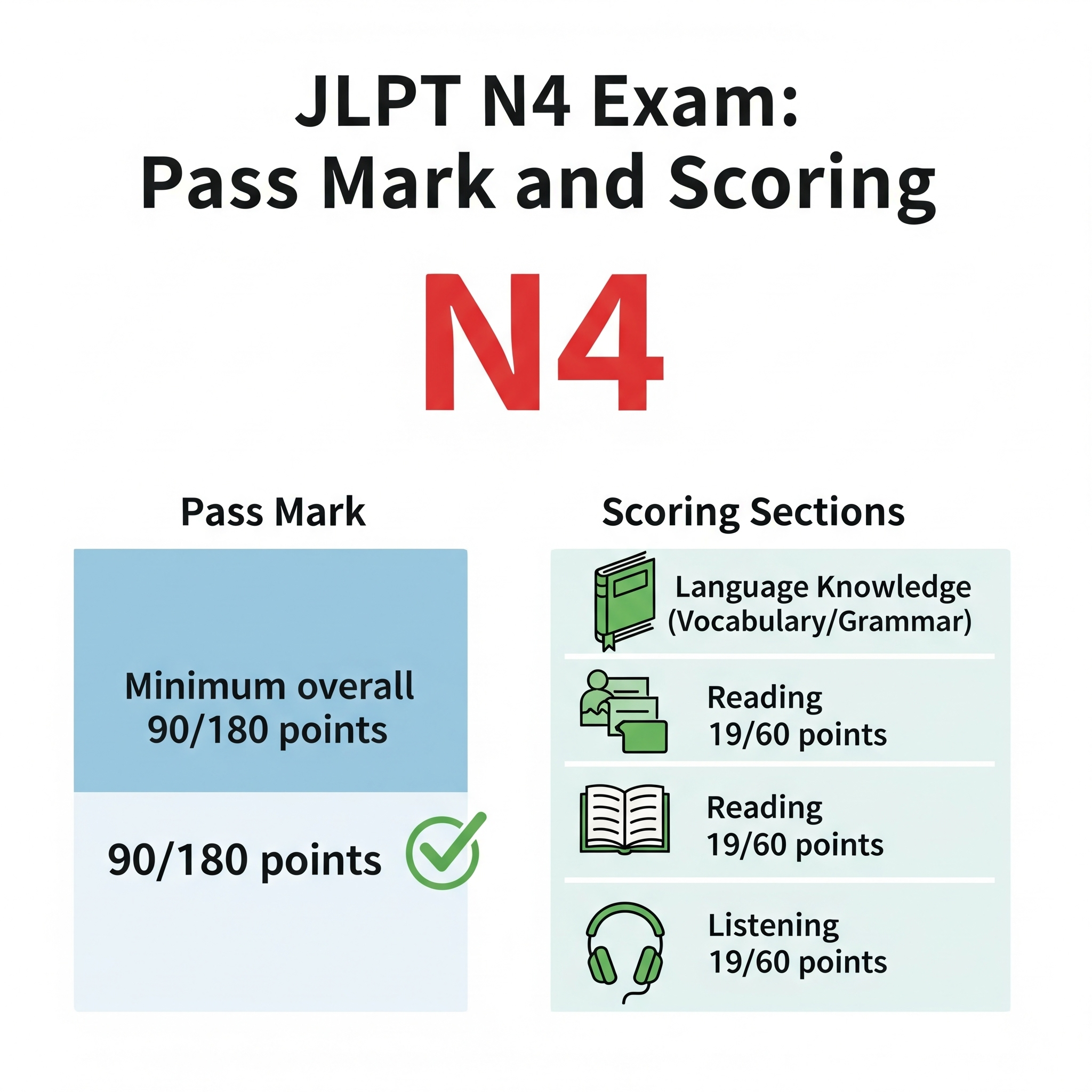
- Perfect Your Time Management: The N4 exam is 30 minutes for Language Knowledge (Vocabulary) and 60 minutes for Language Knowledge (Grammar) and Reading, followed by 35 minutes for Listening. That’s tight! Practicing with a timer is the only way to know if you can comfortably finish each section without panicking.
For more details, please visit JLPT N4 December 2025 Question Paper: What to Expect
Step-by-Step: The Samurai Method for Conquering Past Papers
Alright, enough theory. Let’s get practical. Here’s your battle-tested plan.
Step 1: Gather Your Armory (Finding the Papers)
First, you need the materials. You can find official past papers with answer keys on the official JLPT website: https://www.jlpt.jp/e/. They offer one sample paper for each level. It’s the most authentic source available.
For a wider range of past papers, websites like JPDrills https://jpdrills.com/ offer a fantastic database of user-contributed questions from past exams, which is an incredible resource for targeted practice.
Internal Link: While you’re gathering resources, have you seen our essential list of JLPT N4 Answer Sheet PDF – Printable Template for Practice Tests It pairs perfectly with this guide!
Step 2: The First Blood (Your Initial Simulation)
This is crucial. Pick a recent past paper (e.g., from 2022 or 2021). Set aside a solid 2.5-hour block of uninterrupted time. Get your pencils ready, silence your phone, and simulate the real exam conditions as closely as possible.
- Use the official time limits for each section. No cheating!
- Use an answer sheet. You can find printable versions online. Getting used to filling in those bubbles quickly and accurately is a small but important detail.
- Do not look at the answer key until you have completely finished the entire test.
This first run isn’t about getting a perfect score. It’s about gathering data on your current ability under pressure.
For more details, please visit JLPT N4 2025 Answer Key: Release Dates & How to Check
Step 3: The Post-Battle Analysis (This is Where the Magic Happens)
Grading your test is just the beginning. A simple score of 75/180 tells you almost nothing. You need to become a detective.
- Categorize Your Mistakes: Don’t just mark questions right or wrong. Create a chart or use a notebook to categorize every error:
- Vocabulary (語彙 Goi): Was it a kanji reading you didn’t know? A word meaning?
- Kanji (漢字): Did you misread it? Could you not write it from hiragana?
- Grammar (文法 Bunpou): Did you not understand the grammar point? Did you choose the wrong particle?
- Reading (読解 Dokkai): Was the answer in the text but you misread it? Did you run out of time?
- Listening (聴解 Choukai): Did you forget the key info? Was the speech too fast?
- Identify Patterns: After a few practice tests, look at your error chart. Do you see a pattern? Maybe you consistently miss questions involving ~そうだ (I hear that…) or ~ようだ (it seems like…). Maybe listening questions where two people are making plans are your kryptonite. This pattern is your personalized study guide.
For more details, please visit JLPT N4 Answer Key 2025 – Check Your Results Here
Step 4: Targeted Training (Sharpening Your Blade)
Now, take the insights from your analysis and act on them.
- If ~てもらう and ~てくれる (giving and receiving) are a problem, don’t just move on. Open your textbook, rewatch Tofugu’s brilliant explanation on the topic, and do 20 extra practice questions on just that point.
- If a specific kanji keeps tripping you up, add it to your flashcard deck with a memorable example sentence.
- If listening speed is the issue, incorporate more passive listening into your daily life. Listen to Nihongo Con Teppei’s podcast for beginners on your commute.
Internal Link: Struggling with the listening section? We’ve got a whole post dedicated to JLPT N4 Answer Key 2025 – Check Your Scores & Predictions
Step 5: Repeat the Process
Do this entire process with multiple past papers. Space them out—maybe one every 3-4 weeks at first, and then more frequently as the exam approaches. Track your score and, more importantly, track the reduction in your specific error types. This visible progress is a huge motivator!
Unique Insights & Pro Tips from the Dojo
- Beware the “I Recognized It” Trap: It’s easy to look at a answer key and say, “Oh, I knew that!” But during the exam, you didn’t. Be brutally honest with yourself. If you got it wrong, you didn’t know it well enough under pressure. That’s the standard.
- The Power of the Answer Key (Beyond the Letter): The official answer keys often just list the correct choice (e.g., “問29: 4”). Your job is to go back and understand why #4 is correct and, critically, why the other three options are wrong. The test makers design wrong answers to trick you based on common mistakes. Understanding their tricks makes you immune to them.
- Listen, Then Listen Again: For listening sections, don’t just check the answers. Listen to the audio track again, following along with the script if you have it. Identify the exact sentence or word that gave away the answer. Train your ear to catch those “clue” words.
- The “Why” Behind the “What”: When reviewing a reading passage you found difficult, don’t just translate it. Ask yourself: “What is the main point of each paragraph?” “What is the author’s overall opinion?” This higher-level analysis is what the reading section is truly testing.
Final Words of Encouragement
Using past papers effectively is a process. It requires honesty, discipline, and a willingness to confront your weaknesses. But I promise you, it is the single most effective method to move from passively studying Japanese to actively preparing to conquer the JLPT N4.
Remember, samurai weren’t born masters; they trained with purpose. You are doing the same. Each past paper you dissect is a training session. Each mistake you analyze and correct is a skill honed.
You have the strategy. You have the resources. Now, go forth and practice! 頑張ってください!(Ganbatte kudasai!)
Internal Link: Ready to create a full study plan? Combine this guide with our Latest JLPT N4 Answer Key – Understand Your Mistakes & Improve for a guaranteed path to success!