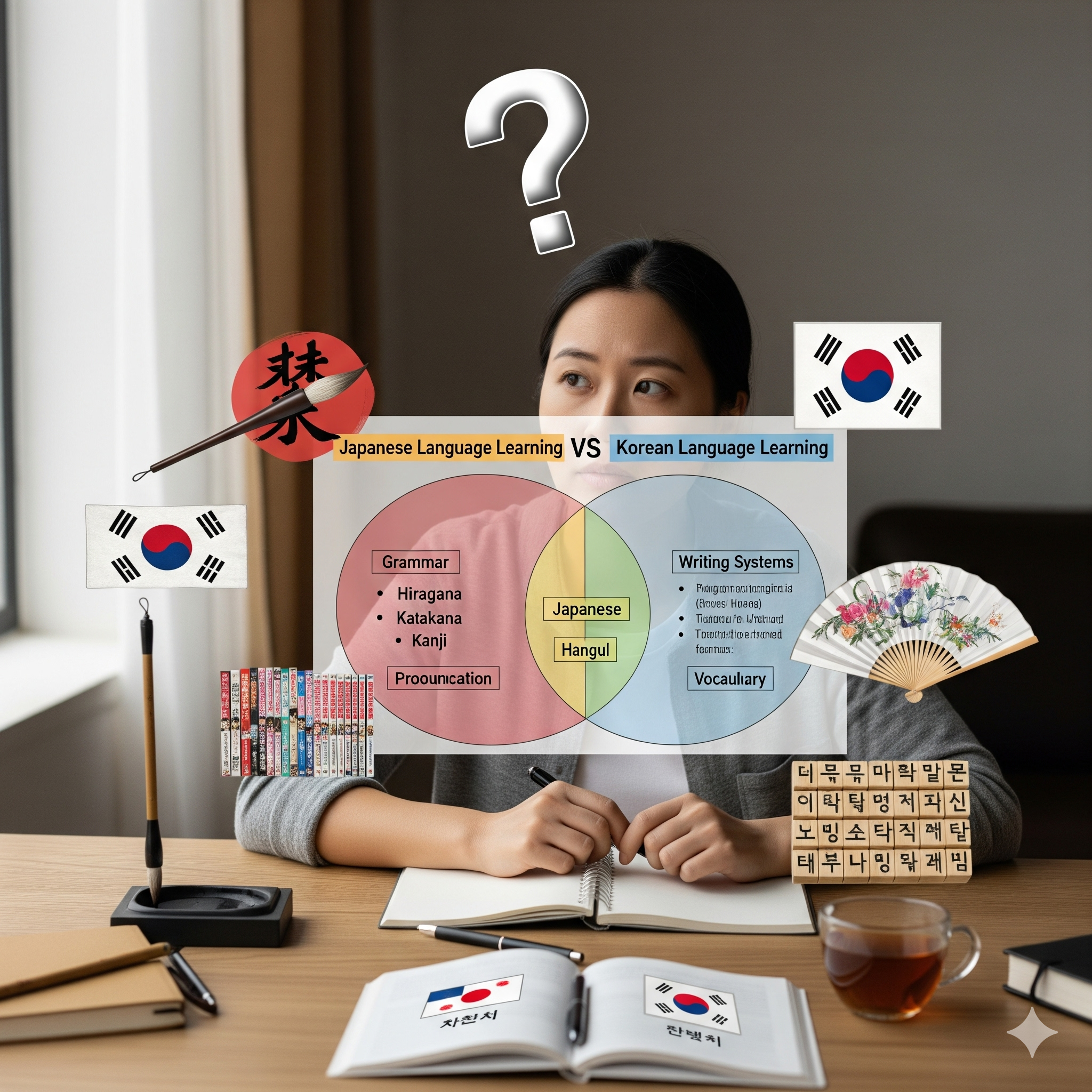
So, you’ve decided to embark on the incredible journey of learning an East Asian language. The music, the dramas, the cuisine, the culture—it all calls to you. But then you hit the first, and arguably biggest, crossroads: Should I learn Japanese or Korean?
As someone who has spent years deep in the weeds of Japanese, passed the JLPT N1, and helped countless students navigate this exact question, I’m here to give you a detailed, honest comparison. I’ll ditch the hype and the overly simplistic answers. The truth is, “easier” is a deeply personal concept. It depends entirely on your background, your goals, and how your brain is wired.
We’re not just going to say “Hangul is easy, Kanji is hard, so Korean wins.” It’s so much more nuanced than that. Let’s break it down together.
The Quick Answer (But Please Keep Reading!)
If you held a gun to my head and forced me to give a general answer for a native English speaker, I’d say: Korean often has a gentler initial learning curve, but Japanese can have more predictable intermediate stages.
Korean’s writing system, Hangul, is a masterpiece of logical design that you can learn in a weekend. This gives beginners a massive and immediate confidence boost. Japanese, with its triple-threat writing system (Hiragana, Katakana, Kanji), can feel intimidating right out of the gate.
However, as you move beyond the basics, the landscape shifts. Japanese grammar, while complex, follows remarkably consistent rules. Korean pronunciation and nuanced honorifics can present a significant challenge later on.
But this is a surface-level take. Let’s dig into the specifics.
Head-to-Head: Breaking Down the Key Challenges
1. The Writing System: The Most Obvious Difference
This is the biggest mental hurdle and where the two languages diverge dramatically.
- Korean (Hangul): This is, without a doubt, one of the easiest and most logical writing systems ever created. King Sejong the Great designed it in the 15th century to promote literacy. It’s not a collection of random symbols; it’s an alphabet. You can learn the basic characters and their assembly in a single afternoon. The victory of cracking Hangul so quickly cannot be overstated—it’s a huge motivational win. Verdict: A clear and massive win for Korean.
- Japanese (Hiragana, Katakana, Kanji): Buckle up. Japanese uses three scripts simultaneously.
- Hiragana & Katakana: These are syllabaries, much like Hangul, with 46 characters each. They are phonetic and not too difficult to learn. You can master each in a week or two with practice. Hiragana is for native words and grammar, Katakana is for foreign loanwords (like コーヒー for “coffee”).
- Kanji: This is the big one. Adopted from Chinese, Kanji are logographic characters where each symbol represents a meaning and has multiple pronunciations. To be functionally literate, you need to know around 2,000 of them. This is a long, multi-year marathon of memorization and practice. It’s daunting, but for many (myself included), it’s also deeply fascinating and rewarding. If you’re starting out, our guide on How to Start Learning Kanji Without Losing Your Mind can help.
Insight: Hangul offers a sprint; Japanese writing is a marathon. Your preference might depend on whether you prefer a quick win or a long-term, puzzle-like challenge.
2. Grammar: Are They Even the Same?
Here’s a fascinating twist: Japanese and Korean grammar are surprisingly similar. Both are subject-object-verb (SOV) languages, which is the reverse of English. This means the verb always comes at the end of the sentence.
- English: I (S) eat (V) an apple (O).
- Japanese: 私は (S) リンゴを (O) 食べます (V).
- Korean: 나는 (S) 사과를 (O) 먹습니다 (V).
Both languages also use particles (little markers attached to words) to indicate grammatical function (like subject, topic, object, location). If you grasp this concept in one language, you’ll have a huge head start in the other.
The main difference often lies in sound and perception. Japanese can sound softer to English ears, while Korean, with its more frequent use of consonant sounds, can sound harder. However, Korean grammar introduces complexities like a wider array of speech levels and conjugations that can be tricky to master.
Verdict: A draw, with a slight edge to Japanese for its slightly more consistent rules, but it’s very close.
3. Pronunciation: Listen Closely
- Japanese: Pronunciation is often considered easier for English speakers. The sound inventory is small, with only 5 vowel sounds and fairly simple consonants. The rhythm is mora-timed (like syllables), making it sound very even. The biggest challenge is mastering pitch accent—the subtle rise and fall of tone on a word that can change its meaning (e.g., 箸 háshi chopsticks vs. 橋 hashí bridge). However, getting it wrong usually just makes you sound non-native rather than causing confusion.
- Korean: This is where Korean gets tough. It has sounds that simply don’t exist in English, like the triple distinction between plain consonants (ㄱ *g*), tense (ㄲ kk), and aspirated (ㅋ *k*). Then there’s the infamous vowel ㅡ (eu), which is a struggle to produce correctly. Mastering these distinctions is crucial for being understood.
Verdict: Japanese pronunciation is generally easier to approximate for beginners. Korean pronunciation requires more precise auditory training and mouth gymnastics from the start.
4. Vocabulary and Cultural Concepts
- Japanese: A huge portion of modern Japanese vocabulary consists of words imported from English and other Western languages and written in Katakana. Words like テレビ (terebi – TV), スマホ (sumaho – smartphone), and レストラン (resutoran – restaurant) are everywhere. This can be a fantastic crutch for beginners.
- Korean: While Korean also has loanwords (콤퓨타 kompyuta – computer, though computer is now more commonly 컴퓨터 keompyuteo), it has a much stronger tendency to create new words using native Korean or Sino-Korean roots. This means fewer easy-to-recognize cognates for an English speaker.
Both languages have complex systems of honorifics and politeness levels that are baked into the grammar. You must constantly be aware of your relationship with the person you’re speaking to. This is a cultural and linguistic challenge common to both.
The X-Factor: Which Language Resonates With You?
After all this technical talk, here’s the most important part. The “easier” language is the one you are most motivated to stick with.
- Passion is Fuel: Are you dreaming of reading Haruki Murakami in the original? Are you a die-hard fan of anime and J-pop? Your deep connection to Japanese culture will power you through the Kanji grind. Does K-drama give you life? Does the sound of Korean music give you chills? That passion will make memorizing tricky pronunciation feel worthwhile. This intrinsic motivation is the single greatest predictor of success. I wrote more about this in The #1 Secret to Successfully Learning Japanese.
- Your Goals Matter: Do you want to achieve conversational fluency for travel? Korean might feel faster. Do you want to achieve high-level literacy for business or academic study? Both are immense challenges, but the path for Japanese, guided by the JLPT, is very structured.
- Access to Resources: Both languages are well-supported, but Japanese might have a slight edge in the sheer volume of textbooks, online resources like Tae Kim’s Guide, and graded readers, especially for intermediate and advanced learners.
The JLPT Pathway: A Structured Journey for Japanese
As a JLPT expert, I have to highlight this. The Japanese-Language Proficiency Test (JLPT) provides a clear, five-level (N5-N1) roadmap for learning Japanese. Each level has defined grammar, vocabulary, and Kanji goals. This structure can be incredibly helpful. You always know what to study next, which makes the long journey feel more manageable. Preparing for the JLPT N5 or N4 can give you concrete, short-term targets to aim for.
Final Verdict: It’s Not a Race, It’s a Journey
Let’s be blunt: Neither language is “easy” for an English speaker. The US Foreign Service Institute (FSI) classifies both as Category V languages, among the most difficult, requiring approximately 2,200 hours of study to reach professional proficiency.
But let’s reframe the question from “Which is easier?” to “Which is a better fit for me?“
- You might prefer KOREAN if: You value a logical, easy-to-learn writing system. You’re a auditory learner who isn’t intimidated by tricky new sounds. You want to feel a rapid sense of progress in the first few months.
- You might prefer JAPANESE if: You aren’t scared off by complex writing systems and actually enjoy the idea of learning characters. You appreciate a language with a huge number of English loanwords. You thrive with a structured, exam-based learning path (like the JLPT).
At the end of the day, the best choice is the one that makes you excited to open your textbook or language app every single day. Don’t choose based on a perceived notion of difficulty. Choose based on the culture that captures your heart and the sound that resonates with your soul.
Whichever path you choose, it will be one of the most rewarding intellectual adventures of your life. 頑張って! (Ganbatte! – Do your best!) Or, as they say in Korean: 화이팅! (Hwaiting!)
Can I Learn Japanese in 3 Months? What’s Actually Possible
Can You Learn Japanese in a Year? Study Plans & Expectations