So, you’ve caught the Japanese language bug. Maybe you’ve conquered the basics with N5, or perhaps you’ve been studying on your own and are wondering what the next step looks like. Your gaze inevitably falls on the JLPT N4, and the question pops into your head: “Just how hard is this thing?”
Let’s be real. “Difficult” is a relative term. For a marathon runner, a 5k is a warm-up. For someone who’s never run, it’s a monumental challenge. The JLPT N4 is your first real 5k in the world of Japanese proficiency. It’s a tangible step up from N5, moving you from simple survival phrases into the realm of actual conversation and comprehension.
As someone who has both taken and prepared students for this exam, I’m here to give you an honest, no-fluff breakdown. We’ll look under the hood of the N4, not to intimidate you, but to empower you with a clear roadmap. Let’s demystify it together.
What Exactly is the JLPT N4? Beyond the “Basic” Label
The official line is that JLPT N4 measures the ability to understand basic Japanese. But “basic” can be misleading. Think of it this way:
- N5: You can say, “I like coffee.” (コーヒーが好きです。)
- N4: You can understand and explain, “I used to not like coffee, but because my friend recommended a delicious one, I started drinking it last year and now I really enjoy it.” (昔はコーヒーが好きじゃなかったけど、友達がおいしいのを勧めたから、去年飲み始めて、今はとても好きです。)
See the difference? N4 is where you start connecting ideas, expressing past experiences, giving reasons, and describing sequences of events. It’s the bridge between a tourist and someone who can genuinely begin to engage with the language and culture.
A Realistic Look at the N4 Exam Structure
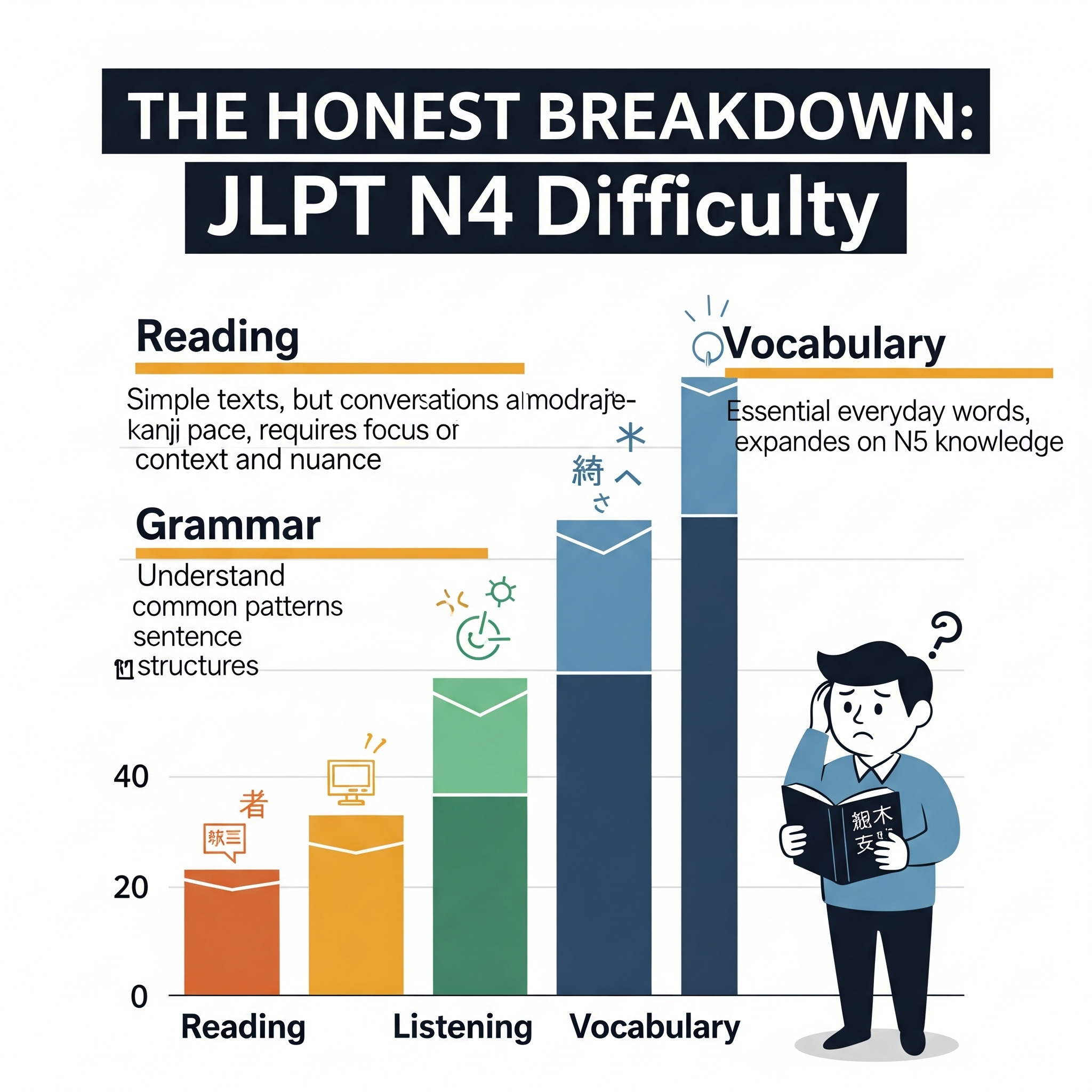
The exam is divided into three sections, just like N5, but the depth and length of the content increase.
1. Language Knowledge (Vocabulary) – 30 minutes
This section tests your grasp of approximately 1,500 words (about 700 new words from N5). It’s not just about memorizing nouns; you’ll need to know a wider array of verbs, adverbs, and adjectives. The questions often involve identifying the correct word for a context or finding the right reading for a kanji.
2. Language Knowledge (Grammar) & Reading – 60 minutes
This is where the difficulty noticeably ramps up.
- Grammar: You’ll encounter around 80 new grammar patterns. These include crucial concepts like:
- Potential Form (できる – can do): 日本語が少し話せます。 (I can speak a little Japanese.)
- Volitional Form (~よう – let’s…): 映画を見よう。 (Let’s watch a movie.)
- Giving/Receiving (あげる、くれる、もらう): 先生が本をくれました。 (The teacher gave me a book.)
- ~なければならない (have to/must): 勉強しなければならない。 (I have to study.)
- ~たり~たりする (doing things like…): 週末は買い物をしたり、料理をしたりします。 (On weekends, I do things like shop and cook.)
- Reading: The passages are longer and more complex than N5. You won’t just find simple notices; you’ll read short letters, brief explanations, and opinion pieces of about 200 characters. The key skill here is reading for intent, not just for literal meaning.
3. Listening – 35 minutes
The listening section feels significantly faster. The dialogues are longer, the speakers talk at a more natural (though still slowed) pace, and the questions require you to hold onto information and infer meaning. You’ll encounter:
- Task-Based Comprehension: “What should this person do first?”
- Point Comprehension: “Why is the man apologizing?”
- Quick Response: You hear a short phrase and choose the most natural reply.
So, Is JLPT N4 Actually Difficult? The Honest Answer
Here’s the core insight: The N4 is not conceptually difficult, but it requires a significant investment in consistent practice.
The grammar points themselves are logical. However, the challenge lies in three areas:
- The Volume: 1,500 words and 80 grammar patterns is a lot of information. Without a solid study plan, it’s easy to feel overwhelmed.
- The Application: You can memorize a grammar rule but still freeze up when you need to use it in a listening exercise or a reading passage. The test checks for active understanding, not just passive recognition.
- The Speed: The listening section, in particular, can be brutal if you’re not used to processing spoken Japanese quickly. You don’t have time to translate in your head; you need to understand directly.
But here’s the encouraging part: This is all a matter of training, not innate talent. Anyone can learn this with the right approach.
How to Conquer the JLPT N4: A Practical Game Plan
Forget cramming. Success on the N4 is built on sustainable habits.
1. Master Kanji, Systematically:
You’ll need to know about 300 kanji (an addition of 200 from N5). Don’t just rote memorize them. Learn them with vocabulary. Use apps like Anki (outbound link) for spaced repetition. See a kanji like 勉 (endeavor) in 勉強 (study)? Now you’ll recognize it in 勤勉 (diligent, hard-working). This is how your knowledge compounds. For a deeper dive, check out our guide on How to Make Kanji Stick Forever.
2. Grammar is Your Friend, Not Your Foe:
Don’t just read grammar points. Use them. Write example sentences about your own life. “私は昨日、勉強しなければならなかった。” (I had to study yesterday.) This makes the grammar memorable and personal. A fantastic free resource for grammar is Tae Kim’s Guide to Learning Japanese (outbound link).
3. Listen Until Your Ears Bleed (Figuratively!):
Immerse yourself in Japanese audio. Listen to NHK’s Easy News (outbound link) on your commute. Watch anime or J-dramas without subtitles, then with Japanese subtitles. The goal is to get comfortable with the rhythm and sound of the language. For specific listening strategies, we have a whole post on Training Your Ear for Japanese Listening.
4. Practice Tests are Non-Negotiable:
You wouldn’t run a marathon without training. Don’t take the JLPT without doing full, timed practice tests. This is the single most important thing you can do to prepare. It builds your stamina, familiarizes you with the question format, and highlights your weak spots. The official JLPT Past Paper Collections (outbound link) are invaluable.
The Real Reward: Beyond the Certificate
While passing the test is a fantastic goal, the real value of studying for N4 is what it does for your Japanese in the real world.
This is the level where Japanese starts to become usable. With N4 knowledge:
- You can navigate more complex travel situations, like asking for directions involving transfers or understanding announcements at a train station.
- You can have simple, meaningful conversations with friends, talking about your hobbies, weekend plans, and past experiences.
- You can start to enjoy simple manga (like よつばと! – Yotsuba&!) or children’s books.
- You understand the basic structure of the language, which makes learning new things easier and faster.
It’s the level where you stop being a pure beginner and start becoming a legitimate learner.
Final Verdict: Is JLPT N4 for You?
The JLPT N4 is a challenging but absolutely achievable milestone. It demands respect in terms of the study hours required, but it doesn’t require genius. It requires consistency.
If you are willing to put in a solid 2-3 hours of study per week for 4-6 months (depending on your starting point), you can confidently pass this exam. The difficulty is less about intellectual horsepower and more about dedication and smart study habits.
You are building the foundation for fluency, one kanji, one grammar point, one listening session at a time. Embrace the challenge, trust the process, and 頑張ってください (ganbatte kudasai) – do your best! You’ve got this.
And if you’re just starting your journey, our post on JLPT N5: Your First Step to Learning Japanese is the perfect place to begin. Once you’ve conquered N4, you can start looking ahead to the Big Jump: Preparing for the JLPT N3.
How Long to Study for JLPT N4? Realistic Timelines Explained