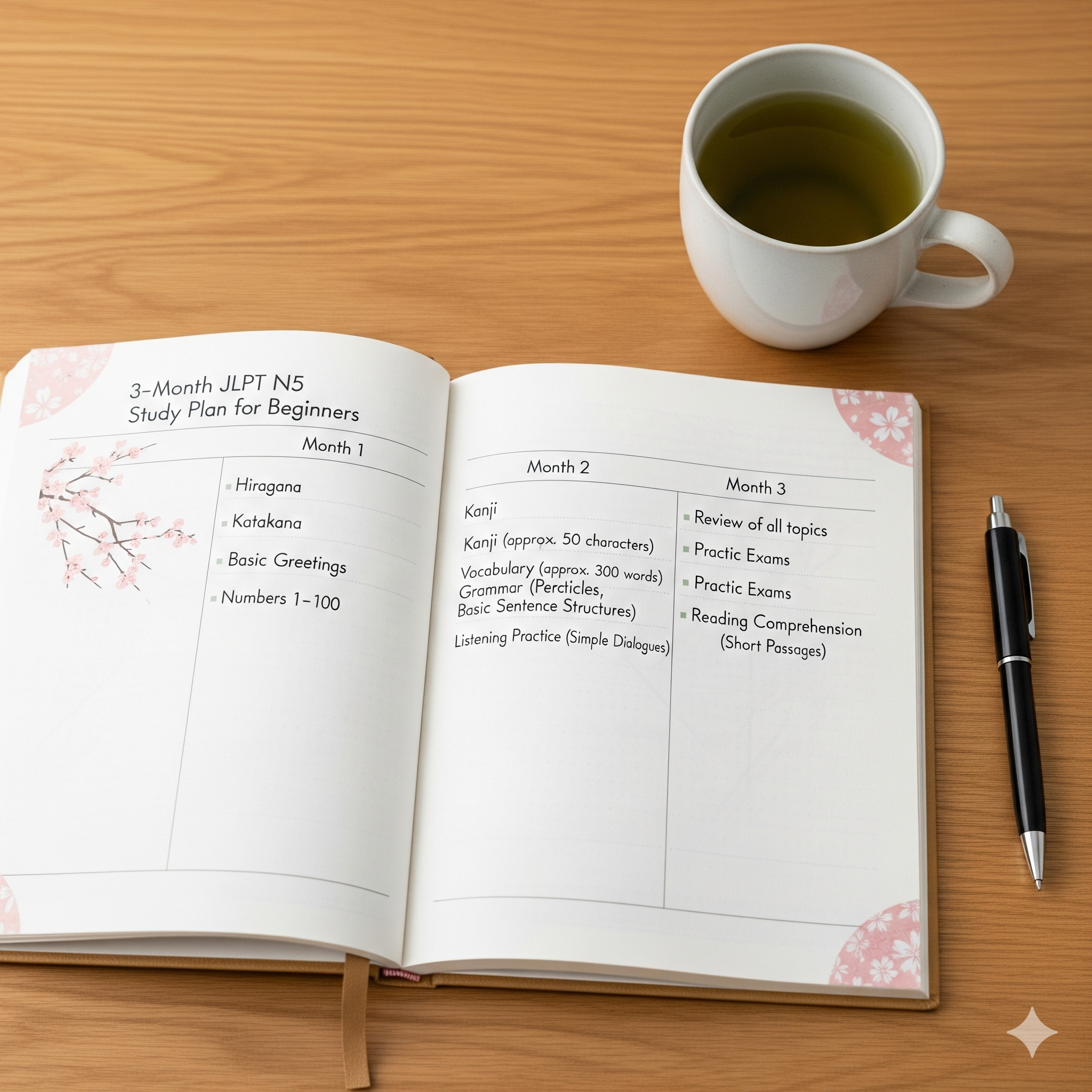
Konnichiwa, future Japanese speaker!
So, you’ve decided to take the plunge and aim for the JLPT N5. First off, congratulations! That first step is often the hardest. Maybe you’re a total beginner, fascinated by anime, planning a trip to Japan, or just looking for a new intellectual challenge. Whatever your reason, you’re probably wondering one thing:
“Can I really go from zero to passing the JLPT N5 in just three months?”
The answer is a resounding yes—but it requires a solid plan, consistent effort, and the right mindset. As someone who has both taken and prepared students for the JLPT, I can tell you that the N5 is absolutely achievable with a focused approach. It’s designed to certify that you have a foundation in basic Japanese.
This isn’t about cramming; it’s about building a sustainable habit. Let’s transform those jitters into a step-by-step roadmap to success.
What Exactly is the JLPT N5?
Before we dive into the plan, let’s understand the goal. The JLPT (Japanese-Language Proficiency Test) N5 is the first and lowest of five levels. To pass, you need to demonstrate a basic understanding of Japanese.
You’ll be tested on:
- Vocabulary: Around 800 words.
- Grammar: Basic sentence patterns (~40-50 grammar points).
- Kanji: Reading approximately 100 characters.
- Listening: Comprehending short, slow conversations about daily topics.
The exam is divided into two sections: Language Knowledge (Vocabulary/Grammar) & Reading and Listening. There’s no speaking or writing component.
Sounds manageable, right? It is! The key is consistency.
The Golden Rule: Consistency Over Cramming
Here’s the most important insight I can give you: 15-20 minutes of daily study is infinitely more effective than a 4-hour session once a week. Language learning is like building a muscle; it needs regular exercise. This 3-month plan is built around this core principle.
Your Essential Toolkit (Resources)
You don’t need a mountain of books. A few key resources will do:
- A Primary Textbook: This is your backbone. I highly recommend “Genki I” or “Minna no Nihongo”. Genki is particularly friendly for self-studiers. We’ll base our plan on completing Genki I.
- Outbound Link: Get Genki I on Amazon or your local bookstore.
- Flashcard App: For vocabulary and kanji drilling. Anki (powerful, customizable, free) or Memrise (more game-like) are fantastic.
- Outbound Link: Download Anki here
- A Dedicated Notebook: For grammar notes, writing practice, and personal examples.
- Listening Practice: YouTube is your best friend here. Channels like Japanese Ammo with Misa and Learn Japanese from Zero! are goldmines.
- Outbound Link: Visit Japanese Ammo with Misa on YouTube
The 3-Month JLPT N5 Study Plan: A Week-by-Week Breakdown
This plan assumes you are starting from scratch. Adjust as needed, but try to keep the pace.
Month 1: Laying the Foundation (Weeks 1-4)
Goal: Get comfortable with the basics of Japanese. Complete Genki I Lessons 1-3.
- Week 1: The Fundamentals
- Focus: Hiragana and Katakana. Do not skip this! Trying to learn Japanese with romaji is like learning to run before you can walk—you’ll trip later.
- Action: Use Anki decks or writing practice to memorize all Hiragana. By day 3-4, start introducing Katakana. By the end of the week, you should be able to read them slowly but surely.
- Practical Application: Label items in your house with sticky notes in kana. Try reading the Japanese titles on your manga or anime.
- Week 2: Your First Sentences (Genki Lesson 1)
- Focus: Basic greetings (こんにちは, さようなら), self-introductions (は, です), and the question particle か.
- Action: Learn the vocabulary list for Lesson 1. Practice the dialogues out loud. Do all the workbook exercises.
- Humanizing Tip: Find a language exchange partner on apps like HelloTalk or Tandem and just say “はじめまして” (Nice to meet you). That first real interaction is a huge boost!
- Week 3: This and That (Genki Lesson 2)
- Focus: Demonstratives (これ, それ, あれ – this, that, that over there) and the verb です’s negative and past forms.
- Action: Drill the new vocabulary. The concept of こそあど (ko-so-a-do words) is crucial. Create a mind map.
- Insight: This is where Japanese makes a beautiful distinction that English doesn’t (proximity to speaker vs. listener). Embrace the logic!
- Week 4: Verbs and Time (Genki Lesson 3)
- Focus: Numbers, time, and the first major grammar point: verb conjugation (ます-form).
- Action: This is a big week. Spend extra time memorizing numbers and time vocabulary. Practice conjugating verbs from the dictionary form to the ます-form.
- Practical Application: Describe your daily schedule in Japanese. “Ima nanji desu ka?” (What time is it now?) should become a reflex.
Month 2: Building Momentum (Weeks 5-8)
Goal: Tackle more complex grammar. Complete Genki I Lessons 4-6.
- Week 5 & 6: Adjectives and Likes/Dislikes (Genki Lessons 4 & 5)
- Focus: い-adjectives and な-adjectives, and the grammar for expressing likes (が 好きです) and dislikes.
- Action: Adjectives are fun! They bring so much color to your language. Learn the conjugation rules for both types. Practice by describing everything around you.
- Internal Link: Struggling with adjectives? Check out our deeper dive on [Mastering Japanese Adjectives: A Simple Guide for Beginners].
- Week 7 & 8: Existence and Motion Verbs (Genki Lesson 6)
- Focus: The verbs あります (to exist for inanimate things) and います (to exist for living things), and using the particle で to indicate where an action takes place.
- Action: This lesson is often a stumbling block. The あります/います distinction is new for English speakers. Use picture drills: a book arimasu on a table, a cat imasu on a chair.
- Humanizing Tip: Don’t get discouraged if you mix these up. Even intermediate learners sometimes do! The goal is understanding, not instant perfection.
Month 3: Review, Practice, and Conquer (Weeks 9-12)
Goal: Solidify all knowledge, introduce Kanji formally, and take practice tests.
- Week 9 & 10: Comprehensive Review & Kanji Blitz
- Focus: Review Genki Lessons 1-6 thoroughly. Start seriously studying the first ~60 N5 kanji from Genki.
- Action: Go back through each lesson’s vocabulary and grammar. Create summary sheets. Dedicate 15 minutes daily to kanji, learning 5-10 new ones per day and reviewing old ones with Anki.
- Internal Link: Make kanji less scary with our post on [How to Learn Kanji for JLPT N5: Fun and Effective Methods].
- Week 11 & 12: Mock Tests and Listening Immersion
- Focus: Apply your knowledge under exam conditions.
- Action: This is non-negotiable. Find official JLPT N5 practice tests or past papers online. Set a timer and take a full test. This acclimates you to the format, pace, and pressure.
- Action: Intensify listening practice. Listen to the audio from Genki dialogues daily. Watch Japanese kids’ shows on YouTube—they speak slowly and use basic vocabulary.
- Internal Link: Nervous about the listening section? We’ve got you covered with [5 Tips to Ace the JLPT Listening Section].
A Sample Study Day in the Life
- Morning (15 mins): Review Anki flashcards (vocab & kanji) on your phone during breakfast/commute.
- Lunch Break (20 mins): Read through one grammar point from your textbook and write two example sentences.
- Evening (25 mins): Do one workbook exercise. Watch one Japanese learning YouTube video while making dinner.
- Total: ~60 minutes of focused, broken-up study.
See? It’s not about having huge blocks of time. It’s about weaving Japanese into the fabric of your day.
Beyond the Books: Humanizing Your Study
- Find Your “Why”: Remind yourself why you started. Put a picture of Japan or a quote from your favorite anime on your desk.
- Make Mistakes: You will make them. Lots of them. Laugh at them. Every mistake is a lesson learned.
- Celebrate Small Wins: Finished a chapter? Nailed a kanji? Celebrate! Tell a friend. Your brain responds to positive reinforcement.
You are embarking on an incredibly rewarding journey. The JLPT N5 is just the first milestone, a certification that you’ve built a strong foundation. This 3-month plan is your map. Trust the process, stay consistent, and remember to enjoy the ride.
Ganbatte kudasai! (Do your best!)
あなたの頑張りを応援しています!(I’m cheering for your effort!)
JLPT N5 in One Month: Your Ambitious But Possible Crash Course Study Plan
How to Check Your JLPT N5 Results Online: A Sensei’s Step-by-Step Guide
JLPT N5 Exam Duration: Your Complete Guide to Timing and Test-Day Strategy