So, you’ve signed up for the JLPT N2. The test date is looming, your calendar is packed, and that stack of textbooks on your desk is starting to look less like a resource and more like a monument to your anxiety.
Sound familiar?
As a long-time Japanese language sensei and JLPT strategist, I’ve guided hundreds of students through this exact scenario. Let me be perfectly clear: passing the N2 is a significant achievement that requires a solid foundation. A crash course isn’t about magic; it’s about strategic, focused intensity.
This post isn’t for the complete beginner. It’s for the busy professional, the overwhelmed student, the dedicated learner who has life happening but is fiercely committed to passing. This is your battle plan. We’re going to focus on high-impact studying, because when time is your most precious resource, you can’t afford to waste a minute.
Who is This Crash Course Really For?
Before we dive in, let’s be honest about the prerequisites. To have a fighting chance with a short-term plan, you should already be:
- Around the N3 Level: You have a good grasp of basic grammar and know most of the N3 kanji. You can understand slow, clear Japanese on familiar topics.
- Honest About Your Time: You can commit to 90-120 minutes of focused study daily, plus longer sessions on weekends. This isn’t about cramming 10 hours on Sunday; it’s about consistent, daily effort.
- Ready to Prioritize: This plan requires sacrifice. It means fewer Netflix binges and more anki reviews. It means listening to podcasts on your commute instead of your favorite music.
If you’re nodding your head, then let’s get started. You can do this.
The Core Philosophy: Maximize Efficiency, Minimize Waste
Forget trying to “cover everything.” That’s a recipe for burnout. Your mantra for the next 8 weeks is “Targeted Practice.” We will focus on the areas that offer the highest return on investment (ROI) for your study time.
- Mock Tests Are Your Compass: You can’t know where to focus if you don’t know where you are. Before you even open a textbook, take a full, timed practice test under exam conditions. This is non-negotiable. It will brutally and honestly reveal your weaknesses.
- Active Recall Over Passive Review: Simply re-reading notes is useless. You must actively engage your brain. Use flashcards (like Anki), do practice questions, and force yourself to recall information.
- Integrated Skills: Don’t study vocabulary in isolation. When you learn a new word, learn it in a sentence. When you study a grammar point, practice writing a sentence with it. Connect everything.
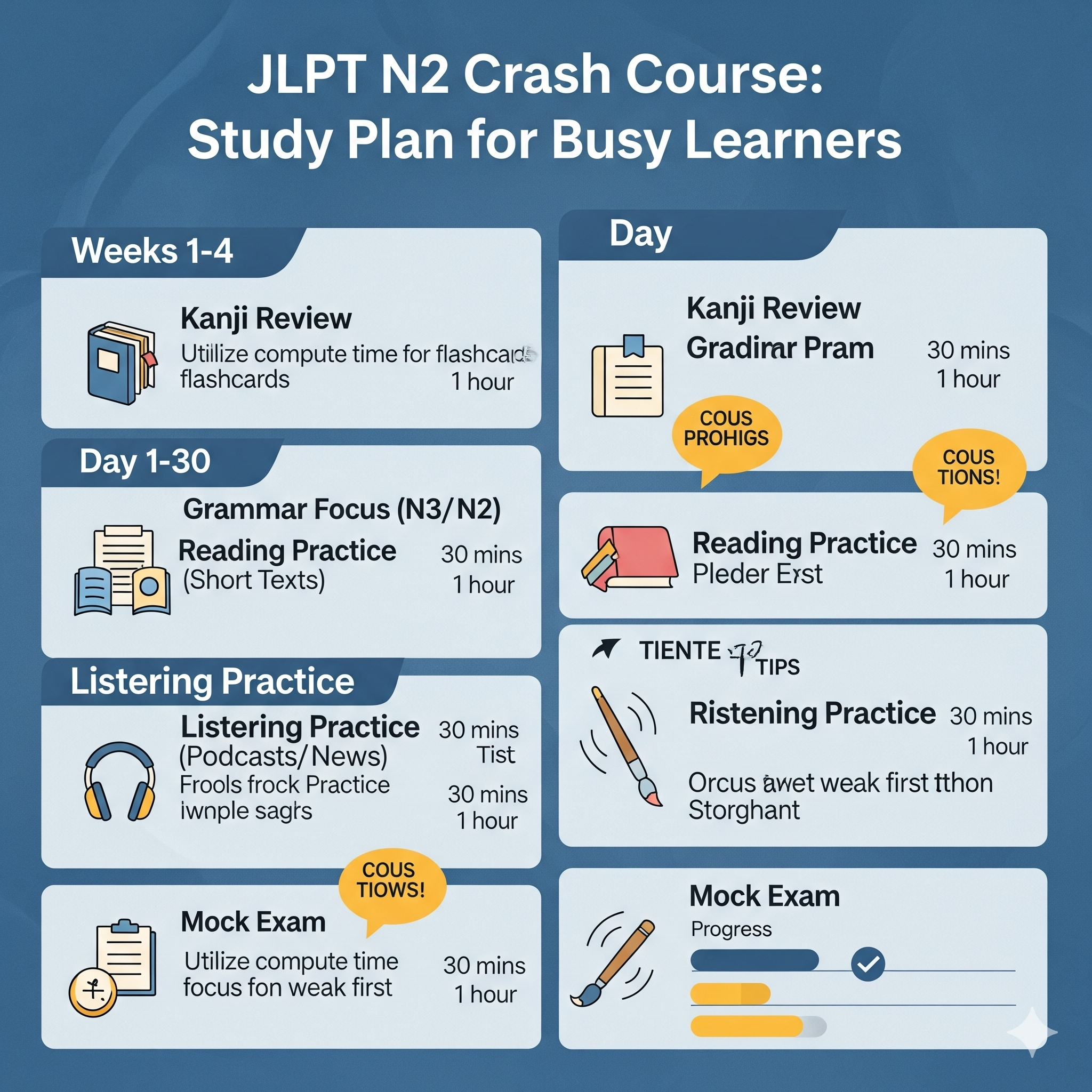
Your 8-Week JLPT N2 Crash Course Plan
This plan assumes you have about 8 weeks until the test. Adjust the timeline as needed, but keep the structure.
Weeks 1-2: Diagnosis & Foundation Building
- Day 1: TAKE A FULL-LENGTH PRACTICE TEST. Use the official JLPT practice workbooks or a reputable publisher like So-Matome or Shin Kanzen Master. Grade it harshly.
- Analyze Your Results: Where did you lose the most points? Was it reading comprehension? Listening? Specific grammar patterns? This analysis dictates your entire study plan.
- Gather Your Arsenal: Based on your weaknesses, choose one primary resource for each section. Don’t buy 10 books; you won’t use them. I highly recommend:
- Grammar & Reading: Shin Kanzen Master N2 Grammar and Reading (affiliate link). It’s dense but incredibly thorough.
- Vocabulary/Kanji: So-Matome N2 Vocabulary and Kanji (affiliate link). Its daily/weekly structure is perfect for a crash course.
- Listening: The Shin Kanzen Master N2 Listening book is excellent for strategy, but also immerse yourself with real content (see below).
- Start a Error Log/Notebook: Every time you get a question wrong, write down the grammar point, vocab word, or reason for the mistake. This notebook is gold—review it daily.
Weeks 3-6: The Grind – Rotational Focus
This is where the work happens. Each day, rotate your focus but keep all skills active.
- Sample Weekday (90 mins):
- 20 mins – Anki Review: Drill your custom deck based on your error log and new words you encounter.
- 30 mins – Grammar: Study 3-4 new N2 grammar points from your book. Don’t just read them. Write 2 original sentences for each one.
- 20 mins – Reading: Do one reading comprehension passage. Time yourself! The clock is your biggest enemy in the reading section.
- 20 mins – Listening: Do one listening section from your prep book. Then, for passive immersion, listen to a Japanese podcast like Nihongo Con Teppei for beginners/intermediates on your commute.
- Sample Weekend (3-4 hours):
- Full Section Practice: Do a full 語彙 (vocab/grammar) section or 読解 (reading) section from a practice test.
- Intensive Listening: Watch a Japanese drama or anime without subtitles, then re-watch a key scene with Japanese subtitles to check your understanding. (Netflix with Language Reactor plugin is fantastic for this).
- Error Log Review: Spend significant time going over every mistake from the week. Understand why you got it wrong.
Weeks 7-8: Final Review & Test Simulation
- Shift to Full Practice Tests: Your priority now is stamina and strategy. Every weekend, take a full, timed practice test. This is as much about building your mental endurance as it is about knowledge.
- Refine Your Test-Taking Strategy:
- Reading Section: Learn to skim. Answer the questions that have line references first. Don’t get bogged down on one hard passage.
- Listening Section: Use the precious few seconds before each question to skim the answers. Predict what the question might be about.
- Time Management: The N2 is a race against time. Know how many minutes you can spend on each question and stick to it.
- Focus Exclusively on Your Error Log: Your notebook is now your most important textbook. Review it relentlessly.
- The Final Week: Taper off. Do light reviews, listen to Japanese to keep your ear tuned, but avoid learning new material. Get plenty of sleep. Your brain needs to consolidate what it has already learned.
Unique Insights: The Secrets to N2 Success
- The Grammar-Reading Link: N2 grammar isn’t just for the grammar section. The complex structures are everywhere in the reading passages. If you can deconstruct a sentence grammatically, you can understand its meaning even if you don’t know every word. This is a huge advantage.
- Listening is a Skill, Not Knowledge: You can’t “memorize” listening. It’s a muscle that must be trained daily. Even 15 minutes of active listening per day is infinitely better than 2 hours once a week. For more on this, check out my deeper dive on how to improve your Japanese listening skills quickly.
- The Power of “N1” Kanji: Many N2 passages use N1-level kanji… with furigana. If you recognize those kanji, you read faster and comprehend better. Briefly flipping through an N1 kanji book can give you an unexpected edge. Wondering what’s next? Here’s a look at the jump from N2 to N1 and how to prepare for it.
Essential Resources & Backlinks
- Official JLPT Website: The source of truth for test format, dates, and practice questions. https://www.jlpt.jp/e/
- Jisho.org: The best online Japanese dictionary. Use it constantly. https://jisho.org/
- Anki: For digital flashcards. The spaced repetition system is scientifically proven for memorization. https://apps.ankiweb.net/
- Tae Kim’s Grammar Guide: A fantastic free resource for looking up grammar points you’re struggling with. https://guidetojapanese.org/learn/
- NHK Easy News: Great for bite-sized reading practice with built-in audio for listening. https://www3.nhk.or.jp/news/easy/
You’ve Got This.
The JLPT N2 is a marathon sprinted. It’s tough, but it is absolutely within your reach. This crash course is demanding, but it’s structured to make every minute count. Remember why you started. Visual yourself opening that results slip and seeing the beautiful word: 合格 (gōkaku) – Pass.
Trust the process, be kind to yourself on the hard days, and keep going. 頑張ってください!(Ganbatte kudasai!)
P.S. Feeling overwhelmed by kanji? You’re not alone. I wrote a separate post on breaking down the JLPT N2 kanji list into manageable chunks that might help!