So, you’ve set your sights on the JLPT N2. First off, すごい! (Awesome!). It’s a huge milestone that bridges the gap between intermediate and advanced Japanese. It’s the key that unlocks doors to better job opportunities, understanding complex media like novels and news, and having truly deep conversations.
But let’s be real: the jump from N3 to N2 is… significant. The volume of kanji (around 1000), vocabulary (6000+ words), and grammar patterns can feel overwhelming. You might be asking yourself, “How on earth am I supposed to memorize all of this?”
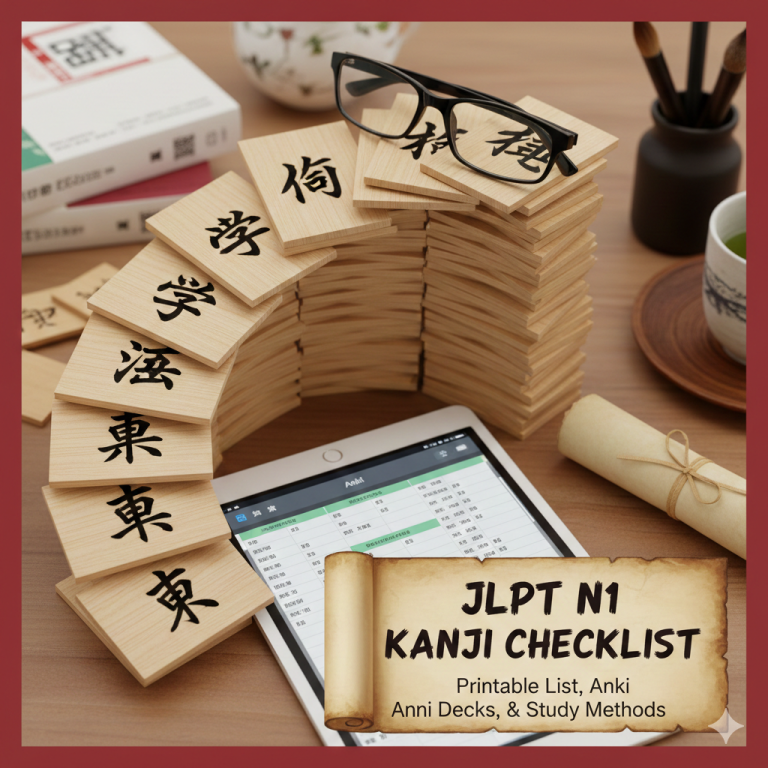
The answer isn’t just raw hours of study. It’s about studying smarter. And in my years of teaching and passing these exams myself, the single most effective tool I’ve found for memorization is the humble flashcard—supercharged by a digital powerhouse called Anki.
In this guide, we’ll dive deep into how you can use JLPT N2 flashcards and Anki decks not just to memorize, but to truly internalize the language and crush the exam.
Why Flashcards (And Specifically Anki) Are a Game-Changer for JLPT N2
Our brains are wired to forget. It’s a feature, not a bug! But we can hack this system using a principle called Spaced Repetition (SRS). SRS is the algorithm that shows you information right before you’re about to forget it, cementing it into your long-term memory with minimal effort.
Anki is a free, open-source software (and app) that automates this entire process. Forget about manually sorting paper cards into “easy,” “medium,” and “hard” piles. Anki does that for you, calculating the perfect time to show you a card again.
For the vast amount of knowledge required for the JLPT N2, this isn’t just helpful; it’s essential. It ensures you’re spending your precious time on the things you find difficult, not re-reviewing what you already know.
The Best Pre-Made JLPT N2 Anki Decks (And How to Use Them)
A quick word of caution: downloading a deck is just the first step. The real magic happens when you engage with it. Don’t just click “Good” mindlessly. Read the word aloud, form a quick mental sentence, and truly test your recall.
Here are some of the most respected pre-made decks out there:
1. The “JLPT N2 Vocabulary” Deck by NihongoShark
- What it is: A massive, comprehensive deck covering the core vocabulary needed for the test. It often includes example sentences, which are crucial for understanding context.
- Why it’s great: The cards are usually cleanly formatted with audio pronunciations. This is a fantastic “set-it-and-forget-it” foundation for your vocab studies.
- Where to find it: A quick Google search for “NihongoShark N2 Anki Deck” should lead you to their website where they offer it for free.
2. The “All in One Kanji” Deck (N2 Version)
- What it is: As the name suggests, this deck focuses on the kanji required for N2. It typically includes on’yomi and kun’yomi readings, common vocabulary words that use the kanji, and stroke order diagrams.
- Why it’s great: It attacks kanji from multiple angles. You’re not just memorizing a character; you’re learning how it’s actually used in words, which is exactly how the JLPT tests it.
- Pro Tip: Use this in tandem with a dedicated kanji study book like Kanji Master N2 or So-Matome N2 Kanji. The book provides the structured lessons, and the Anki deck handles the memorization.
3. Bunpro Decks for N2 Grammar
- What it is: While Bunpro is primarily a fantastic subscription-based SRS website for grammar, they often have associated Anki decks available. These decks are meticulously organized and include fantastic example sentences.
- Why it’s great: Grammar is where context is king. A good grammar deck won’t just give you a pattern; it will force you to recall it within a sentence, testing your true understanding.
- Where to find it: Check the Bunpro Community Forums (outbound link) for shared resources. (Always respect the creators’ terms of use!).
(Internal Blog Post Link: For a deeper dive into mastering these tricky patterns, check out our article on 【How to Conquer JLPT N2 Grammar Points】).
Beyond Pre-Made: The Power of Making Your Own JLPT N2 Flashcards
While pre-made decks are a fantastic resource, creating your own cards is where the deepest learning happens. The act of creating the card is a study session in itself.
When you come across a new word in a novel, a new grammar pattern in a drama, or a kanji you can’t read on a menu—that’s your cue to make a card.
How to make effective cards:
- For Vocabulary: Don’t just put English on one side and Japanese on the other.
- Front: The target word (e.g., 批評する – hihyou suru)
- Back: A simple definition (e.g., “to criticize, to review”) AND, most importantly, an example sentence in Japanese where you found it. This builds context.
- For Grammar:
- Front: A sentence with the target grammar point blanked out. (e.g., 彼は芸術家というより、職人___。)
- Back: The full sentence with the correct answer highlighted (e.g., 彼は芸術家というより、職人といったほうがいい。) and a brief explanation of the meaning.
- Add Audio: Use a Text-to-Speech (TTS) add-on for Anki like AwesomeTTS to generate audio for your example sentences. Hearing the language is critical for the JLPT listening section.
(Internal Blog Post Link: Struggling to find good reading material? We’ve compiled a list of 【Best Japanese Novels and News Sites for JLPT N2 Learners】 to help you immerse yourself.)
Advanced Anki Tips for the Discerning N2 Student
Once you’ve got the basics down, these pro tips will supercharge your reviews.
- Use the Low-Key Add-on: This simple add-on hides all the review statistics on the main screen. It sounds trivial, but it eliminates the anxiety of seeing a “1,000 cards due” number and helps you focus on the process, not the pressure.
- Tag Your Cards Religiously: When you create cards, tag them with
#grammar,#kanji,#vocab,#listening, etc. Later, if you realize you’re weak on a specific type of vocabulary (e.g., business terms), you can create a custom study session to drill just those tags. - Don’t Be a Perfectionist: Your cards don’t need to be works of art. The goal is understandable and accurate information. Spending 5 minutes designing one card is inefficient. The power is in the repetition, not the card’s aesthetics.
- Sync Everywhere: Download the Anki mobile app (iOS is paid, Android is free). It’s worth every penny. This allows you to crush your reviews during your commute, in line at the grocery store, or during any other bits of “dead time” throughout your day. Consistency is far more important than long, grueling study sessions.
A Crucial Warning: The Pitfalls of Relying Only on Flashcards
Flashcards are incredible for building a foundation of knowledge. But the JLPT N2 tests application.
You can know the meaning of 批評する and 評価する, but can you understand the nuanced difference in a reading passage? You can memorize every grammar pattern, but can you quickly identify the correct one to complete a sentence under time pressure?
Flashcards must be supplemented with active practice.
- For Reading: Read real Japanese articles on NHK News Web Easy (outbound link) or native novels.
- For Listening: Watch Japanese TV, dramas, and YouTube videos without subtitles. Then, watch them again with Japanese subtitles to confirm what you heard.
- For Application: Do actual JLPT practice tests under timed conditions. This is non-negotiable.
(Internal Blog Post Link: Put it all together with our ultimate 【JLPT N2 Study Plan & Schedule: A 3-Month Guide】).
Conclusion: Your Path to N2 Success
Anki and JLPT N2 flashcards are not a magic bullet, but they are the most efficient and powerful memorization tool available. They are the scaffold upon which you will build your Japanese ability.
Start with a pre-made deck to get a running start, but quickly transition to making your own cards from the real Japanese content you encounter. Embrace the daily review habit, supplement with active immersion, and trust the process of spaced repetition.
The mountain of N2 vocab, kanji, and grammar is climbable. With Anki as your guide, you’ll not only reach the summit on test day but you’ll find yourself in a new world of Japanese fluency on the other side.
頑張ってください!(Ganbatte kudasai! – Do your best!)
JLPT N2 Crash Course: Short-Term Study Plan for Busy Learners
JLPT N2 Cheat Sheet: Quick Grammar & Vocabulary Review
Does JLPT N2 Have Furigana? Test Structure Answered