
Konnichiwa, future JLPT conquerors!
So, you’ve decided to take the plunge and tackle the Japanese-Language Proficiency Test, starting with the N5 level. Welcome! This is where an exciting journey begins. You might have found our pillar post, JLPT N5 Vocabulary Complete List: Nouns, Verbs, Adjectives & Flashcards which gives you the big-picture strategy.
Now, it’s time to drill down into one of the most critical components of that strategy: verbs.
A mere “JLPT N5 verbs list” with English meanings is a good start, but it’s not enough. To truly pass the exam and, more importantly, to actually communicate, you need to understand how these verbs work, how they change, and how they live and breathe in real Japanese sentences.
That’s exactly what this guide is for. We’re not just going to list them; we’re going to bring them to life. As your guide, I’ll share insights from years of teaching, common pitfalls students face, and practical applications you can use immediately. Let’s move beyond memorization and into mastery.
Why Verbs Are the Beating Heart of Your N5 Journey
Before we dive into the list, let’s understand the “why.” In any language, verbs are the engine of the sentence. They describe what happens. In Japanese, they are even more powerful because they also convey crucial information like politeness, tense (past/present/future), and intention.
Mastering the N5 verbs list means you’ll be able to:
- Describe your daily routine (
おきます– okimasu – to wake up,はたらきます– hatarakimasu – to work). - Talk about your hobbies and likes (
よみます– yomimasu – to read,すきます– sukimasu – to like). - Ask for directions and navigate (
いきます– ikimasu – to go,きます– kimasu – to come). - Interact politely in shops and restaurants (
かいます– kaimasu – to buy,たべます– tabemasu – to eat). - Express your needs and feelings (
のみます– nomimasu – to drink,ねます– nemasu – to sleep).
Essentially, these ~70-80 verbs are your first toolkit for building real, functional Japanese sentences. They are the foundation upon which you will build everything else.
For more detail, please visit Complete JLPT N5 Vocabulary List with Meanings
Decoding Japanese Verbs: Groups and Conjugation Made Simple
This is the part that often intimidates beginners, but fear not! The N5 level focuses on the most predictable verb types. Japanese verbs are divided into three groups. Understanding this from the start will make your life infinitely easier.
グループ 1 (Group 1): う-Verbs (Godan Verbs)
These are the most common verbs. They end in a syllable from the う-line of the hiragana chart (う, つ, る, く, ぐ, す, ぬ, ぶ, む). To conjugate them, you change the ending sound. For example, the verb かいます (to buy) ends with います. Its root is か-.
グループ 2 (Group 2): る-Verbs (Ichidan Verbs)
These verbs typically end in ~えます or ~います. They are easier to conjugate because you simply drop the ~ます and add the new ending. For example, たべます (to eat) becomes たべ + ない (don’t eat), たべ + た (ate).
グループ 3 (Group 3): Irregular Verbs
The JLPT N5 has only two irregular verbs, and you use them all the time! They are します (shimasu – to do) and きます (kimasu – to come). You simply have to memorize their conjugations.
Pro Tip: When you learn a new verb, always learn it in its
~ますform first. This is the polite, present affirmative form, and it’s the standard dictionary form for learners. It’s also the form you’ll see on most JLPT N5 verbs lists. From the~ますform, you can almost always identify its group and conjugate it correctly.For more examples, please visit JLPT N5 Vocabulary with Example Sentences for Daily Use
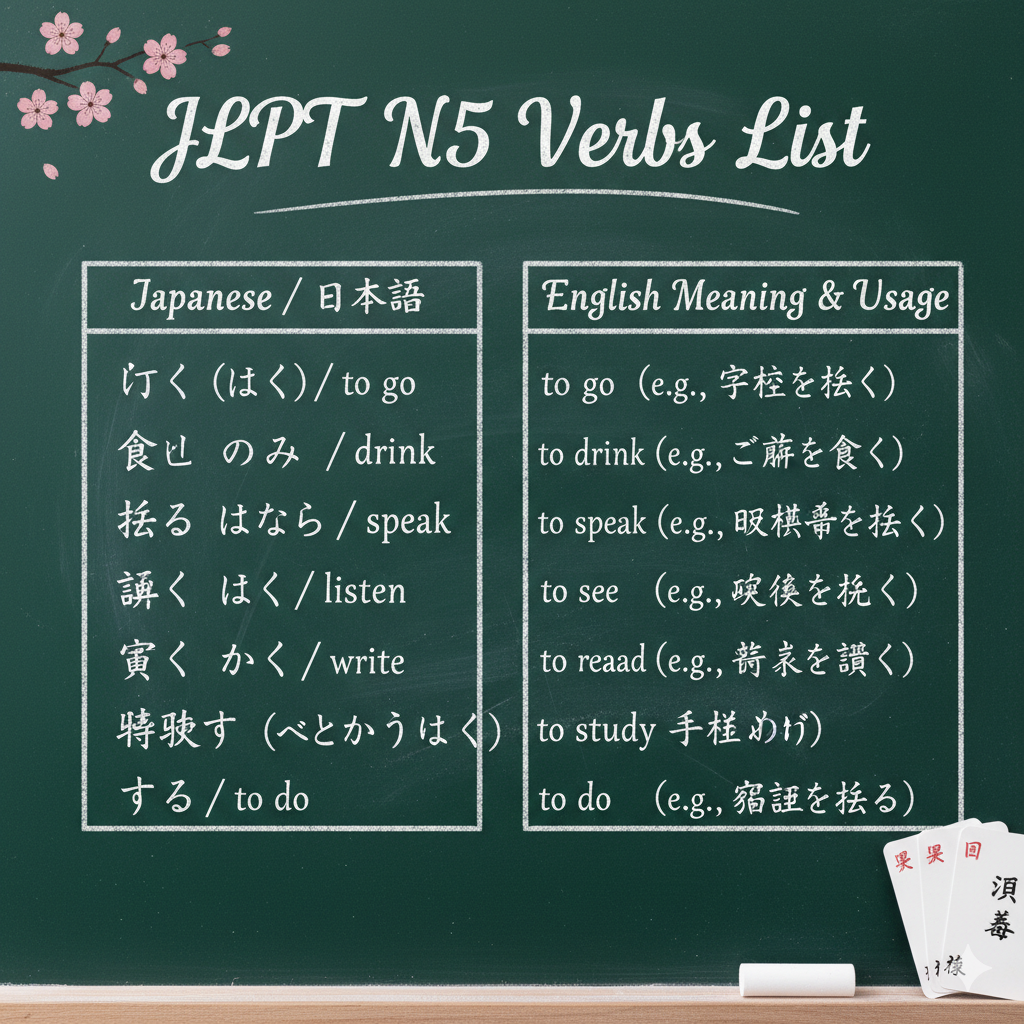
The Essential JLPT N5 Verbs List: Meanings, Usage, and Conjugation
Here is our curated list of must-know N5 verbs. We’ve organized them by category to make them easier to learn and remember. Each verb is presented in its ~ます form (polite form), followed by its dictionary form (plain form) in parentheses, which is crucial for grammar patterns you’ll learn.
Daily Life & Routine Verbs
These verbs are the backbone of describing your day.
- おきます (起きます) (oku – to wake up)
- Example: わたしは 7じに おきます。(Watashi wa shichi-ji ni okimasu.) – I wake up at 7 o’clock.
- ねます (寝ます) (neru – to sleep)
- Example: よる 11じに ねます。(Yoru juuichi-ji ni nemasu.) – I sleep at 11 PM.
- はたらきます (働きます) (hataraku – to work)
- Example: 父(ちち)は びょういんで はたらきます。(Chichi wa byouin de hatarakimasu.) – My father works at a hospital.
- やすみます (休みます) (yasumu – to rest, to take a day off)
- Example: 土曜日(どようび)は やすみます。(Doyoubi wa yasumimasu.) – I take Saturdays off.
Movement & Travel Verbs
Essential for getting around and making plans.
- いきます (行きます) (iku – to go)
- Example: あした としょかんに いきます。(Ashita toshokan ni ikimasu.) – I will go to the library tomorrow.
- きます (来ます) (kuru – to come)
- Example: 友達(ともだち)が うちに きます。(Tomodachi ga uchi ni kimasu.) – My friend will come to my house.
- かえります (帰ります) (kaeru – to return home)
- Example: 5じに かえります。(Go-ji ni kaerimasu.) – I will return home at 5.
- あります (aru – to exist (for inanimate objects))
- Example: つくえの 上(うえ)に 本(ほん)が あります。(Tsukue no ue ni hon ga arimasu.) – There is a book on the desk.
- います (iru – to exist (for living things))
- Example: 公園(こうえん)に 子ども(こども)が います。(Kouen ni kodomo ga imasu.) – There are children in the park.
Action & Activity Verbs
What you do throughout your day.
- よみます (読みます) (yomu – to read)
- Example: 新聞(しんぶん)を よみます。(Shinbun o yomimasu.) – I read the newspaper.
- ききます (聞きます) (kiku – to listen; to ask)
- Example: 音楽(おんがく)を ききます。(Ongaku o kikimasu.) – I listen to music.
- みます (見ます) (miru – to see; to watch)
- Example: テレビを みます。(Terebi o mimasu.) – I watch TV.
- します (shiru – to do)
- Example: サッカーを します。(Sakkaa o shimasu.) – I play soccer. (Note:
しますis used for many activities).
- Example: サッカーを します。(Sakkaa o shimasu.) – I play soccer. (Note:
- べんきょうします (勉強します) (benkyou suru – to study)
- Example: にほんごを べんきょうします。(Nihongo o benkyou shimasu.) – I study Japanese.
Food & Drink Verbs
For surviving and thriving in Japanese restaurants!
- たべます (食べます) (taberu – to eat)
- Example: 朝(あさ)ごはんを たべます。(Asagohan o tabemasu.) – I eat breakfast.
- のみます (飲みます) (nomu – to drink)
- Example: コーヒーを のみます。(Koohii o nomimasu.) – I drink coffee.
- かいます (買います) (kau – to buy)
- Example: みずを かいます。(Mizu o kaimasu.) – I will buy water.
Social & Interaction Verbs
For connecting with people.
- いいます (言います) (iu – to say)
- Example: 「ありがとう」と いいます。(‘Arigatou’ to iimasu.) – I say “thank you.”
- はなします (話します) (hanasu – to speak)
- Example: 先生(せんせい)と はなします。(Sensei to hanashimasu.) – I speak with the teacher.
- あいます (会います) (au – to meet)
- Example: 友達(ともだち)に あいます。(Tomodachi ni aimasu.) – I meet my friend.
For more details, please visit JLPT N5 Adjectives: i-Adjectives & na-Adjectives Explained
From List to Language: How to Actually Use These Verbs
A list is static. Language is dynamic. Here’s how to make these verbs work for you.
1. Mastering Basic Sentence Structures
The two most important sentence structures at N5 are:
- Xは Yが すきです。 (I like Y.) – For emotions and potentials.
- Xは Yを Vます。 (X does Y.) – For actions. The particle
を(o) marks the direct object of the verb.
Example:わたしは りんごを たべます。 (Watashi wa ringo o tabemasu.) – I eat an apple.
(わたし – I, りんご – apple, たべます – eat)
2. Conjugating for Past Tense and Negation
This is non-negotiable for the test and real life.
- Past Affirmative (~ました):
たべます(eat) ->たべました(ate) - Past Negative (~ませんでした):
たべます(eat) ->たべませんでした(did not eat)
Practice:
- Q: きのう、なにを たべましたか。 (What did you eat yesterday?)
- A: ぱんを たべました。でも、コーヒーは のみませんでした。 (I ate bread. But, I didn’t drink coffee.)
3. Combining Verbs with Other N5 Grammar Points
Verbs are rarely alone. They love company. You’ll need to combine them with grammar from your studies:
~ましょう(Let’s…):いきましょう(Let’s go!)~たいです(I want to…):のみたいです(I want to drink.)~ことが すきです(I like verbing):よむことが すきです(I like reading.)
check out our post on JLPT N5 Nouns: Essential Words You Must Know.
Study Hacks: How to Memorize and Internalize This List
- Don’t Cram, Sprinkle: Learn 5-10 verbs a day. Use them immediately.
- Flashcards with a Twist: Use apps like Anki (outbound link to a reputable source) or Memrise. Don’t just put the verb. Put the verb in a full sentence on the back of the card.
- Write a Diary: The single most effective method. Every day, write 3-5 sentences about your day using the verbs you’re learning. “I woke up at 7. I ate toast. I drank tea. I went to school.” It forces practical application.
- Shadowing: Find a beginner podcast like NHK Easy News (outbound link) or a textbook audio track. Listen and repeat exactly what they say, mimicking the rhythm and pronunciation. This builds muscle memory.
Common Mistakes to Avoid
- Confusing
あります(aru) andいます(iru): Remember: Thingsが あります, people and animalsが います. - Mixing up
ききます(kiku – to listen) and聞こえます(kikoemasu – to be audible): At N5, you only needききます. - Forgetting the particle
を: It’s easy to drop it, but本をよみます(I read a book) is correct, while本よみますis grammatically wrong at this level.
Beyond the N5 List: Your Next Steps
Once you have a firm grip on these verbs, you’re ready to move into more complex territory. The next step is learning the て-form, which is the gateway to a huge range of expressions like asking for permission (~ても いいです), making requests (~てください), and connecting multiple verbs.
You can start preparing by reading our guide on “How to Conjugate Japanese Verbs: Te-form and Beyond” (internal link).
Conclusion: Your Verb Toolkit is Ready
Remember, this JLPT N5 verbs list is more than just vocabulary to be memorized. These are the building blocks of communication. Take your time with them. Practice them daily. Use them in sentences. Conjugate them until it becomes second nature.
Passing the JLPT N5 is an fantastic and achievable goal. By truly mastering these fundamental verbs, you’re not just preparing for a test; you’re laying the strongest possible foundation for your entire Japanese language journey.
がんばってください! (Ganbatte kudasai! – Do your best!)
P.S. Struggling with remembering all the Kanji? We’ve got you covered. Our JLPT N5 Kanji Writing Worksheet Pack (internal link/product link) is a great resource to practice writing the kanji for these verbs and other essential vocabulary.


