Konnichiwa, future JLPT N5 champion!
So, you’ve decided to take the first exciting step on your Japanese language journey by tackling the JLPT N5. You’ve read our pillar post, JLPT N5 Vocabulary Complete List: Nouns, Verbs, Adjectives & Flashcards, and you’re ready to dive in. But now, you’re staring at a list of hundreds of words you need to memorize. It feels daunting, doesn’t it?
You’re not alone. Vocabulary is the bedrock of the N5 exam. Without a solid grasp of those core ~700 words, the listening and reading sections can feel like trying to solve a puzzle with missing pieces.
But what if I told you there’s a proven, almost magical tool used by polyglots and successful JLPT students worldwide? A tool that leverages the science of memory to make vocabulary stick for good.
That tool is JLPT N5 vocabulary flashcards.
In this comprehensive guide, we’re not just going to tell you to “use flashcards.” We’re going to dive deep into the how and why. We’ll compare the two most powerful methods—digital Anki decks and printable PDFs—and give you the exact strategies to use them effectively. By the end of this post, you’ll have a personalized, battle-tested plan to crush the vocabulary section of the JLPT N5.
Why Flashcards are Your Secret Weapon for JLPT N5 Success
Let’s be honest: rote memorization by reading a list is boring and, frankly, ineffective. Your brain is designed to forget information it deems non-essential. This is known as the Ebbinghaus Forgetting Curve.
Flashcards, especially when used with a Spaced Repetition System (SRS), actively fight this curve. SRS is a learning technique that shows you information right before you’re about to forget it, searing it into your long-term memory. It’s the difference between gently watering a plant every day versus flooding it once a month.
For the JLPT N5, this is crucial. The vocabulary isn’t just about knowing the word “本 (hon – book)”; it’s about instantly recognizing it in a sentence, understanding its kanji, and knowing its sound for the listening section. Flashcards force your brain to actively recall this information, building the strong neural pathways needed for test day.
Method 1: The Digital Powerhouse – Anki Flashcards
If you’re serious about language learning, you will eventually meet Anki. It’s a free, powerful, and highly customizable SRS flashcard program (available for PC, Mac, iOS, and Android).
What Makes Anki So Effective for JLPT N5 Vocabulary?
Anki automates the entire SRS process. You don’t have to figure out when to review; Anki’s algorithm does it for you. You simply rate how well you knew a card (Again, Hard, Good, Easy), and Anki schedules the next review at the optimal time.
A typical JLPT N5 vocabulary flashcard deck in Anki will include much more than just the word and meaning. Good decks are rich with information:
- Vocabulary Word: The target word (e.g., 食べます – tabemasu)
- Furigana: The reading in small text above the kanji (essential for N5!).
- Pitch Accent Diagram: A visual representation of the word’s intonation (e.g., はし↧ (bridge) vs. はし↗ (chopsticks)). This is a game-changer for sounding natural.
- Example Sentence: Seeing the word used in a simple, N5-appropriate context.
- Audio: A native speaker pronunciation clip. Critical for training your ear.
How to Find and Use a Pre-Made JLPT N5 Anki Deck
- Download Anki: First, download and install Anki on your preferred device from the official Anki website (outbound link to a trusted resource).
- Find a Deck: Go to AnkiWeb and search for “JLPT N5.” Look for decks with high ratings and a large number of reviews. The “Core 2.3k N5” or “JLPT N5 Vocabulary” by reputable creators are excellent starting points.
- Download and Import: Download the
.apkgfile and double-click it to automatically import it into Anki. - Set a Daily Goal: Consistency is key! Don’t be a hero. Start with a manageable goal, like 15 new cards and all due reviews per day. Anki will tell you exactly how many reviews you have each day. 20-30 minutes daily is often enough.
💡 Pro Tip from a Sensei: Don’t just passively flip cards. When a card appears, say the word and its meaning out loud. Engage multiple senses. For the card “飲みます (nomimasu – to drink),” mimic the drinking action. This physical connection creates a stronger memory.
The Potential Pitfalls of Anki (And How to Avoid Them)
Anki is a tool, not a magic pill. The biggest mistake learners make is downloading a massive deck and adding 100 new cards a day. This leads to “review burnout” where you have 300+ reviews piling up, causing you to quit.
- Pitfall: Review Overload.
- Solution: Be conservative with new cards. 10-15 per day is a sustainable pace that will still have you finishing the N5 deck well before your exam.
Method 2: The Tactile Classic – Printable PDF Flashcards
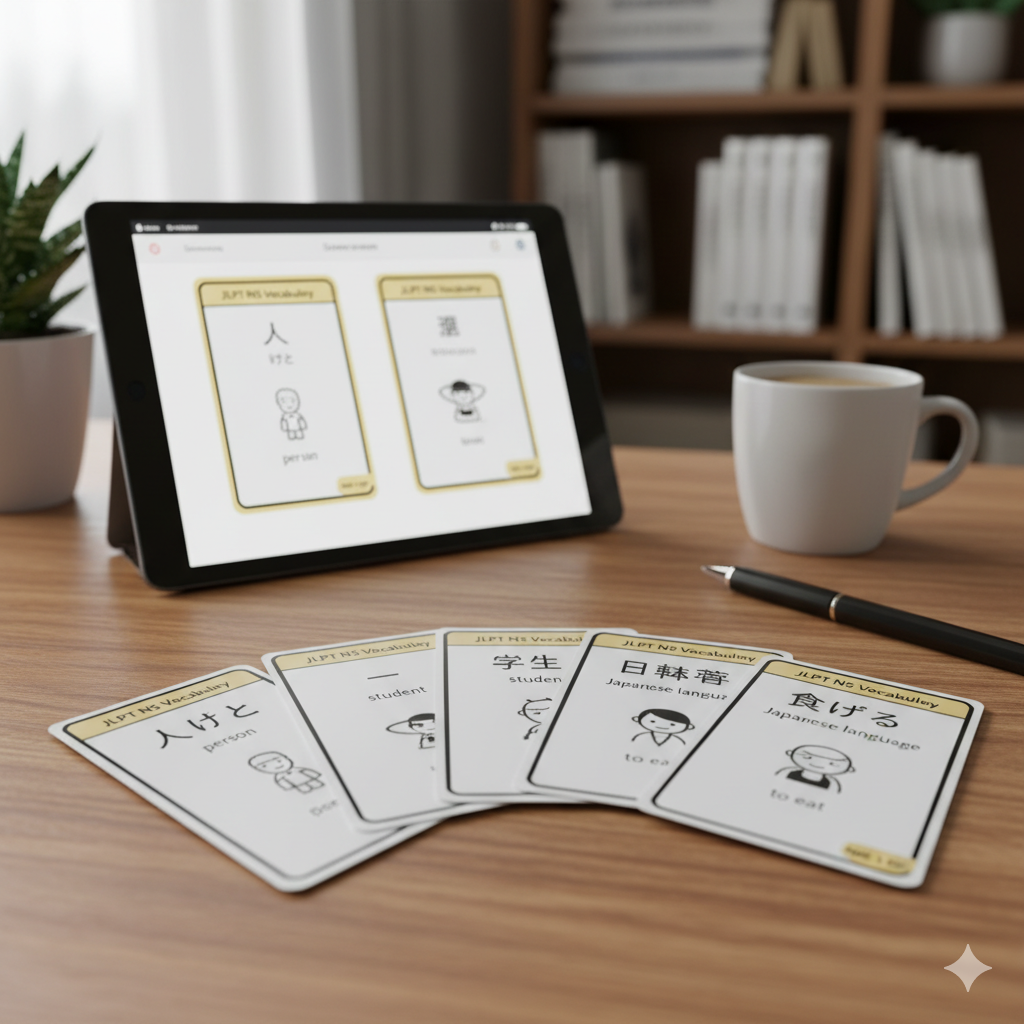
Maybe you’re someone who learns best by physically writing things down. Maybe you want to study away from screens, or you just love the feel of holding cards in your hand. This is where printable JLPT N5 vocabulary flashcard PDFs shine.
The Benefits of Physical Flashcards
- No Distractions: There are no notifications popping up on a piece of paper.
- Kinesthetic Learning: The physical act of writing out the cards (if you make them yourself) is a powerful memory aid.
- Portability & Flexibility: Easy to take anywhere, and you can spread them out on a table to organize and categorize words.
- Customization: You control exactly what goes on each card.
How to Create Your Own Masterful Flashcards
If you choose the DIY route, don’t just write “猫 – neko – cat.” Make your cards work for you!
Front of the card:
- Just the word: 猫
- Or, for kanji practice: 猫 (with the reading on the back)
Back of the card:
- Reading: ねこ (neko)
- Meaning: Cat
- Pitch Accent: Draw a simple arrow: ne↘ko
- Example Sentence: 私は猫がいます。(Watashi wa neko ga imasu.) – I have a cat.
- (Optional) A small doodle! You don’t have to be an artist; a simple stick-figure cat will make the card unforgettable.
Where to Find Pre-Made Printable PDFs
Many websites offer free, high-quality printable sets. A simple search for “JLPT N5 vocabulary flashcards PDF” will yield great results. Sites like Tofugu (outbound link to a respected authority) often have well-designed resources or can point you in the right direction.
Anki vs. PDF: Which JLPT N5 Flashcard Method is Right for YOU?
This isn’t about which is objectively “better.” It’s about which is better for you.
| Feature | Anki (Digital + SRS) | Printable PDFs (Physical) |
|---|---|---|
| Spaced Repetition | ✅ Automatic & Optimal | ❌ Manual (you have to sort cards yourself) |
| Portability | ✅ Great (on your phone) | ✅ Great (a stack of cards) |
| Multimedia | ✅ Audio, Images, Furigana | ❌ Text and drawings only |
| Customization | ✅ High (but can be technical) | ✅ Ultimate (scissors and pens!) |
| Cost | Free (except iOS app) | Free (if you have ink/paper) |
| Best For | Tech-savvy learners, efficiency | Tactile learners, minimalists, customizers |
My Expert Advice? Many successful students use a hybrid approach. They use Anki as their primary drilling tool for its unbeatable SRS efficiency. Then, they use physical flashcards or a notebook to specifically target their “problem words”—the ones they consistently get wrong in Anki. Writing these stubborn words out by hand can provide the extra boost needed to finally remember them.
Beyond the Card: How to Truly Learn N5 Vocabulary
Flashcards are for memorization, but language is for communication. To move words from your “passive” memory (you recognize it) to your “active” memory (you can use it), you need to go beyond the flashcard.
- Use It in a Sentence: For every new word you learn, try to create a simple, personal sentence. Learning “新しい (atarashii – new)”? Say, “私は新しい車が欲しいです (I want a new car).” Making it personal makes it stick.
- Group Words by Theme: Don’t just study randomly. Group your JLPT N5 vocabulary flashcards by category: food (りんご、さかな、ごはん), places (がっこう、えき、びょういん), verbs (します、見ます、行きます). This mimics how you’ll need to access the words in real life.
- Listen for Them: As you study your flashcards, find the words in the wild. Use the vocabulary list from your deck and listen for those words in beginner podcasts like NHK Easy News (outbound link) or on shows like “Terrace House.” The moment you hear a word you just studied, it’s an incredible motivator!
- Connect to Grammar: Vocabulary and grammar are best friends. The word “行きます (ikimasu – to go)” is useless without the particle “へ (e)” or “に (ni)” to indicate where you’re going. As you learn new words, think about the grammar points they pair with. For a deeper dive into this, check out our post on Complete JLPT N5 Vocabulary List with Meanings.
Your Action Plan: Integrating Flashcards into Your N5 Study Routine
Okay, let’s get practical. Here’s a sample week integrating flashcards into your study plan, assuming you’re using Anki:
- Morning (10 mins): On your commute or with your morning coffee, do your daily Anki reviews. This warms up your brain.
- Study Session (30 mins): Focus on one specific theme (e.g., “Daily Routine” verbs). Study 10-15 new cards on that theme. Afterward, practice writing 3-5 sentences using those new words and a grammar point you know.
- Evening (5 mins): Right before bed, quickly skim through the new cards you learned that day. Sleep is when memory consolidation happens, making this a powerful trick.
- Weekend: Instead of new cards, use this time to review your problem words. Write them down, record yourself saying them, or test yourself with a practice test from our guide on JLPT N5 Vocabulary with Example Sentences for Daily Use.
Free Resources: Get Your JLPT N5 Vocabulary Flashcards Started
To get you started on your journey right now, here are some trusted sources for both Anki decks and PDFs:
- AnkiWeb: (https://ankiweb.net/) – The main repository for shared decks. Search for “JLPT N5.”
- Tae Kim’s Guide to Learning Japanese: (https://guidetojapanese.org/) – A fantastic free resource for grammar that often links to good vocabulary tools.
- Jisho.org: (https://jisho.org/) – Your best friend for looking up words, checking stroke order, and seeing example sentences. Use it to create your own custom cards.
You’ve Got This!
Mastering JLPT N5 vocabulary is a marathon, not a sprint. It requires consistent, dedicated effort. But with the power of JLPT N5 vocabulary flashcards—whether you choose the high-tech efficiency of Anki or the tactile simplicity of PDFs—you have a proven system to make that effort count.
Remember, every card you review is a step closer to understanding a conversation, reading a sign, and ultimately, unlocking a new culture. It’s a challenging but immensely rewarding journey.
Don’t forget to circle back to our main pillar post, JLPT N5 Nouns: Essential Words You Must Know, to tie your vocabulary study into a full, comprehensive preparation plan.
Ganbatte kudasai! (Do your best!)
Disclaimer: This blog post contains links to external websites not managed by us. We are not responsible for the content of these sites. The JLPT is administered by the Japan Foundation and Japan Educational Exchanges and Services.
For further deep dive into adjectives please check out JLPT N5 Adjectives: i-Adjectives & na-Adjectives Explained