
Kon’nichiwa, future JLPT champion!
So, you’ve decided to take the plunge and tackle the JLPT N5. First of all, omedetou gozaimasu (おめでとうございます) – congratulations! This is a fantastic first step on your Japanese learning journey. I remember my own students often feeling a mix of excitement and nervousness at this stage. The biggest question I get is: “Is the N5 grammar difficult?”
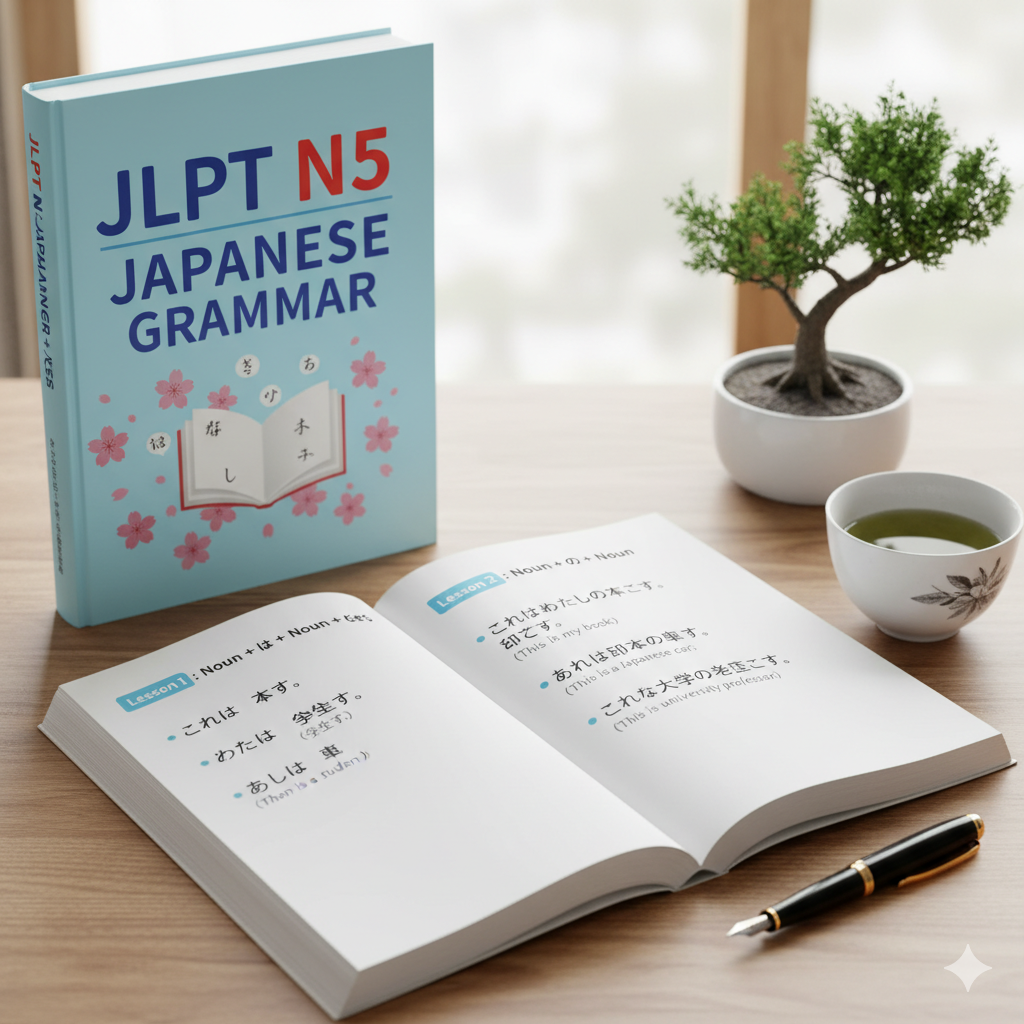
My answer is always the same: “It’s a foundation, and every strong building needs a solid foundation.”
The N5 isn’t about complex literary expressions; it’s about learning the essential building blocks that allow you to understand and create simple, meaningful Japanese sentences. It’s the grammar you’d use to introduce yourself, ask for directions, talk about your day, and describe the world around you in a basic way.
In this guide, we’re going to walk through these building blocks together. We’ll move beyond dry textbook lists and breathe life into each grammar point with clear explanations and, most importantly, plenty of jlpt n5 grammar examples that you can actually imagine using. Think of this as a conversation with your personal tutor, filled with insights and practical tips to make these rules stick.
Internal Link: If you’re still getting familiar with the overall JLPT structure and what the N5 exam entails, be sure to read our comprehensive Pillar Post: JLPT N5 Grammar Guide: Essential Bunpō with Examples & Practice for a complete overview.
Understanding the Mindset: What N5 Grammar Really Is
Before we dive into the specifics, let’s set the right expectation. The N5 level is about survival Japanese. The grammar points are the tools you need for everyday, simple interactions. Don’t get overwhelmed by the number of points; instead, see them as a toolkit. Each tool has a specific purpose.
A key insight I share with my students is that Japanese grammar is like assembling a puzzle in a different order than English. Instead of Subject-Verb-Object (e.g., “I eat bread”), Japanese follows a Subject-Object-Verb pattern (e.g., “I bread eat” – Watashi wa pan o tabemasu). Grasping this fundamental difference early on will make everything else feel much more logical.
Ready to open the toolbox? Let’s go!
Category 1: The Absolute Essentials – Particles (The Signposts of a Sentence)
If there’s one thing you need to master at N5, it’s particles. These tiny hiragana characters (like は, が, を, に, で) are the signposts that tell you the function of each word in a sentence. They are the glue that holds everything together.
1. The Topic Marker: は (wa)
- Function: Indicates the overall topic of the sentence—what you’re talking about. It’s like saying, “Speaking of [this thing]…”
- Common Mistake: It’s pronounced wa when used as a particle, not ha.
- jlpt n5 grammar examples:
- わたしは がくせい です。
- Watashi wa gakusei desu.
- (Speaking of me,) I am a student.
- これは ほん です。
- Kore wa hon desu.
- (Speaking of this,) This is a book.
- たなかさんは あした きます。
- Tanaka-san wa ashita kimasu.
- (Speaking of Mr. Tanaka,) He will come tomorrow.
- わたしは がくせい です。
2. The Subject Marker: が (ga)
- Function: Identifies the specific subject of a verb, often used for new information, questions, or describing abilities and desires. The difference between は and が is a deep topic, but for N5, think of が as pointing a finger directly at the “doer.”
- jlpt n5 grammar examples:
- だれが きますか。
- Dare ga kimasu ka?
- Who is coming? (The question word “who” is the new information.)
- むらかみさんが きます。
- Murakami-san ga kimasu.
- Ms. Murakami is the one who is coming. (Identifying the specific person.)
- わたしは にほんごが わかります。
- Watashi wa nihongo ga wakarimasu.
- (Speaking of me,) I understand Japanese. (が marks what is understood.)
- だれが きますか。
3. The Object Marker: を (o)
- Function: Marks the direct object of a verb—the thing that receives the action.
- Common Mistake: Pronounced *o*, not wo.
- jlpt n5 grammar examples:
- あさごはんを たべます。
- Asagohan o tabemasu.
- I eat breakfast.
- みずを のみます。
- Mizu o nomimasu.
- I drink water.
- にほんごを べんきょうします。
- Nihongo o benkyou shimasu.
- I study Japanese.
- あさごはんを たべます。
4. The Location/Time Marker: に (ni)
- Function: A multi-purpose particle indicating a specific point in time, a target location (with existence verbs), or an indirect object (the “to” someone).
- jlpt n5 grammar examples:
- Time: しちじに おきます。
- Shichi-ji ni okimasu.
- I wake up at 7 o’clock.
- Target Location (Exists): がっこうに います。
- Gakkou ni imasu.
- (I) am at school. (For living things: います)
- Indirect Object: ともだちに はなします。
- Tomodachi ni hanashimasu.
- I talk to my friend.
- Time: しちじに おきます。
5. The Location/Means Marker: で (de)
- Function: Indicates the place where an action occurs, or the means or tool used to do something.
- jlpt n5 grammar examples:
- Action Location: レストランで たべます。
- Resutoran de tabemasu.
- I eat at a restaurant.
- Means/Tool: はしで たべます。
- Hashi de tabemasu.
- I eat with chopsticks.
- Transportation: でんしゃで いきます。
- Densha de ikimasu.
- I go by train.
- Action Location: レストランで たべます。
Particles can be tricky! For a deeper dive , check out our dedicated post: JLPT N5 Grammar Explained with Video Lessons
Category 2: Being and Existence – The “Is” and “Are” of Japanese
6. The Copula: です (desu)
- Function: This is the polite form of “is,” “am,” “are.” It’s used with nouns and na-adjectives to state what something is.
- jlpt n5 grammar examples:
- わたしは がくせい です。
- Watashi wa gakusei desu.
- I am a student.
- これは ペン です。
- Kore wa pen desu.
- This is a pen.
- きのうは 日よう日 でした。
- Kinou wa nichiyoubi deshita. (Past tense: でした)
- Yesterday was Sunday.
- わたしは がくせい です。
For free grammar pdf please visit JLPT N5 Grammar PDF Free Download
7. Existence Verbs: あります (arimasu) and います (imasu)
- Function: Both mean “there is/are.” Use あります for inanimate objects (things, plants) and events. Use います for animate objects (people, animals).
- Insight: This distinction is crucial and reflects a cultural attention to the nature of things.
- jlpt n5 grammar examples:
- あります: つくえのうえに ほんが あります。
- Tsukue no ue ni hon ga arimasu.
- There is a book on the desk.
- います: きっさてんに がくせいが います。
- Kissaten ni gakusei ga imasu.
- There is a student in the café.
- ありません (Negative): じかんが ありません。
- Jikan ga arimasen.
- I don’t have time. (Literally, “Time does not exist for me.”)
- あります: つくえのうえに ほんが あります。
Category 3: Describing the World – Adjectives
Japanese has two types of adjectives: i-adjectives and na-adjectives. How they connect to a noun is the key difference.
8. I-Adjectives (い-adjectives)
- Function: These adjectives end with い (in their dictionary form) and can directly modify a noun without an extra particle.
- jlpt n5 grammar examples:
- あつい ひ
- Atsui hi
- a hot day
- おいしい りんご
- Oishii ringo
- a delicious apple
- この さむい コーヒー
- Kono samui koohii
- This cold coffee.
- あつい ひ
9. Na-Adjectives (な-adjectives)
- Function: These adjectives need a な to connect to a noun. They often don’t end with い (but some, like きれい, do – a common pitfall!).
- jlpt n5 grammar examples:
- しずかな まち
- Shizuka na machi
- a quiet town
- きれいな はな
- Kirei na hana
- beautiful flowers
- べんりな でんわ
- Benri na denwa
- a convenient phone
- しずかな まち
Want to expand your descriptive power? Our list of JLPT N5 Grammar Quiz with Answers is a perfect next read.
Category 4: The Power of Verbs – Actions and Tenses
Verbs are the engines of your sentences. At N5, you’ll work with verbs in their polite ます-form.
10. Present/Future Tense: ます-form
- Function: Used for polite speech. It can describe a habitual action (I eat breakfast every day) or a future action (I will eat breakfast tomorrow).
- jlpt n5 grammar examples:
- べんきょうします。
- Benkyou shimasu.
- I study / I will study.
- あした、えいがを みます。
- Ashita, eiga o mimasu.
- I will watch a movie tomorrow.
- べんきょうします。
11. Past Tense: ました-form
- Function: The polite past tense.
- jlpt n5 grammar examples:
- きのう、べんきょうしました。
- Kinou, benkyou shimashita.
- I studied yesterday.
- ゆうべ、ピザを たべました。
- Yuube, piza o tabemashita.
- I ate pizza last night.
- きのう、べんきょうしました。
12. Negative Form: ません
- Function: The polite negative (“do not”).
- jlpt n5 grammar examples:
- あさごはんを たべません。
- Asagohan o tabemasen.
- I do not eat breakfast.
- コーヒーを のみません。
- Koohii o nomimasen.
- I do not drink coffee.
- あさごはんを たべません。
13. Past Negative Form: ませんでした
- Function: The polite past negative (“did not”).
- jlpt n5 grammar examples:
- きのう、べんきょうしませんでした。
- Kinou, benkyou shimasen deshita.
- I did not study yesterday.
- せんしゅう、がっこうに いきませんでした。
- Senshuu, gakkou ni ikimasen deshita.
- I did not go to school last week.
- きのう、べんきょうしませんでした。
For more details, please visit JLPT N5 Grammar by Usage: Particles, Verbs, and Adjectives
Category 5: Asking Questions and Making Connections
14. The Question Marker: か (ka)
- Function: Simply place か at the end of a statement to turn it into a question. No need for question-word order like in English!
- jlpt n5 grammar examples:
- これは ほんです。 -> これは ほんですか。
- Kore wa hon desu. -> Kore wa hon desu ka?
- This is a book. -> Is this a book?
- がくせいですか。
- Gakusei desu ka?
- Are you a student?
- これは ほんです。 -> これは ほんですか。
15. The “And” Connector: と (to)
- Function: Connects nouns together exhaustively, meaning “and” (and only the things listed).
- jlpt n5 grammar examples:
- ほんと じしょ
- Hon to jisho
- a book and a dictionary
- 月よう日と 水よう日
- Getsuyoubi to Suiyoubi
- Monday and Wednesday
- ほんと じしょ
16. The “But” Connector: しかし (shikashi) / でも (demo)
- Function: しかし is more formal written “but,” while でも is the common conversational “but.”
- jlpt n5 grammar examples:
- あめです。でも、でかけます。
- Ame desu. Demo, dekakemasu.
- It’s raining. But, I will go out.
- あめです。でも、でかけます。
Putting It All Together: A Mini-Conversation Using N5 Grammar
Let’s see how these pieces fit into a realistic, simple dialogue.
Situation: Two acquaintances, Yamada and Sato, meet in the morning.
- Yamada: おはようございます。さとうさん。
- Ohayou gozaimasu. Sato-san.
- Good morning, Ms. Sato.
- Sato: おはようございます。やまださん。きょうは いい てんき ですね。
- Ohayou gozaimasu. Yamada-san. Kyou wa ii tenki desu ne.
- Good morning, Mr. Yamada. The weather is nice today, isn’t it? (ね is a sentence-ending particle seeking agreement.)
- Yamada: そう ですね。きのうは あめ でしたが、きょうは はれ です。
- Sou desu ne. Kinou wa ame deshita ga, kyou wa hare desu.
- It is, isn’t it? Yesterday was rainy, but today is sunny. (が here is used as a soft “but” to connect contrasting sentences.)
- Sato: きょう、ごご こうえん に いきますか。
- Kyou, gogo kouen ni ikimasu ka?
- Are you going to the park this afternoon?
- Yamada: いいえ、いきません。きょうは いそがしい です。あした、いきます。
- Iie, ikimasen. Kyou wa isogashii desu. Ashita, ikimasu.
- No, I’m not going. I am busy today. I will go tomorrow.
See? With just a handful of N5 grammar points, you can already have a meaningful exchange!
For more grammar points please visit JLPT N5 Grammar List: 50 Must-Know Grammar Points
Your Action Plan for Mastery
- Learn in Context: Don’t just memorize the rules. Create your own sentences. Change the nouns and verbs in the examples I’ve given. “I eat bread” -> “My friend drinks tea.”
- Listen and Repeat: Find resources like NHK’s Easy Japanese (Web Easy) or the Tae Kim’s Guide to Learning Japanese app. Hear the grammar in use and shadow the speaker.
- Practice, Practice, Practice: Use workbooks like the “Shin Kanzen Master” or “So-Matome” JLPT N5 series. They provide targeted exercises that are invaluable.
- Don’t Fear Mistakes: You will mix up は and が. You will forget な. It’s all part of the process. The goal is to be understood, not perfect.
For more examples sentences please visit JLPT N5 Grammar with Example Sentences
Final Words of Encouragement
The JLPT N5 grammar list might seem long, but each point is a key that unlocks a part of the Japanese language. Take it one point at a time, practice with real sentences, and be patient with yourself.
You have everything you need to succeed right here. Ganbatte kudasai (がんばってください) – Do your best!
- JLPT Official Website – For official test guidelines.
- NHK Web Easy – For simple Japanese news articles.
- Tae Kim’s Grammar Guide – A fantastic free resource for deeper grammatical understanding.


